
Pinnacle Of Spirituality In The Peak Of Politics

The stories of Ramayana and Mahabharata are fascinating because they deal with royal politics and conspiracy.
Like never before in recent history, Indian politics seems to be on the path of embracing traditional principles of dharma.
By Nityananda Dasa
When Prime Minister Narendra Modi inaugurated the Rama Mandir in Ayodhya on January 22, 2024, we could hear diverse opinions emerging from the country:
“Finally, an Indian PM upholding the Vedic tradition has arrived.”
“No, PM doing so is unorthodox.”
“No, he is a cultural reviver.”
“No, he is a political opportunist.”
“Hindu awakening is happening.”
“No, this is spiritual drama for electoral gain.”
It’s evident that spirituality and politics are intertwined at present more than ever in the recent past. Let us look at politics and spirituality from the scriptures.
People of this world are usually attracted to politics, quarrel, hypocrisy, violence, sports, sex and romance. That’s why we find that our scriptures and epics, like the Mahabharata and the Ramayana, deal with these subject matters too. Lord Krishna and Lord Rama had to deal with royal politics and conspiracy, and therefore these stories are fascinating even though they are several centuries old. Let us look into each of them and how they dealt with political turmoil for the ultimate wholesome socio spiritual well-being of the society.
The Mahabharata And The Kurukshetra War
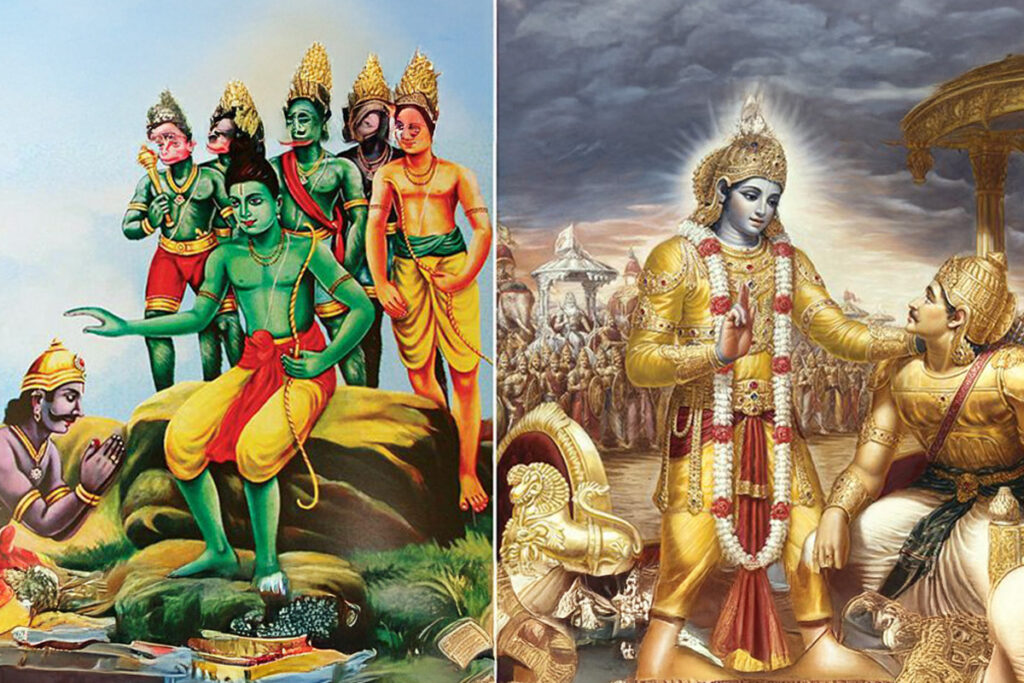
Two political groups, the Kauravas and the Pandavas, assembled once and for all to settle things in the battlefield of Kuruksetra. Not only the warriors but almost everybody — socialists, spiritualists, economists and common public — were watching it with rapt attention. They were excited to know the outcome: “What is going to happen? Who is going to win?”
Interestingly, Lord Sri Krishna spoke the sacred message of the Bhagavad-gita at this juncture, just when the battle was about to begin. One may wonder, Why didn’t he speak this message to an unknown sage in a remote forest or in a cave. Instead, Krishna taught this teaching to a political figure like Arjuna. And in this battlefield setting, among the various topics that he discussed, in front of the leading political heads of the world, he tactfully brought the highest spiritual teaching (carama-sloka) for the benefit of the whole world:
sarva-dharman parityajya
mam ekam saranam vraja
aham tvam sarva-papebhyo
mokshayishyami ma sucah
“Abandon all varieties of religion and just surrender unto Me. I shall deliver you from all sinful reactions. Do not fear.” (Bhagavad-gita 18.66)
Krishna achieved His mission. The world recognized the Bhagavad-gita as the heart of Mahabharata.
Ramayana War
Long before the events of Mahabharata was the period of Lord Rama and Ramayana. On one side there was Rama’s vanara-sena, and on the other side, across the ocean, there was Ravana-sena. Even the devas were assembled to witness the battle. Sages and humans were absorbed in that battle. The battle of all battle was set to begin. Vibhishana, Ravana’s own brother, approached Lord Rama expressing his desire to switch side, just prior to the battle. In the middle of the two armies, Rama tactfully delivered his ultimate message, the transcendental message to the worlds keeping a political figure like Vibhishana in the front:
sakrid eva prapanno yas
tavasmiti ca yacate
abhayam sarvada tasmai
dadamy etad vratam mama
“It is My vow that if one only once seriously surrenders unto Me, saying “My dear Lord, from this day I am Yours,” and prays to Me for courage, I shall immediately award courage to that person, and he will always remain safe from that time on.’” (Valmiki Ramayana, Yuddha-kanda 18.33)
Rama tactfully delivered his best product when everybody was attentive and involved in the battle. The world recognized it. Vibhishana-saranagati is considered the heart of Ramayana.
Supreme message in a romantic setting
Apart from the above two political instances, which are always exciting to read and hear about, the world is also attracted to romantic affairs. Krishna tactfully taught the world the supremacy of gopis’ renunciation and the purity of gopis’ devotion in the all-attractive romantic setting of rasa-lila.
na paraye ’ham niravadya-samyujam
sva-sadhu-krityam vibudhayushapi vah
ya mabhajan durjara-geha-srinkhalah
samvriscya tad vah pratiyatu sadhuna
“I am not able to repay My debt for your spotless service, even within a lifetime of Brahma. Your connection with Me is beyond reproach. You have worshiped Me, cutting off all domestic ties, which are difficult to break. Therefore, please let your own glorious deeds be your compensation.” (SB 10.32.22)
The world of Aryans (civilized and righteous people) understood the rasa-lila teaching as the heart of Srimad-Bhagavatam.
Krishna and Rama gave not only assurances of protection to surrendered people but also demonstrated their words. Krishna exhibited his supreme mystic power to protect Draupadi while she was attempted to be disrobed in the Kuru assembly. Similarly, Lord Rama exhibited his righteousness towards Kaikeyi and protection of Jatayu in the midst of women-centric political situation.
An Act Of Compassion
Whether it is Krishna or Rama, deliverance of dharmic security to the world through the Kurukshetra war and Ramayana war was more than a mere tactful political strategy. Even if it is so, it was due to their selfless compassion. It is unfathomable intelligence, strategy, tactics and compassion of God in giving the world sublime gift of all gifts.
In current Indian politics, Rama and Krishna have once again emerged as significant figures, especially after the building of the Ayodhya temple. But is it as good as the situation that was during the historical time of Krishna and Rama? Is our politics fully centered on the teachings of Krishna and Rama? These are some of the questions about current politics. Let us see the differences between pseudo and real politicians.
Parikshit vs Paundraka Politics
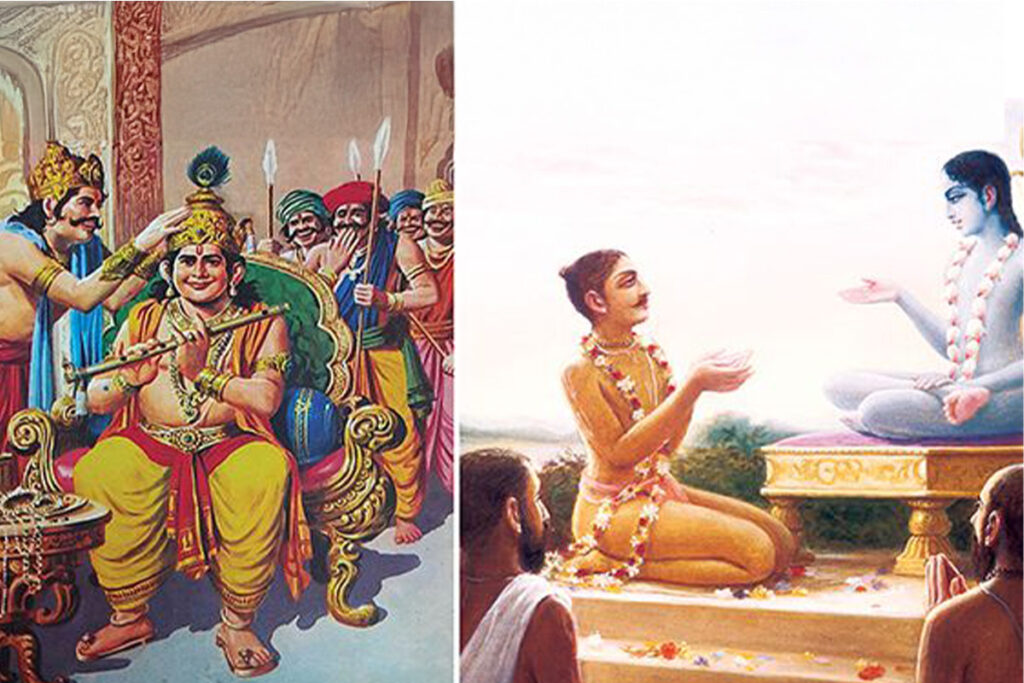
Parikshit, the successor of the Pandavas, was a qualified king and politician, but he ruled in a way that promoted dharma, Krishna consciousness. The Srimad-Bhagavatam describes him as a rajarshi and a topmost devotee. He even ensured that Kali, the personification of adharma, couldn’t exert his influence as long as he remained the king. On the other hand, we hear about King Paundraka who, even when Krishna was physically present in Dvaraka, promoted himself as Krishna, God, instead of promoting Krishna as God. He shamelessly claimed that he was the original Vasudeva. This blunder, of course, led to his destruction.
When Krishna and Rama participate in politics, they request everyone to surrender to them. Such politics is very sweet and dharmic, and people are happy. After all, they are the very personification of dharma. When others promote themselves by using politics, it creates chaos and adharma. At best, they become a laughingstock — like Paundraka.
In Which Category Do The Current Politicians Fall?
It is also unfair to conclude that current politicians are ruthlessly presenting just themselves by using Rama in politics. Although they may not have the purest of intentions while presenting Rama, at least they are talking about Rama and have not banished him completely from their vocabulary. Technically, this kind of mixing Rama-bhakti while promoting oneself is called mixed devotion, and such semblance of bhakti is under rajo-guna, or mode of passion. We find in the Puranas how devatas oftentimes approached Lord Vishnu to secure their position while fighting the asuras. There is still lot of positivity in this endeavor because politics is temporary and it will disappear, but Rama is eternal and will stay forever. Even when Rama is used for personal, temporary politics, the eternal Rama will continue to inspire genuine practitioners and followers.
Over the last several decades, especially after Indian independence, we have seen politicians working hard to get political gain by avoiding Rama and Krishna altogether. This they did because they wanted to promote so-called secularism, which according to them shouldn’t talk about dharma or religion at all. Although the masses were steeply immersed in Rama-bhakti and Krishna-bhakti, many of our politicians consciously deleted and removed or undermined many references to our scriptures and their sacred teachings in order to implement such a distorted idea of secularism. Such attempts are compared to the acts of demons like Putana, Ravana, Paundraka or Shurpanakha, who wanted to eliminate Rama and Krishna at all costs. Compared to that, if politicians today are using Rama and awakening the consciousness of Rama to a certain degree, it should be appreciated.
Sometimes strict spiritual practitioners and devotees (dharmikas) may take objection to such display of Rama-bhakti by the current politicians. Seeing such acts as deviation from pure devotional standards, such practitioners may condemn the politicians for using Rama for their individual politics. However, rather than seeing the negativity in such political acts, such dharmikas could learn to appreciate whatever sincerity these politicians have shown in presenting Rama through politics even when it is tinged with their selfish motives. By doing so and by acknowledging them for what they deserve, their heart may open wider. They will probably be encouraged more to follow in the footsteps of Rama. Devotees of Rama can join hands with them appropriately and try to help them to deliver Sri Rama in his purest form. Or maybe the devotees of Rama can take the help of politicians for the purpose of delivering the message of Sri Rama to the masses. Probably, many of the politicians are also waiting for such guidance.
Devotees, however, should not carry a utopian idea that the politicians will deliver pure spiritual principles through their governance. The saragrahi devotees (essence-seekers) will not fail to congratulate, recognize and appreciate the politicians’ favorable approach, big or small, that may usher in the introduction of politics centered on spiritual principles.
Anyway, it is difficult to expect politics with a pure spirituality motive from modern politicians, but let there be some implementation of spiritual principles. Righteous people, who are concerned about the welfare of society, should not only be politically alert but should also tactfully influence the politics as much as possible without giving up the principle of depending on Krishna so that one day the country and the whole world can see politics like that of King Yudhishthira or Parikshit, where pure politics and sublime spirituality go hand in hand.|
Integrating politics and pure spirituality
Let us look at some examples where spiritual seers, who generally stay away from political decisions, stepped in and took major decisions in order to maintain social order:
- The brahmanas killed King Vena as an act of emergency and later appointed King Prithu as his successor. (Canto 4, Chapter 14).
- Visvamitra took the help of kshatriyas (Dasharatha, Rama and Lakshmana) for subduing the demons in order to perform yajna for the welfare of the world.
-
Lord Sri Chaitanya Mahaprabhu inspired his devotees to go on a procession to protest against the Kazi who had banned the performance of harinama-sankirtana in Navadvipa. Interestingly, the same Lord Chaitanya refused to meet King Prataparudra, who happened to be a faithful follower and devotee, despite repeated requests from many devotees. He did this in order to maintain the proper reputation of the renounced order so that people’s faith remains intact. If people lose their faith in the renounced order, no one will care to listen to a sannyasi’s inistructions.
Srila Prabhupada’s Views On Politics
|In contrast, Srila Prabhupada often met politicians and state leaders like Morarji Desai and Indira Gandhi because he felt that meeting them would help in creating a favorable situation for preaching. He said, “Out of the twenty-six qualifications, one qualification is daksha, expert. If there is need of fighting, they can fight like very expert. That is also needed. Krishna consciousness does not mean one-sided. Krishna as all-pervading, the Krishna consciousness movement also should be all-pervading. It should touch everything, even politics, sociology, everything, if required. That is the aim.” (July 11, 1973). Srila Prabhupada also encouraged his disciple Balavanta Dasa to start a political party — “In God we trust”. Another statement from his talks: “Politics and battles are also included within Krishna consciousness.” (Srimad-Bhagavatam 3.1.10 — May 21, 1973, Dallas)
Despite the above statements encouraging participation in politics, we also find how Srila Prabhupada warned against getting swayed away in nationalistic bodily consciousness and also advised retiring from active politics at the appropriate time like the Pandavas. He also advised that the saintly persons should engage in the propagation of sankirtana and teaching of dharmika principles instead of actively taking part in politics.
In Conclusion
Devotees should not simply reject politics as maya and be averse to it because the sustained long-term propagation of dharma is facilitated when there is favorable dharmic government. At the same time, devotees should exclusively depend on Krishna and not on political situation or the politicians. The devotees should learn the art of tactfully using every situation — favorable or unfavorable — for the propagation of Krishna consciousness, which is the panacea for the human civilization.
Nityananda Dasa serves as a brahmacari (resident monk) at ISKCON Chowpatty in Mumbai since 1999. He is learned in Gaudiya Vaishnavism and Sri Vaishnavism. He also underwent traditional learning at Bhagavata Vidyapitham in Govardhan under the guidance of His Grace Gopiparanadhana Prabhu.
बीटीजी डिजिटल पत्रिका की सदस्यता लें
BTG डिजिटल मैगज़ीन के साथ कृष्ण भावनामृत के अपने पथ पर आगे बढ़ें! अभी सदस्यता लें और हमारे समुदाय द्वारा साझा की गई विकास, आत्मज्ञान और जुड़ाव की प्रेरणादायक कहानियों को जानें।
सदस्यता लें