
The Crown Belongs To Krishna: The Appearance Of Sri Sri Radha-

Londonisvara
Evidently, Lord Krishna in His deity form wanted to be worshiped in London by Srila Prabhupada and his disciples
By Satyaraja Dasa
THE YEAR WAS 1933. The mission to the West had been a long time coming. Sri Chaitanya, Krishna in the form of His own devotee, had famously predicted some 450 years earlier that His name would be heard in every town and village of the world.1 Gaudiya Vaishnava luminary Bhaktivinoda Thakura (1838–1914) elaborated on this prediction, prophesying that fortunate souls from numerous countries would band together in kirtana, and that the process of bhaktiyoga would thereby know worldwide acclaim.2
As the twentieth century moved forward, Bhaktivinoda’s son Bhaktisiddhanta Sarasvati (1874–1937), having founded the Gaudiya Math in 1918, set forth to make these predictions a tangible reality.3 London was his focus.
The relationship between India and England had been checkered. The British Raj ruled the subcontinent from 1858 to 1947, offering new facility to India’s people while simultaneously trivializing her indigenous culture and, according to some, stealing her riches. Consequently, the Gaudiya Matha’s journey west in the 1930s could have been seen as a form of spiritual retribution, even if, more accurately, it was an act of grace: The Gaudiya mission moving west was born of a desire to share India’s rich spiritual culture and had little to do with the political situation of the time.
Thus, on April 10, 1933, four years prior to his passing, Bhaktisiddhanta Sarasvati engaged three distinguished disciples in making the arduous journey. Their ship took them thousands of miles from home, and after a wearying ten-day voyage, the SS Victoria docked in Naples. Once there, the determined disciples traveled by train to the British capital, arriving at London’s Victoria Station on April 22. Shortly thereafter, the London Gaudiya Mission Society was formally registered at Caxton Hall, Westminster, making history on behalf of Sri Chaitanya Mahaprabhu, Bhaktivinoda Thakura, and the entire disciplic succession.4
By the time Srila Bhaktisiddhanta’s men arrived, thousands of Indians were already residing in England, and so by May 11 of that year a temporary Gaudiya Math center was established at Greyton Garden, Kensington, London, supported by those already familiar with the Krishna tradition.
While Indians were naturally drawn to this authentic representation of their own Vaishnava culture, a handful of indigenous Britishers and Germans were attracted as well, and while this was certainly a breakthrough for Srila Bhaktisiddhanta and his Gaudiya Mission – i.e., a tangible manifestation of Sri Chaitanya’s prediction coming to pass – it never progressed beyond a preliminary introduction, with few members becoming serious practitioners.5
Significantly, this initial endeavor took place in Europe, not America. For Srila Bhaktisiddhanta’s disciples, going to England was a logical and strategic move, especially given the United Kingdom’s longstanding relationship with India and its then prominent position on the world stage. Moreover, America at the time did not hold the same global significance as it would some thirty years later, in Srila Prabhupada’s time.
In fact, in the 1930s, the United Kingdom was a substantial colonial power in India. During the Victorian era, it was the largest empire the modern world had thus far seen, and it was the only one to have ruled the entire Indian subcontinent. Neither the Sultanates, nor the Mughals, nor Emperor Ashoka had managed to accomplish this. Naturally, then, London was the preferred port of call in the time of Bhaktisiddhanta Sarasvati, when India was still under colonial rule.
However, after WWII, Indian independence, and the advent of the United States as a global superpower, the world was virtually reinvented, at least politically, and America would become the natural first choice for Gaudiya missionary activity in the West, especially if Krishna consciousness were to spread around the world as Chaitanya Mahaprabhu and Srila Bhaktivinoda had predicted. In other words, if Srila Prabhupada had commenced his western journey in the 1930s, as his colleagues did, it is likely he would have initially gone to London and Germany. But that was not to be.
Enter Srila Prabhupada
By 1965, when Srila Prabhupada finally set sail, America had replaced Britain as the seat of power in the Western world. For this reason, among others, Prabhupada boarded the SS Jaladuta for New York, arguably the most important city of the time. He focused on two things: the form of Lord Krishna and the resounding desire of his spiritual master, who had told him: “Just try to preach in English language. If you do, both the people you speak to and you yourself will be benefitted.”
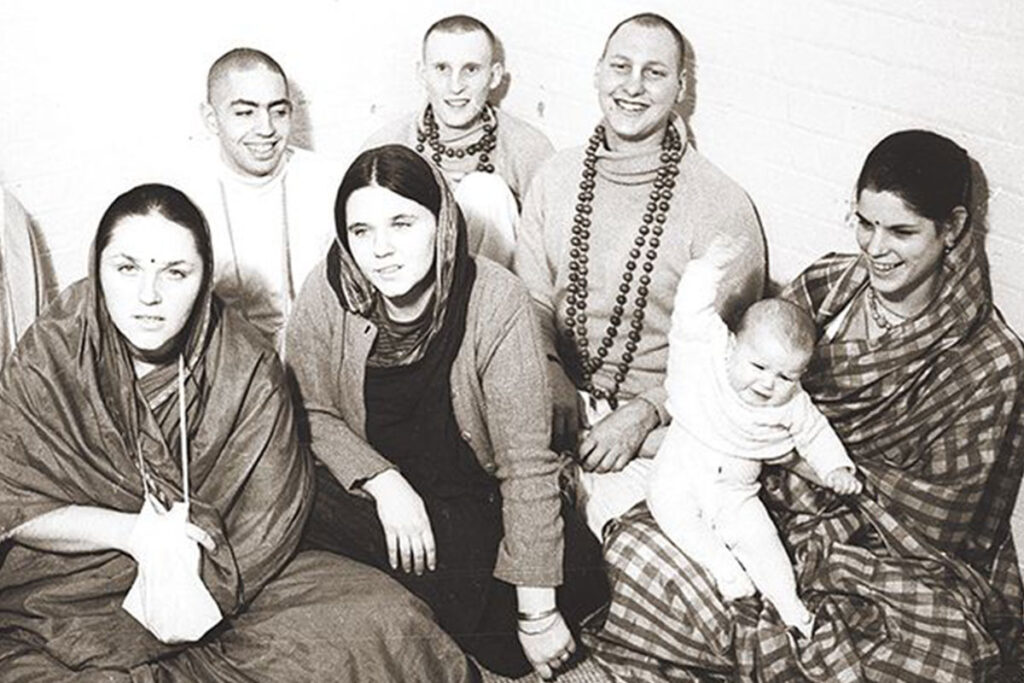
Srila Prabhupada sent three couples (along with baby Saraswati) to London in 1968.
When Prabhupada arrived in New York City, his first order of business was to bring his master’s mission to this emperor of all cities. This he did, and by the end of 1966 his movement was established beyond any doubt – a subject that has been documented by many.6 Soon after, he opened ISKCON temples in Los Angeles, San Francisco, Seattle, Montreal, and elsewhere. London, too, would be among his prime targets, as we shall now see.
“After Montreal,” he wrote in a letter to the New York devotees as far back as 1967,7 “if I can establish one branch in London, it will be a great success for our mission.” He underlined his interest in establishing a center in London only one week later: “I wish that at least four centres may be established in the Western countries, including one in London.”8
This latter comment was directed to Kirtanananda, one of Prabhupada’s leading New York disciples at the time, and later that year he sent Kirtanananda to try to fulfill this goal. But results were wanting, for Kirtanananda, upon returning from a short trip to India with Prabhupada, allowed himself to get sidetracked in New York, a story unto itself.9
Nonetheless, Prabhupada knew how hard his guru had worked to establish a presence in London, and while the political and cultural climate was different in the 1930s, as noted, it would still be a major accomplishment if he could bring Krishna consciousness to the British world on behalf of Bhaktisiddhanta Sarasvati.
Prabhupada set foot for the first time on English soil on July 23, 1967, when his flight to India was delayed and the airline arranged for him to spend the night at the Excelsior Hotel, near Heathrow. But the time was not right to establish his mission in Old Blighty, and so he decided not to abort his trip to India, nor would his disciple Kirtanananda, on his way back to America, serve as his emissary in the UK.
Rather, ISKCON’s presence in London would have to wait until the fall of 1968, more than a year after Prabhupada’s initial visit, when Syamasundara, an early disciple from America’s West Coast, became convinced that if he could make his way to London, he could somehow get the Beatles to listen to Prabhupada’s message and thus spread Krishna consciousness through their musical connections and fame – which is exactly what eventually happened.10
In early September 1968, Syamasundara realized his dream when he and his wife, Malati, along with their daughter, Saraswati, and two other couples – Gurudasa and Yamuna, and Mukunda and Janaki – arrived in London, initially finding a temporary dwelling at 80 Herne Hill in Lambeth (Greater London). Prabhupada was thrilled.
By September 10, the first street kirtana took place in Trafalgar Square, as the entire disciplic succession no doubt smiled down and sang along.
The devotees moved to various temporary dwellings, such as the ramshackle 22 Betterton Street, Covent Garden, where they tried to establish themselves but with little luck. They struggled financially, even if their determination and enthusiasm made their struggles seem insignificant. By winter, they were well known throughout the city and appreciated by the youth of London. At that time, too, George Harrison offered to buy them a five-story building near the British Museum, and by the summer’s end of 1969, the Bury Place temple was a done deal, beginning ISKCON’s real mission in London. Indeed, the Square Mile’s first Rathayatra lit up city streets that summer as well.
But it took awhile to establish a presence, and Prabhupada, at George’s behest, stayed at John Lennon’s Tittenhurst estate while renovations were underway at Bury Place. It wasn’t until the following winter that things started really happening, with a formal temple. It was then that Sri Sri Radha-Londonisvara arrived. Prior to this, ISKCON devotees worshiped small brass Radha-Krishna deities or wooden Jagannatha deities, but no full-size marble Radha-Krishna deities – Radha-Londonisvara were the first.
Yamuna, in particular, had asked Prabhupada if she could worship large deities like those worshiped in India. Prabhupada assured her that a form of Krishna, unlike any she had ever seen, would soon arrive at the temple. And on his word the devotees planned an official opening day – even without any sure plan for the acquisition of deities.
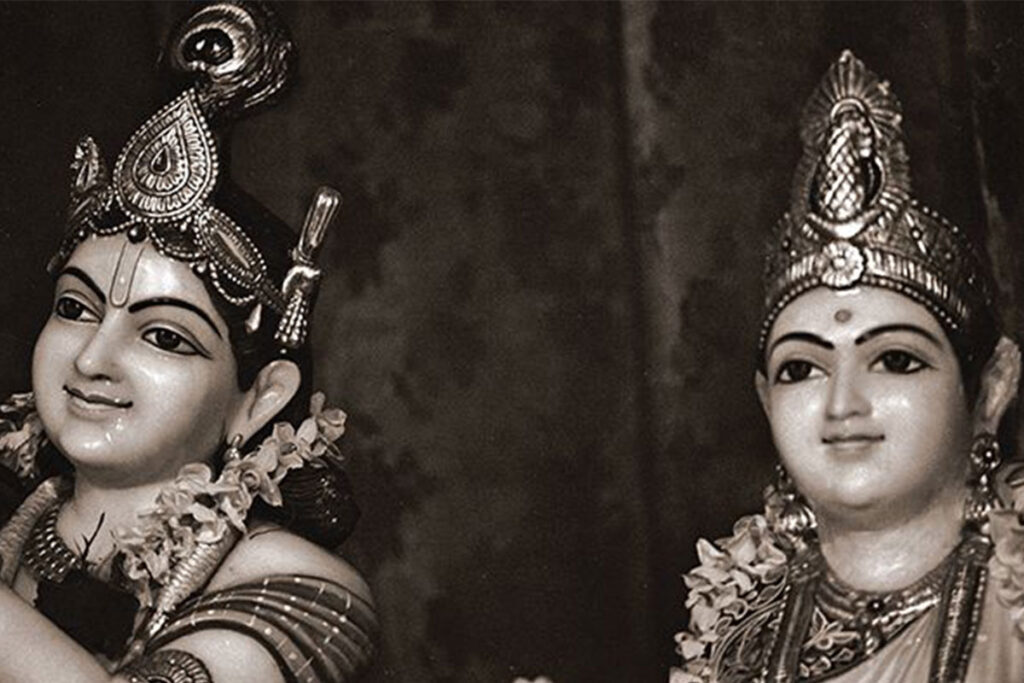
The True “Controller” Of London
The story starts with Janaki, Mukunda’s wife, who answered the temple phone, as she had so many times before. A Hindu gentleman, Mr. Goyal, was on the other end, saying that he had three-foot-tall white marble deities of Radha and Krishna at the local Hindu Centre and that They might be suitable for the devotees’ new temple in London. This was something of a miracle, since the temple was soon to open, and no deities were in place.
Goyal asked Janaki if Prabhupada would like to see Them, since Goyal lived nearby and could easily get to the temple. Janaki told Mukunda about the conversation, and along with Tamala Krishna they decided to drive to Goyal’s residence on their own, doing reconnaissance work for Srila Prabhupada. When they arrived, they exchanged pleasantries with Goyal, who promptly showed them the deities. Impressed by the beautiful forms before them, they quickly made their way back to their spiritual master to tell him what they had seen.
Listening to the animated descriptions given by his disciples, Prabhupada asked for his coat, and out they went in the temple van. Syamasundara was behind the wheel, with Prabhupada next to him. Tamala Krishna and Mukunda accompanied them in the back. As they soon found out, Goyal was in possession of these divine forms because the local East London Hindu Centre would not have them. They had ordered deities from India, but the tip of one of Radharani’s fingers had been chipped in transit; customary Hindu tradition forbids the worship of such images, and so the Centre had given the images to Goyal to store. Prabhupada was unconcerned with such pedestrian conventions.
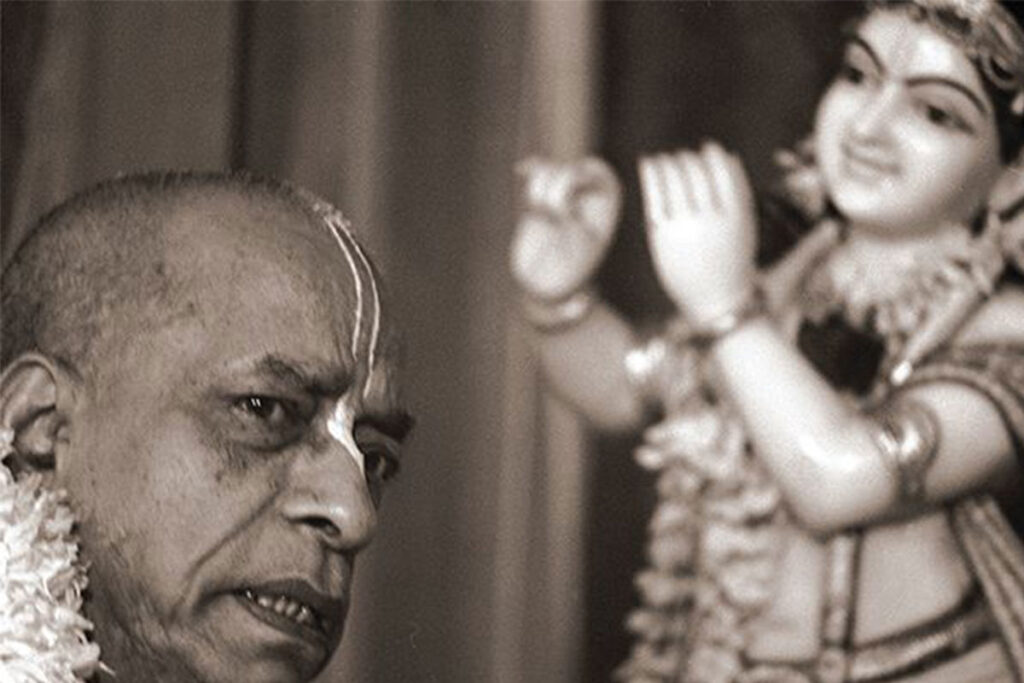
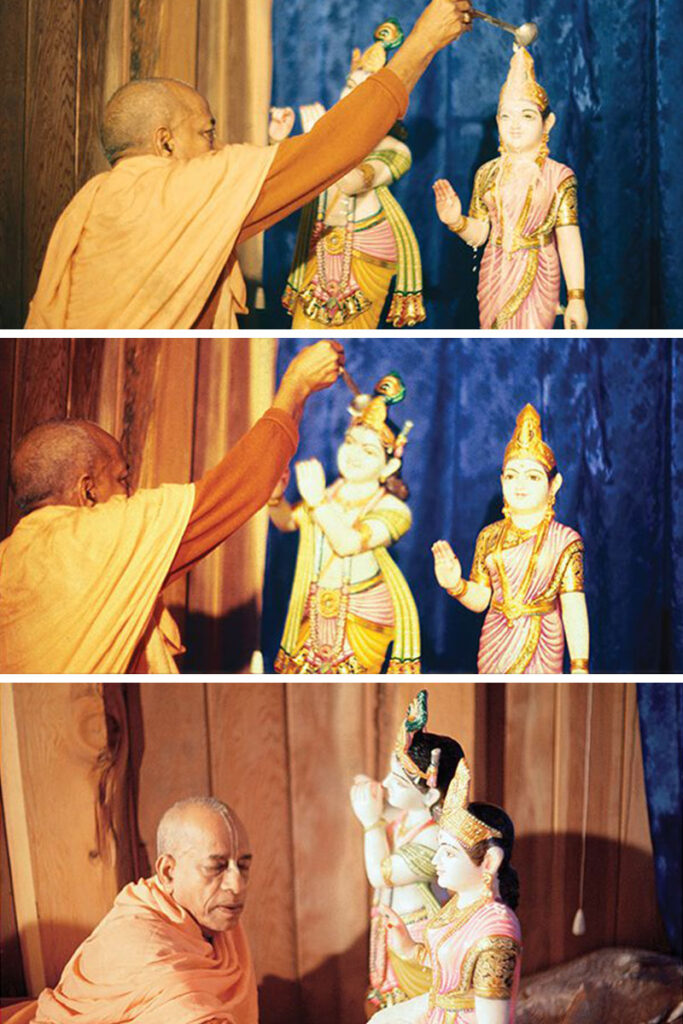
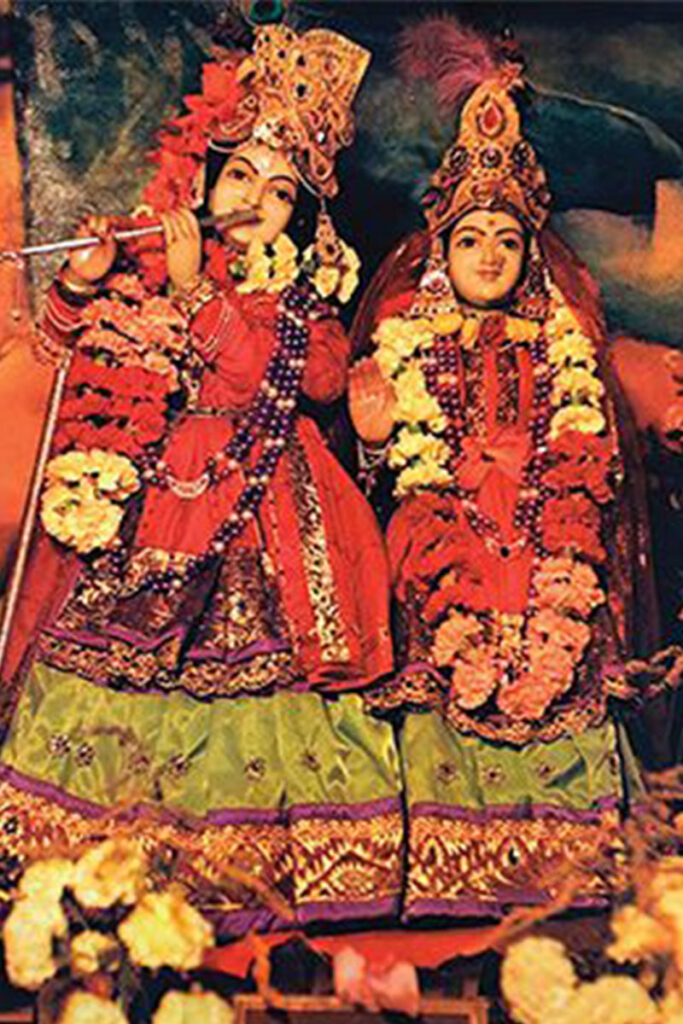
Srila Prabhupada installed the London deities (above and at top) in December 1969.
When His Divine Grace and his disciples entered Goyal’s dwelling, they were shown into the living room, where stood the deities in a corner, covered by cloth. Although Goyal was anxious to display Them before Prabhupada at once, Prabhupada exhibited a casual mood, engaging in cordial discussion with Goyal and family, almost as if he were uninterested in the deities. Prabhupada’s disciples sat in silence, enamored by what seemed to them like some kind of transcendental tactic.
Suddenly, after an hour or so, Prabhupada rose from his chair and casually said, “Okay, let us see Them,” as he made his way across the room.
The cloth was removed. Syamasundara gasped, and the others similarly expressed delight, but Prabhupada showed no special interest.
“Do you think your temple can use them?” Goyal offered.
“Yes, it is possible,” replied Prabhupada nonchalantly.
Then he turned to Syamasundara.
“Can you lift Krishna?”
And to Tamala.
“Can you lift Radha?”
Each disciple took hold of their respective deitiy and lifted Them delicately. Although the forms of Krishna and His consort were solid marble and thus weighty, the two young devotees carried Them with confidence.
“Thank you very much,” Prabhupada said, and without looking back continued toward the door.
Goyal appeared confused, not sure what was taking place. He managed to blurt out, “We will bring Them to the temple in a few days.”
But the devotees were already on their way out.
“That’s all right,” replied Prabhupada, “we can manage. We have our own transport.”
And with that, he gestured toward his disciples.
“Syamasundara, Tamala, take Them out to the van. Go on, go ahead.”
Goyal watched the deities make Their exit as Prabhupada kept talking to him and smiling as they left. He made no attempt to stop them. Although Goyal said several times, “But wait,” Prabhupada quickly countered with, “It’s all right; we will look after Them,” as he and the other devotees kept moving toward the door.
Next thing the young disciples knew, they were carefully placing the deities in the back of the van, climbing in with Them, and making sure They were safely situated. Syamasundara closed the doors and jumped in the driver’s seat, excited that Prabhupada somehow mystically convinced Goyal to let them have the deities. Goyal waved as they left.
“Now drive,” Prabhupada told Syamasundara.
Meanwhile, Tamala Krishna and Mukunda held the deities tight to make sure They didn’t fall over.
Syamasundara drove for a few city blocks. Then Prabhupada told him to stop the car, and Prabhupada got out, went around the side of the car, and opened the back doors. There, on a typical English street, he bowed before Radha and Krishna, tearfully reciting the prayers found in the ancient text known as the Brahma-samhita.
All of a sudden he stopped, turned to the devotees, and said, “Now Krishna has come.”
The young devotees assisting Prabhupada were shocked, each convinced they had witnessed something mystical. Their spiritual master had interacted with Goyal according to necessity, apparently in a shrewd way, but beneath the surface was a transaction with Krishna, who had lovingly agreed to manifest in ISKCON by the grace of His pure devotee.
“Prabhupada,” Mukunda ventured slowly, “I think you have kidnapped Krishna.”
Prabhupada smiled, not affirming or denying his disciple’s well-considered opinion.
Finally, Prabhupada uttered the following words: “In my householder days I had a scheme to borrow a lot of money from the bank, but the bank manager refused. So I spoke to him for a long time and convinced him. He said, ‘Mr. De [Prabhupada’s former name], you should have been a politician.’”
They all laughed.
pulling up and was speechless as the rear doors opened, revealing the deities. As the devotees made their way upstairs, carrying the images that would become the Lords of their lives, on Prabhupada’s instruction they gingerly placed Them in his room. He turned to Yamuna, who was full of anticipation.
“Your marble Radha and Krishna have come,” he said. “Put Them in the corner and cover Them with cloth until They are ready for our worship.”
The chip on Radha’s finger was just Krishna’s trick, Prabhupada told the devotees.
“Because of this, the Hindu Centre wouldn’t want these deities – that was the Lord’s plan, because He wanted to come here.”11
Naturally, Prabhupada immediately began writing letters to his Godbrothers in India. They had initially expressed doubt that he would succeed where they had failed and were utterly convinced that he would return to India having accomplished little. Instead, augmenting several years of success stories in America, he now told the story of how the large Radha-Krishna deities had come into his possession and declared that, because of this, London would soon know a full-fledged Radha- Krishna temple. Indeed, he wrote to Sridhara Maharaja and others, reminding them that this endeavor in England would be the fulfillment of the long-anticipated desire of Srila Bhaktisiddhanta Sarasvati Thakura.
The Temple Opens
Meanwhile, the Bury Place temple was becoming a haven for hippies, Indians, and people intrigued by Krishna in general – it became the hip place to go, for chanting, dancing, and feasting. But for Prabhupada, the main order of business at this point was installing the deities. When this takes place, Prabhupada said, a temple becomes a temple.
“Shyamasundara” writes Ranchor Prime (Ranchor Dasa), “was put in charge of repairing Radha’s hand. Through George he asked for help from the sculptor David Wynne, who came and made the repair.” Ranchor continues:
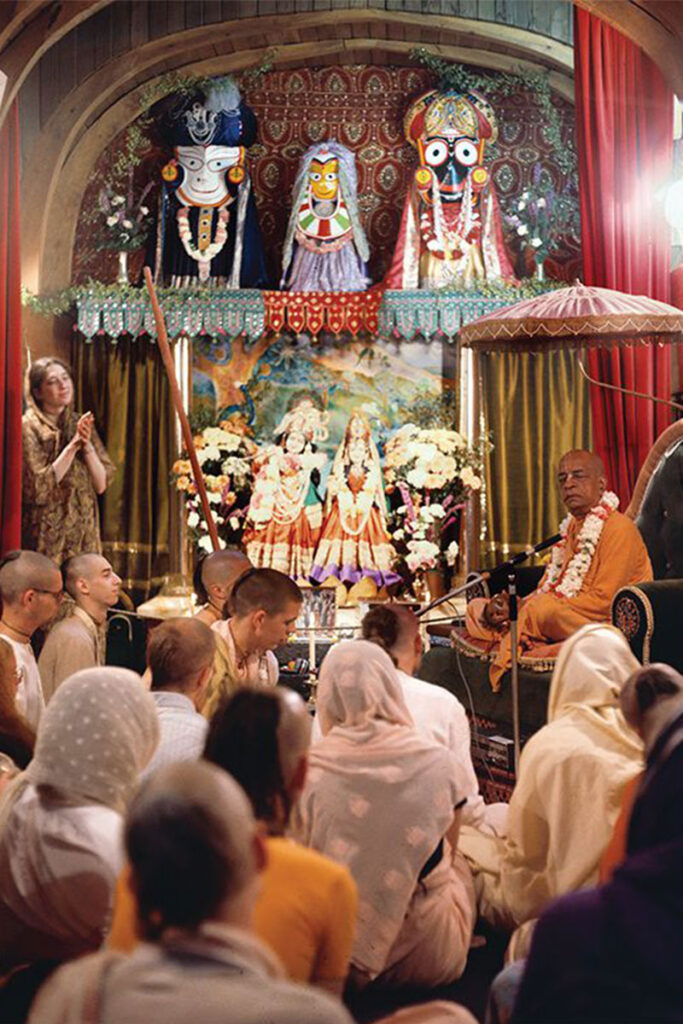
On the morning before the installation, workmen came and laid a deep purple carpet in the temple room – another gift from George. Shyamasundar put the marble altar in place. The yellow sienna formed the main slab, mounted two feet off the floor on blocks of redwood, and the three oblong pieces of granite lay in front as steps. Behind the altar he lined the wall with plain redwood panelling, the natural wood contrasting with the highly polished marble. Above the main altar he fixed a two-inch-thick redwood shelf, firmly supported by two sturdy columns, to bear the three Jagannath deities. Dark purple curtains were hung in front of the altar to divide it from the main room, and four spotlights were installed to illuminate the place where Radha and Krishna would stand.12
On the morning before the installation, workmen came and laid a deep purple carpet in the temple room – another gift from George. Shyamasundar put the marble altar in place. The yellow sienna formed the main slab, mounted two feet off the floor on blocks of redwood, and the three oblong pieces of granite lay in front as steps. Behind the altar he lined the wall with plain redwood panelling, the natural wood contrasting with the highly polished marble. Above the main altar he fixed a two-inch-thick redwood shelf, firmly supported by two sturdy columns, to bear the three Jagannath deities. Dark purple curtains were hung in front of the altar to divide it from the main room, and four spotlights were installed to illuminate the place where Radha and Krishna would stand.12
And then the moment arrived: December 14, 1969, the day of formal installation. Devotees had been advertising the imminent opening for weeks. And by noon of that day, the temple swelled with visitors – even the BBC was there to document the event for television. The temple was packed, with all eyes on Prabhupada.
“This is the most wonderful day for all of London, because Krishna is today appearing in this city,” Srila Prabhupada said in his short opening address. “These deities will be called Radha-Londonisvara, meaning ‘the controller of London.’”13
Mukunda Goswami, who was there, relates the sheer glory (and near catastrophe) of that temple opening:
[Prabhupada] performed the installation ceremony by pouring ladles-full of the liquids over the deities. The milk, ghee and honey cascaded down Their curved bodies, collecting momentarily in the ridges of Their eyes and the folds of Their carved clothing. Then Yamuna, Gurudas, Tamal Krishna and I moved the deities behind the curtain and onto Their marble plinth. Then Prabhupada joined us, having finished the fire ceremony, and directed Yamuna how to dress the deities in Their new clothes. The rest of us were trying to position a purple silken canopy over the deities’ altar. It was to rest upon four turned wooden columns that were painted silver.
The problem was that the pillars slipped and slid all over the altar the minute we tried to place the canopy’s aluminum frame on top of them. We tried once again to place the canopy on the pillars, only to have it slip toward the Deity of Krishna. Prabhupada sprang onto the marble altar and caught the cupola an instant before the aluminum frame crashed onto the Deity’s head. We all exchanged looks – standing on the altar was something none of us would dare to do, but the look on Prabhupada’s face was that of someone rescuing his child from being crushed.
“Take it out,” Prabhupada said to me, holding the frame in both hands,
“Take this out.” I decided I would try to make it look like part of the ceremony. I emerged from the Deity room being careful not to part the curtain and expose the deities to the crowd, and picked my way through the seated crowd, which grudgingly parted to let me pass. From the back of the room I saw that the curtains had parted and Yamuna was twirling three smoking incense sticks the way Prabhupada had shown us in the first months we had known him. The arati ceremony progressed while Prabhupada stood with folded palms before his Lords.14
As Yamuna tells it, with added detail:
Then Purushottama and Tamal Krishna brought the deities to the altar. Prabhupada and I followed, and I closed the curtain. All four of us were in the Deity room. Then an elbow hit one of the columns and immediately a chain reaction occurred. Right in front of us, the column began collapsing. For me everything happened in slow motion. My vision changed. I saw several things simultaneously. Firstly, I had never seen Srila Prabhupada move so fast. With one sweeping motion of his hand, he cleared the items on the bottom step. Then with his right hand, he steadied the column, and with his left hand, he gently but firmly held Srimati Radharani’s hand. It appeared to me almost like a choreographed dance, and yet his movements were so heroic, strong and graceful. It all happened in a split second. As he turned and looked at me, I saw on his brow tiny droplets of perspiration – his mouth frozen into a grim expression. . . . He appeared to me at that moment as the embodiment of chivalry – strong, commanding – saving his beloved Radharani. Srila Prabhupada allowed us to see in that small, extremely intimate gesture that this Radharani was real, not a marble statue, but a person the Supreme Goddess.15
Thus, in a feat that would have been difficult for a man half his age, Srila Prabhupada held up the marble platform while simultaneously clasping Radharani’s hand to steady Her. Afterwards, it would take four young men to carry away that same marble platform. Prabhupada’s nearly superhuman feat was a testament to his love. And all present were witness to it.
From that day forward, the temple continued to grow, with new devotees joining weekly. Projects that had started before the deities arrived were now catapulted to yet another level. For example, the George Harrison connection that led to recording with Apple Records began in the summer of 1969 with the release of a single that quickly became an international hit, broadcasting the Hare Krishna maha-mantra throughout the world. But now, with 1970 approaching, it was breaking records (pun intended).
Then, in the spring of 1971, Apple Records released The Radha Krishna Temple album (on vinyl) in both America and Britain – with Radha- Londonisvara on the cover! The implications should be clearly understood – this was not just an album distributed by devotees but was also available in every major record and department store worldwide. As a result, Their divine forms could now be seen nearly everywhere. Years later, in 1993, the album was released on CD, with liner notes provided by Derek Taylor, the noted English journalist, writer, publicist, and record producer. The Radha Krishna Temple was then remastered and reissued in October 2010, as part of the Apple Box Set. Before the Apple reissues, the album had been re-released as Goddess of Fortune on the Spiritual Sky label in 1973, and in other editions, including that of the Bhaktivedanta Book Trust in 1991. Although these subsequent pressings no longer carried the image of Radha- Londonisvara on the cover, the music was the same, initially inspired by the deities’ presence and eternally potent due to Their empowerment.16
The Band Plays On
The Bury Place temple served as the devotees’ home and outreach facility for nearly a decade, and in 1977 they acquired their current building on Soho Street, moving the deities there in 1978, just after Srila Prabhupada’s departure. Nonetheless, His Divine Grace had visited London – his final trip to the West – while ill earlier in 1977 and approved the Soho Street property, giving his blessings to move the deities there. The devotees – and the deities – were comfortably ensconced in their new temple in 1979, and continue there to this day.
But Prabhupada’s final journey in 1977 is telling: He could have gone anywhere, but he chose to see Sri Sri Radha-Londonisvara, for they were so obviously dear to his heart. Ranchor Prime tells of that visit:
The German devotees went with him, his White Rolls Royce followed by a string of White Volkswagen buses jumping the lights to keep up with him all the way down Finchley Road.
Prabhupada was carried into the temple room to the sound of conches and kirtan as the curtains were pulled back to reveal Radha– London-Ishvara. The devotee performing arati turned to offer incense to Prabhupada and was astonished by the scene. Prabhupada sat right at the foot of the altar, gazing fixedly at Krishna, his eyes streaming tears. As Prabhupada accepted the incense he looked up at the devotee, whose heart melted when he saw Prabhupada’s soft smile.
Around him, tier upon tier, were the temple devotees and the massed members of the German yatra; at his side stood his faithful servants wiping away his tears. It seemed that the whole spiritual world was assembled for Prabhupada to say farewell to his beloved Radha and Krishna, whom he had brought here by his devotion eight years earlier. Now he was back one last time, the tide of his love carrying him to the Manor and finally as far as the feet of Radha–London-Ishvara.17
Surely, Srila Prabhupada has a clear view of Them from the spiritual world.
NOTES
-
Sri Chaitanya-bhagavata (Antya 4.126).
- Bhaktivinoda Thakura, “Nityadharma Suryodoy,” in Sajjana-toshani 4.3 (1885), 8–10.
- For more on the Gaudiya Mission and its move West, see Ferdinando Sardella, Modern Hindu Personalism: The History, Life and Thought of Bhaktisiddhanta Sarasvati (New York: Oxford University Press, 2013). Also see Ferdinando Sardella, “Bengali Vaishnavism in court: the Gaudiya Math’s crisis of succession,” in The Journal of Hindu Studies, Vol. 13, No. 1 (Oxford University Press, 2020), 54–70, as well as his “Bhaktisiddhanta Sarasvati (1874– 1937): Vaishnava Identity in Modern Dress” in Journal of Vaishnava Studies, Vol. 15, issue 2 (Spring 2007), 95–122. For more on the Gaudiya Matha in England, see Mrins Broo, “Hindu Gurus in Europe,” in Handbook of Hinduism in Europe, Volume 1, eds., Knut A. Jacobsen and Ferdinando Sardella (Leiden, The Netherlands: Brill, 2020), 208.
- See Ferdinando Sardella. “Vinode Vani Dasi (Daisy Cecilia Bowtell): A LittleKnown Gaudiya Pioneer in the West,” Journal of Vaishnava Studies, Volume 30, No. 2 (Spring 2022), 85–86. A disciplic succession is a lineage of masters and disciples, passing down eternal truths throughout history.
- Ibid.
- For more on Prabhupada’s life and the story of ISKCON’s success, see Satsvarûpa Dasa Goswami, Srila Prabhupada–lilamrita, Vol. 1–2 (Los Angeles, CA: Bhaktivedanta Book Trust, 1980–82, 2002, reprint); Hayagriva Dasa, The Hare Krishna Explosion: The Birth of Krishna Consciousness in America (New Vrindaban: Palace Press, 1985); Ranchor Prime, When the Sun Shines: The Dawn of Hare Krishna in Britain (Sweden: Bhaktivedanta Book Trust, 2009); Mukunda Goswami, Miracle on Second Avenue: Hare Krishna Arrives in New York, San Francisco, and London 1966–1969 (Badger, C.A., Torchlight Publishing, 2011); Dinatarini Devi, Yamuna Devi: A Life of Unalloyed Devotion (Alachua, Florida: Unalloyed, Inc., 2014); and Joshua M. Greene, Swami in a Strange Land: How Krishna Came to the West (San Rafael, C.A.: Mandala Publishing, 2016).
- Prabhupada letter to Brahmananda, Satsvarupa, Rayram, Gargamuni, Rupanuga, and Donald, March 28, 1967.
- Prabhupada letter to Kirtanananda, April 7, 1967.
- Prabhupada letter to Damodara, October 13, 1967. See also letter to Janardana, October 3, 1967.
- See Shyamasundar Das, Chasing the Rhinos with the Swami, Volume 1 (Selfpublished, 2016), 386–425.
- The full story of the acquisition of the deities and the opening of the temple can be found in Tamal Krishna Goswami, Memories: Anecdotes of a Modern Day Saint, Volume 4, ed., Siddhanta Dasa (Los Angeles: Monsoon Media, 2015); also see Tamal Krishna Goswami, “Radha Londonisvara Lila” (https://iskconklnews.wordpress.com/2010/07/09/ radha-londonisvara-lila/).
- Ranchor Prime, When the Sun Shines: The Dawn of Hare Krishna in Britain,
-
cit., 172.
- Prabhupada modeled the unique naming of these deities after an inspiration that had occurred to him in Paris at around the same time: “The devotees asked Prabhupada to name the new Paris deities. Having explained that people in India looked to London for education and to Paris for enjoyment, he said, ‘Radharani is beautiful, just like a Paris girl, and Krishna has come here to find out this most beautiful of the gopis. So his name is Paris-Ishvara, ‘controller of Paris.”’ After six days in France he returned to the Manor. Having named Krishna in Paris, he agreed to name Krishna in London, calling him London-Ishvara, ‘controller of London.’” See Ranchor Prime, ibid., 329.
- See Mukunda Goswami, Miracle on Second Avenue, op. cit., 420.
- See Dinatarini Devi, Yamuna Devi: A Life of Unalloyed Devotion, op. cit.,
229–230.
- See Joshua Greene, Here Comes the Sun: The Spiritual and Musical Journey of George Harrison (New York: Wiley & Sons, 2007).
- Ranchor Prime, When the Sun Shines: The Dawn of Hare Krishna in Britain, op. cit., 445–446.
बीटीजी डिजिटल पत्रिका की सदस्यता लें
BTG डिजिटल मैगज़ीन के साथ कृष्ण भावनामृत के अपने पथ पर आगे बढ़ें! अभी सदस्यता लें और हमारे समुदाय द्वारा साझा की गई विकास, आत्मज्ञान और जुड़ाव की प्रेरणादायक कहानियों को जानें।
सदस्यता लें