
Ratha-Yatra Learning The Ropes Of Devotion

That can help us better understand the epic
By Ashutosh Kumar
Antiquity has it that Lord Jagannatha, non-different from the Supreme Personality of Godhead Krishna, existed since bygone ages, the Satya Yuga or the Golden era. The temple is situated on the eastern coastal lines of India, widely known as Utkala-kshetra or Purushottama-kshetra, in the present-day Odisha. The Rig Veda authenticates the presence of Lord Jagannatha, the Puranas portray his character, and the folklores recount his pastimes.
The temple of Puri was constructed later by King Indradyumna under the supervision of Lord Brahma. In the Purushottama-Kshetra Mahatmya of Skanda Purana, Lord Brahma himself reveals the true identity of Lord Jagannatha when He instructs King Indradyumna with these words: “Thinking it is a wooden image, O pre-eminent King, let there not be the idea in you that this is a mere image; this is verily the form of Supreme Brahman (Supreme Omnipresent God). As Parambrahman takes away all sorrows and confers eternal bliss, He is known as Daru. According to the four Vedas therefore, the Lord is manifest in the form of Daru (sacred wood). He is the Creator of the entire Universe.” (Chapter 28, verses 39-41). Manifested in a wooden form, seated on the golden throne, Lord Jagannatha with arms wide open and eagerness in his eyes, welcomes everyone into his loving embrace.
The Blazing ‘Sudarshan’ Chakra In The Right Hand
The valiant rulers of Odisha, the Gajapatis, revered Lord Jagannatha as the sole King of the Universe and deemed themselves as his royal guards. However, the history of the temple was not unscathed by the influence of time. Radicalized invaders and converts frequently ransacked the temple, plundered its wealth, and attempted to demolish the holy site like other places of worship in India. If the devotion to the deity were merely emotional or sentimental, it might have faded into obscurity over time.
Yet skeptics often pose the question: If the deity truly embodies divine power, why allow such sinister actions to go unchecked? If only God had descended and gave a befitting response, perhaps it would have proven the existence of a divine force.
Indeed, a valid query. Let us zoom out to broaden our perspective on the unfolding of events. The origins and the traditions of Vedic theology don’t depict an unconditional manifestation of divinity. Turning through the pages of Srimad-Bhagavatam, we find the first being, the cosmic engineer Brahma who wrestled to find God. To his utter surprise, he found himself on a shiny golden lotus that represents spiritual awakening. Yet, ironically, he was grappling with ignorance about his existence and the peculiar surroundings in which he happened to be. Wrestling with this confusion, he went down the lotus, which made him doubly anxious. Finally driven by the desire to resolve his existential crisis, from the surrounding, he heard two syllables ta, pa, which he joined to decipher the meaning tapa, “meditate.” His meditation spans over thousands of celestial years, culminating in the enlightenment and the vision of the spiritual world and the Supreme Creator.
Each time, the Lord subjects his devotees to a test, he intends to gauge the content of their consciousness, the purity of their heart and the sincerity of their actions.
Because every valuable thing comes with a price tag, how can there be an exception in the realm of spirituality? For Brahma, it entailed years of meditation, perhaps that was the cure for his attention-deficit caused by his initial, hyper-anxious state. Conversely, for the people of India, maybe the external attacks served as an antidote to their resilience-deficit caused by excesses of material advancement. However, embedded in that probable reason is a clear and distinct message to the world: the resilient spirit of devoted Indians who practiced spirituality, while safeguarding the places of worship from the marauding invaders and the deceptive proselytizers.
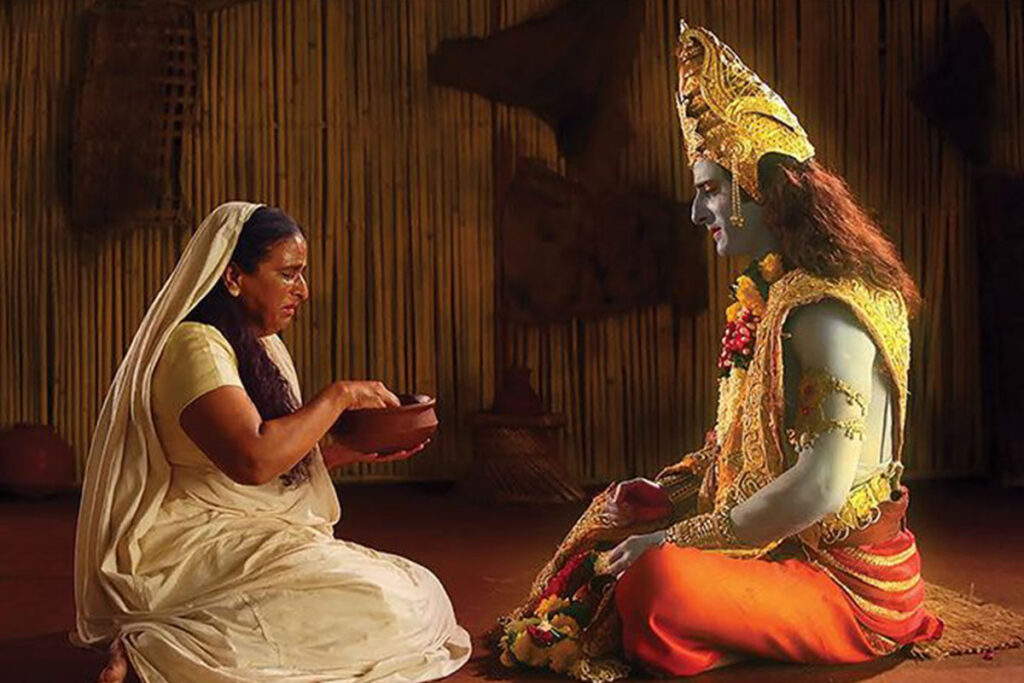
Karmabai feeding khichdi to the Lord
The merciful lotus in the left hand
In the left hand, Lord Jagannatha holds a blooming lotus, which is meant to bewtow blessings upon those who have committed themselves to his Lordship. Through this gesture we glimpse into the Lord’s reciprocation of love regardless of anyone’s social status or lineage. The history of Karmabai exemplifies this beautifully. From an early age, she developed a deep affection for the Lord akin to a mother’s love for her child.
Among the variety of relationships a devotee has with the Lord, paternal love is unique, where the devotee regards the Lord as their own child, while the lord relishes the innocent and sweet feelings of his devotees. Fate, a potent force, plays a crucial role in everyone’s life, more so in the life of the devout.
Karmabai’s story unfolds with a tragedy striking early, leaving her widowed, within few months after marriage. Constantly feeling separation from the Lord and detachment from familial ties, she receives a divine signal urging her to embark on a pilgrimage to Sri Jagannatha Puri. Undeterred and alone, she sets out on a journey from the arid lands of Rajasthan in the northwest to Puri, the spiritual heartland of India on the eastern coast.
Puri has been celebrated for hosting the world’s largest cart festival, a grand annual event where the Lord Jagannatha comes out in a royal procession onto the streets, seated upon his regal chariot, giving his audience to the world. The purpose of this entire festivity is to help us recall how Lord Krishna was (mentally) drawn by the ropes of love from his devotees in Kurukshetra to the sacred land of Vrindavan, the abode of eternal love.
As the devotees draw the Lord with the rope of Love, so does the Lord draw the devotees through the rope of mercy.
Karmabai stayed near the temple and devoutly worshipped the Lord. Her unique offering to the lord was khichdi, porridge rice in the morning times. Hailing from a non-priestly background, she was unfamiliar with the rituals associated with offering food to the Lord. However, Lord Jagannatha, helplessly moved by the parental love of Karmabai, personally visited her home and accepted the khichdi from her hands. Not only that, it is even recorded that the Lord also fed her with his own hands. Such devotional reciprocation between the Lord and his devotees serves as a reminder to all followers of religion: are our religious practices merely rituals or infused with the spirit of devotion?
Some argue, God is formless, without attributes. Yet, historical facts and events suggest quite the contrary. Jiva Goswami, the sixteenth-century Vaishnava theologian, in his rigorous work Tattva Sandarbha counters this notion by asserting that “God has no form” implies “no material form.” Instead God has a spiritual one (sat-cid-ananda-vigraha). And what can delimit the omnipotent Lord from manifesting in the material world before our material eyes? Srila Prabhupada offers a succinct illustration: just as nothing can restrict the President of a nation to visit a jail, so does God’s visit to the material realm. That’s a simple yet profound words of a realized saint.
Even if logic make less sense, the evidence of Karmabai stands as one among countless others, affirming the spiritual form of the Lord and power of devotion as a means to know God at a more personal and informal level. That’s the beauty of devotion. Lord Krishna himself affirms the power of devotion to Uddhava in Srimad-Bhagavatam (11.11.20):
na sadhayati mam yogo
na sankhyam dharma uddhava
na svadhyayas tapas tyago
yatha bhaktir mamorjita
“My dear Uddhava, the unalloyed devotional service rendered to Me by My devotees brings Me under their control. I cannot be thus controlled by those engaged in mystic yoga, Sankhya philosophy, pious work, Vedic study, austerity or renunciation.”
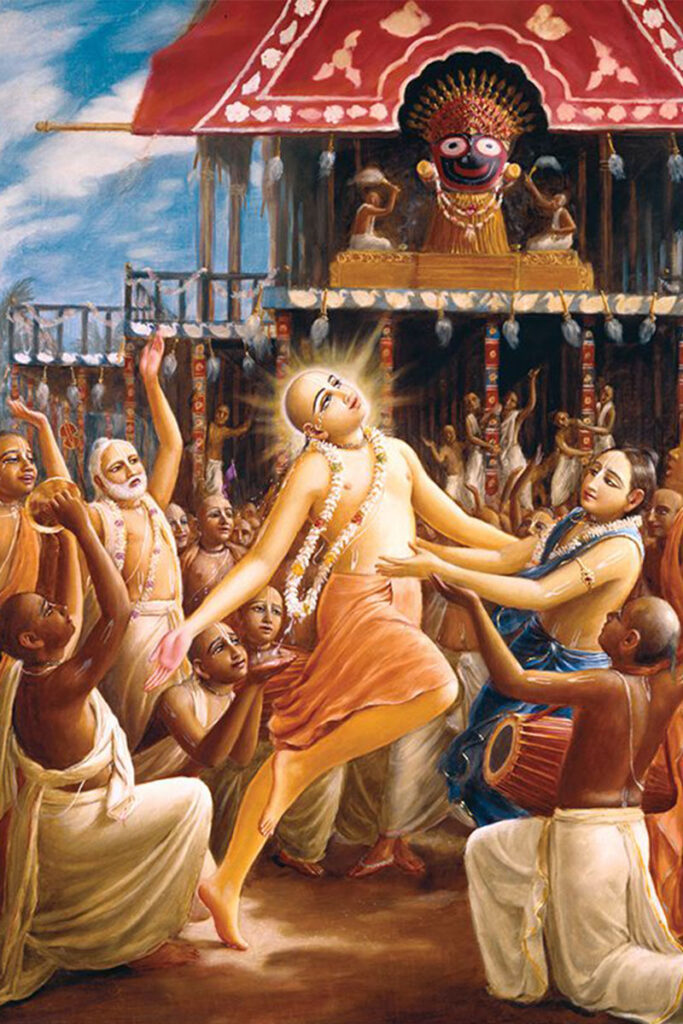
Lord Chaitanya Mahaprabhu would organize circles of kirtana groups around the majestic chariot, celebrating this journey of the Lord on the royal road of Puri.
The Epitome Of Devotion—Sri Chaitanya Mahaprabhu At Ratha-Yatra
The devotional process inherently awakens dormant love for the Lord in every heart, thus endearing the heart of the Lord. As Krishna tells Narada in a renowned verse,
naham tishthami vaikunthe yoginam hridayeshu va
tatra tishthami narada yatra gayanti mad-bhaktah:
“I dwell not in Vaikuntha nor in the hearts of the Yogins, but I dwell where my devotees sing my name, O Narada.”
And who among the devotees are dearer to the Lord than the gopis of the Vraja? Through their selfless love amidst all obstacles, they have captured the heart of the Lord. Even the Lord remains ever indebted to his devotees because of their unconditional love.
Yearning to experience the joy that devotees find in their devotion, Lord Krishna himself appeared as Lord Sri Chaitanya Mahaprabhu as a saint in Bengal. For much of his life, he resided in Puri. Absorbed in the mood of the gopis of Vraja, he embellished the famous Ratha-yatra festival demonstrating to the world the unalloyed relationship between the Lord and the devotee.
Radiating the intensity of a pure devotee, He flooded the entire yatra with waves of profound devotion. Personally drawing the chariot besides countless many devotees, he felt deep contentment that heightened his ecstasy, as he danced soaring high in the sky with the unassuming smile of a beloved reunited with his Lord. Simply put, Lord Krishna in the avatara of a devotee relished the joy of serving himself (Jagannatha). Uncanny as it may sound, that’s the beauty of devotion captivating the Lord beyond control to experience it for himself.
Drawing the cart, from the Jagannatha temple symbolizing the headquarters of the Lord to Gundica temple, which represents Vrindavan, the Lord’s home, Chaitanya Mahaprabhu would organize circles of kirtana groups around the majestic chariot, celebrating this journey of the Lord on the royal road of Puri.
In the realm of bhakti, spontaneity (raga), epitomizes the pinnacle of devotional transformation, opening the floodgates of love towards the Lord. Such blossoming of love was evident in Chaitanya Mahaprabhu’s ecstatic mood. Yet alongside spontaneity, Sri Chaitanya emphasized regulated spiritual practice to activate that dormant love, which encompass the nine limbs of devotion, as outlined in Srimad-Bhagavatam (7.5.23):
sravanam kirtanam vishnoh
smaranam pada-sevanam
arcanam vandanam dasyam
sakhyam atma-nivedanam
Hearing, chanting, remembering, worshipping, praying, serving, befriending, and surrendering to the Lord— these nine processes encapsulate the practical process.
Ratha-yatra stands as a historic festivity that draws people of all color, race, gender, nationality into a shared place of pure devotion. In an era marked by increasing divisions along cultural, social, spiritual, and ethical lines, the historicity of the Jagannatha temple, the resilience of the devotees, and the live spiritual exchanges with the Lord offer unifying thought process to bridge the divides. Thus, unconditional love towards the Supreme fills our hearts and remolds our life positively, as we collectively strive to draw the Lord of the universe into our lives, into our relationships, into our profession and into our society by the rope of devotion.
Ashutosh Patnaik is a senior associate working in an MNC. He holds a master’s degree in finance. Besides work, he is an avid reader and writer in the genre of contemporary-cum-devotional subjects and a frequent contributor to BTG.
बीटीजी डिजिटल पत्रिका की सदस्यता लें
BTG डिजिटल मैगज़ीन के साथ कृष्ण भावनामृत के अपने पथ पर आगे बढ़ें! अभी सदस्यता लें और हमारे समुदाय द्वारा साझा की गई विकास, आत्मज्ञान और जुड़ाव की प्रेरणादायक कहानियों को जानें।
सदस्यता लें