How we deal with people can either elevate or degrade our consciousness.
By Gauranga Vihari Dasa
In life, we meet people with varying natures—some are positive, others more negative. The company we keep can inspire positive thoughts or drag us into negativity. So how do we deal with these differences in relationships?
The Srimad-Bhagavatam, the spotless Purana, sheds light on this. It teaches that the relationships we nurture shape our character. By choosing positive, uplifting associations, we can elevate our mindset and actions.
Naradas Sutras For Positivity
Dhruva Maharaja, a five-year-old boy, felt deeply hurt by the partiality of his father and stepmother. In response to his pain, his mother offered him wise counsel that can inspire us to cultivate fulfilling relationships. This timeless advice is echoed in a sutra by Narada Muni:
gunadhikan mudam lipsed
anukrosam gunadhamat
maitrim samanad anvicchen
na tapair abhibhuyate
In this verse, Narada Muni explains that when interacting with people, they can be broadly categorized into three groups: those who are more qualified, equally qualified, or less qualified. He then offers practical guidance on how to interact with each group:
· For those who are more qualified, one should feel joyful and seek to learn from them.
· For those who are less qualified, one should show compassion and offer assistance.
· For those who are equally qualified, one should strive to build friendship and camaraderie.
Often, our interactions are colored by pride, envy, or a desire to dominate others. Just as water naturally flows to a lower level, our consciousness can easily gravitate toward these lower tendencies. However, elevating our consciousness and behaviour, much like raising water to a higher level, requires effort and awareness. By following Narada Muni’s instructions, we can free ourselves from the threefold miseries of material life—physical, mental, and environmental challenges.
This wisdom aligns with a similar discussion in the Bhagavad-gita, where Arjuna asks Lord Krishna about the characteristics of a person of steady wisdom (sthita-prajna). Lord Krishna explains that such a person transcends the impulses of raga (attachment) and dvesha (aversion), acting from a higher plane of consciousness.
Let us now explore how Narada Muni’s guidance can be applied practically by looking at the lives of great personalities. Through their examples, we can gain deeper insights into how these principles manifest in real-life situations, helping us refine our relationships and live more fulfilling, anxiety-free lives.
A friend recently came to me and told the difficulties that he was facing in following his authority. He was very affected by the whole episode, and he faced a big mental and emotional block. He gathered some courage and expressed his need for a change. He wished to take a role that would provide him greater autonomy and a feeling of contribution to the overall mission. What was encouraging for me from this episode was that even if we are not able to follow authority, we should maintain a favourable disposition at heart. We shouldn’t carry negativity and bitterness in the heart; rather we should be helpful and feel grateful and respectful.
Benefits Of Dealing Appropriately With Seniors
Quite often we are in a situation where we feel something is not right. We have heard or witnessed something in the decision, actions, words of our superiors, which does not sound right or seems questionable. We want to express our concern and get things right.
Some incidents from the Srimad-Bhagavatam can throw some light on this.
A. Yamadutas And Yamaraja
In Sixth Canto, when the Yamadutas attempted to punish the sinful Ajamila, the Vishnudutas forbade them to arrest him. This was first time that Yamadutas saw such divine personalities, and their attempts to follow the authority of their master was defeated. They couldn’t believe that there was someone who above the authority of Yamaraja. Yamadutas felt greatly insulted and wanted clarification on the position of Yamaraja, so they approached him with anger in heart. Despite being in an angry mood, they narrated the incident and humbly put their doubts and questions. Yamaraja, of course, was glad to explain his position and how he was subordinate to the Supreme Personality of Godhead, who was the real master.
B. Dhruva Maharaja And Narada Muni
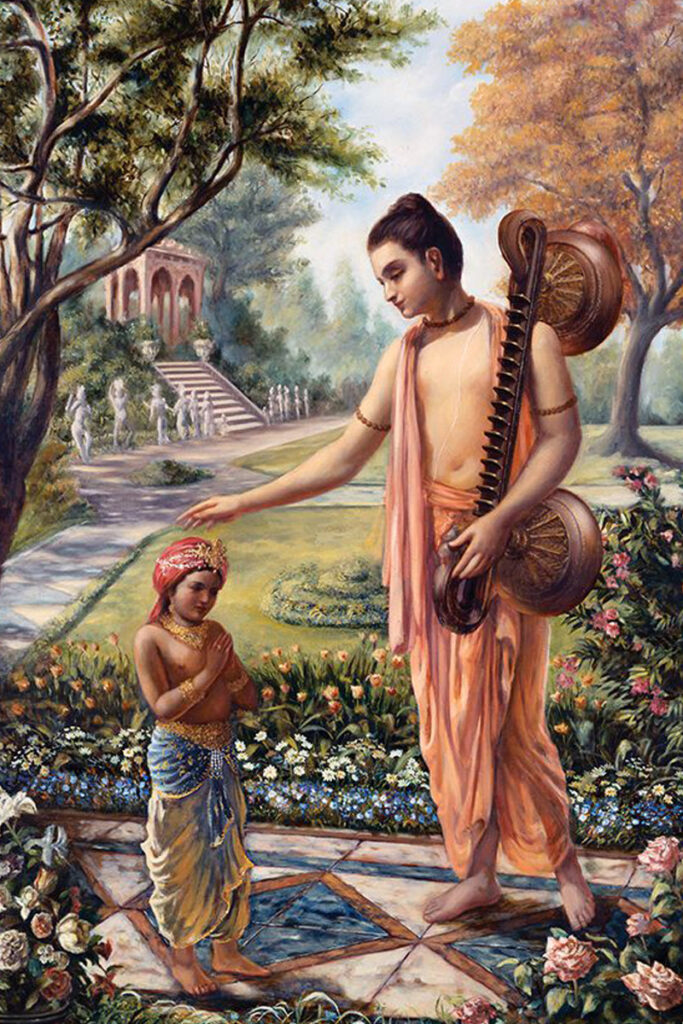
Five-year old Dhruva decided to go to forest inspired by the instructions of his mother. Narada Muni came to meet Dhruva in his journey through the forest and initially tried to persuade him to return home as he was a mere child.
Dhruva did not agree with the advice of Narada, but still he respectfully addressed him and glorified his activities. Then he honestly expressed his needs and how he was willing to work hard for it even if it was going to be a difficult path to take. Actually, Narada was testing Dhruva’s determination and, witnessing his true glory, he showed him a path by which to attain success. Dhruva please Narada by his honesty and respectful dealings.
C. Bali Maharaja And Sukracarya
Lord Vamanadeva appeared in the midst of Bali Maharaja and requested three paces of land as charity. Sukracarya, the priest of Bali, understood that this was Lord Vishnu’s trick to take away all the possessions of Bali. So even though Bali gave the word to Lord Vamana, Sukracarya dissuaded Bali to fulfil his promise.
Bali thought about this advice but decided to reject this advice of his spiritual master. He presented his point logically to Sukracarya that one should not lie once promised, and how all things are ultimately temporary and will be taken away at death, so better use this to serve the brahmanas.
Here Bali Maharaja disobeys the instructions of Sukracarya and gets cursed, but still he follows the proper etiquette of expressing his point of view appropriately, with logic and respect.
The Sixth Canto of Srimad-Bhagavatam describes how Indra failed to respect his spiritual master Brihaspati due to momentary pride that lead to the defeat of devatas at the hands of the asuras. Later under guidance of Lord Brahma they accepted the priesthood of Visvarupa, son of Tvashta. Visvarupa helped devatas to get back their kingdom and their honor.
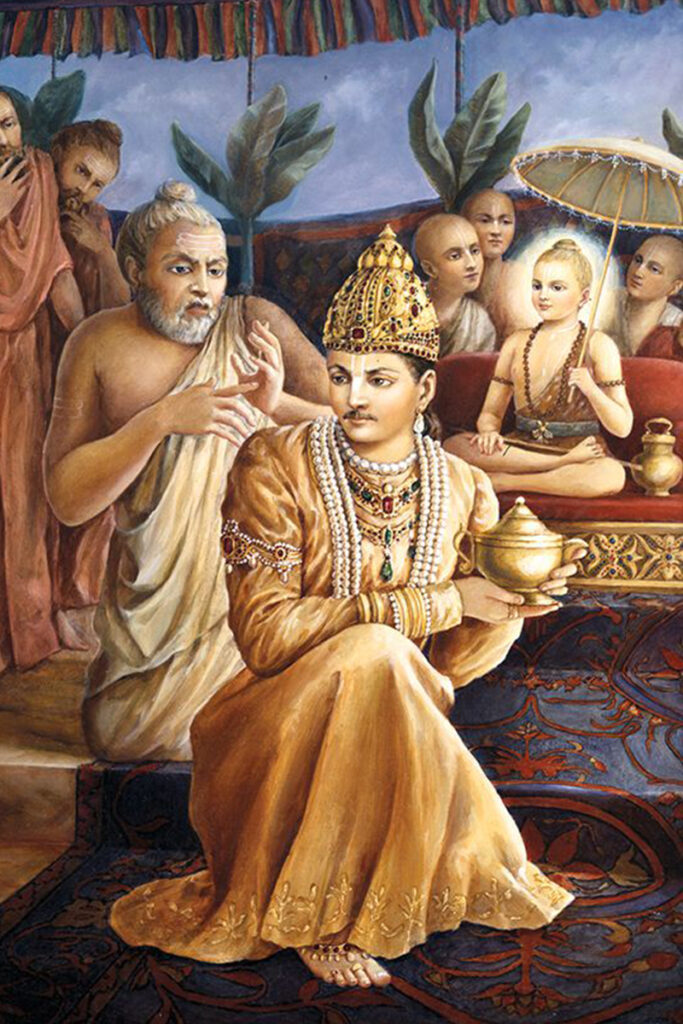
At one point Indra understood that Visvarupa was cheating them by offering oblations to the asuras also. In a fit of anger, he cut off the three heads of Visvarupa in fear. Later Indra repented his action and accepted the reaction with folded hands, understanding that he had done a grave sin by killing his spiritual master out of fear of losing his position.
This incident proves the importance of respectfully asking our superiors about any act, words, deeds that we may not understand. We should patiently handle the situation and respectfully try to clarify the matter. Here we see that an instinctive behavior will lead to such reaction that we will be forced to handle it for the rest of our life.
D. Sringi Cursing Parikshit Maharaja
The First Canto of Srimad-Bhagavatam narrates the story of Parikshit Maharaja. One time while he was in the forest and afflicted with hunger and thirst, he entered the asrama of Samika RIshi. Angered by the cold reception of the sage, who was in deep meditation, Parikshit put a dead snake around the sage’s neck. When the sage’s seven-year-old son Sringi got to know about this incident, he became furious and immediately pronounced a curse that the king would die after seven days by the bite of the snakebird Takshaka.
This incident shows how pride can affect a person to such an extent that he uses Vedic conclusions to justify his actions. As a mere child, Sringi should not have taken justice in his own hands. He could have clarified his concerns with his father who was at the receiving end. This proves that truth is a dynamic reality and depends on the attitude of the person who propagates it.
To summarize, the characters of Srimad-Bhagavatam are guiding and inspiring us to cultivate the right mood in our dealings and thus achieve a state from where we can gradually become unaffected by effects of modes of material nature and try to take shelter of Lord Krishna’s lotus feet with earnestness.
In conclusion the art of dealing with others is a spiritual science that is revealed through the pages and characters of the Bhagavatam. While dealing with superiors, we may want to express certain concerns, but we need to do it in a Vaishnava way, with respect and proper conduct. At the same time the superiors or authority must also remain flexible and attentive to the needs of the subordinate and be open for dialogue. Dialogue will ultimately serve the purpose of uplifting the consciousness, which is the goal all relationships are aiming towards in spiritual circles.
Gauranga Bihari Dasa is a resident monk at Govardhan Eco Village. His services include sastric course coordination and teaching.