Discovering a life of True Adventure

Free to Read
10 mins September, 2026
00:00
00:00

Perhaps, getting lost in life is the only way to truly find yourself. It’s an adventure worth embracing.


By Ashutosh Patnaik


Sometimes, you feel like an actor switching scripts every scene — forgetting who you were playing in the first place. One moment you want to be a coder, the next an investor, then a writer, a speaker, a motivator — all before breakfast. Some mornings, you’re a storm of passion. Other days, you feel like a vehicle stalled without fuel.


They call it being lost, but you’re not lost—you’re layered. You’re not indecisive—you’re at the crossroads of possibilities. You’re not behind—you’re carrying too much meaning without a map. What you’re experiencing isn’t confusion—it’s vision overload. This is a crucial phase of internal growth because the truth no one tells you is this: The fire that burns hottest takes the longest to ignite. Early success looks shiny, but it’s often hollow. In a hyper-competitive environment, it’s easy to get carried away by the numbers, the likes, and the follower count. What gets missed is our individuality.


The case of Karna and Arjuna is a stark example. Contrary to the mainstream projection of Karna being a “victim,” the reality was Karna betrayed himself. Though he earned a place in the best of the academies, Guru Drona’s Archery Academy, he could never earn his guru’s trust. Among all his disciples, Dronacarya perhaps had the best of the two shinning archers budding in front of him—Arjuna and Karna—who would eventually etch their names in the glorious history of Bharat.


But instead of embracing good sportsmanship, Karna harbored a deep envy and even hatred for Arjuna. In his desperate bid to outshine his rival, Karna employed all sorts of underhanded means to gain superiority, resulting in accruing more curses than blessings from all the gurus in his academia. It was indeed a choice by Karna to let his insecurity overshadow his best of warrior virtues. In our journey through life, we too might get carried away by our lower selves—greed, envy, pride, lust, anger. We may achieve something resembling significance, but maybe at the cost of losing ourselves.


Karna’s downfall wasn’t due to a lack of talent, but a lack of self-awareness. His focus wasn’t on becoming the best version of himself, but on surpassing Arjuna. Karna’s envy poisoned his incredible gifts, leading him to make choices that betrayed his own greatness. He had the fire, but misdirected.


This is the very essence of what you’re experiencing. When you feel pulled in a dozen different directions, it’s like you’re trying to outshine a dozen different people, or a dozen different versions of success. It’s a battle against an external standard rather than an internal one.


How do we stop trying to be Karna and find our own path? The answer, it turns out, isn’t found in another battle to be won, but in a completely different story—one of inward discovery. It’s revealed in the becoming of Narada.


From Confusion to Clarity: The Story of Narada’s Becoming


A curious boy, unnamed in his early years, who wandered not with purpose but with readiness. His mother was a simple maidservant. He had no wealth, no prestige, no plan. But what he did have was exposure to the association of Bhaktivedantas—devotees deeply absorbed in spiritual realization.



He listened, he absorbed, he questioned—silently. He wasn’t “planning” his purpose. He was marinating in meaning. Then tragedy struck: his mother, his sole source of warmth and support in a difficult world, died from a snakebite. In an instant, the only anchor in his young life was gone. He was left utterly alone, untethered, and homeless. The world must have felt like it had collapsed around him—a true rock bottom.


Yet, Narada didn’t panic. He explored the world of sages and later ventured through the real world of hustle as a traveler. If you freeze the timeline, it might appear he is lost, all alone! But his purpose became all the more clear as he explored the world. Seeing the fleeting nature all around, his desires gravitated towards the eternal Supreme. He remembered the solace the sages had found in their inner world. He felt an intense, undeniable pull to seek the very source of the peace they had described.


So, he walked into the forest, not in a flight of fancy, but as a deliberate act of surrender. He sat and meditated on the Lord’s form, just as he had heard from the sages. And in that silence, the divine vision of the Lord manifested. Eventually, that boy was reborn—not just physically but spiritually—as Narada Muni, the eternal, transcendental traveler, the cosmic musician, and the motivator of saints and kings alike.
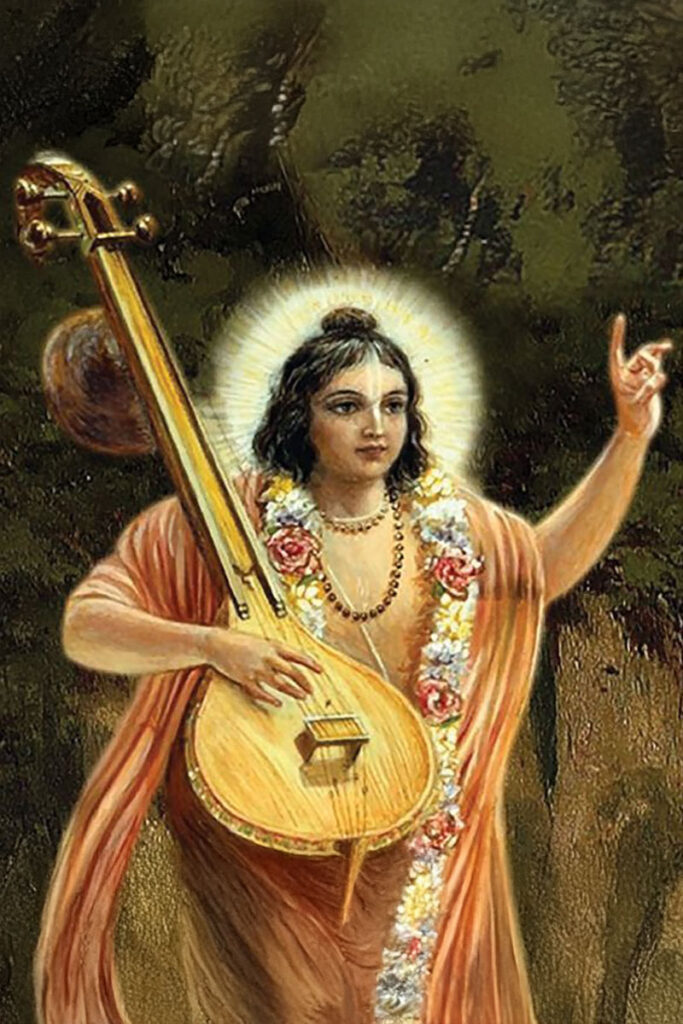


In a world of polarities, seekers wrestling with clarity often prematurely latch on to polarities: those with high aspirations lean towards seeking validation, while those with frustrated dreams praise the glory of humility. None of the above paths are less noble than the other. Problem arises when we follow one externally while deep within seek for the other. Karna’s rivalry-driven path led to a hollow existence, while the boy who became Narada chose quiet receptiveness over competition. The takeaway is this: clarity of purpose comes not from winning battles against others, but from creating space to discover your unique path.


Four steps to re-route our life forward: first principles from Narada’s life


In a fast-paced world that constantly tells us to optimize, hustle, and find our passion, our search for meaning has become a marketplace. Self-help shelves are overflowing with advice—”discover your why,” “live intentionally,” “master your craft.” We read productivity hacks, try habit-stacking, and build vision boards—but the satisfaction seems fleeting. We burn out not from doing too much, but from not doing what truly matters.


This longing isn’t new; it’s ancient. And one of the greatest roadmaps towards integrated, purpose-rich life comes from sage Narada. We will explore the flow of Narada’s life moving from practical life wisdom, into introspective realization, into alignment with spiritual purpose, and towards deeper transformation.


Step 1: Know Yourself Beyond the Noise


In the journey of life, many chase skills, careers, or relationships before understanding who they truly are. But just as a seed carries the blueprint of a tree, you carry within you an identity far greater than roles and labels.


Modern teachings often encourage journaling, solitude, and self-inquiry. These are not ends but means—stepping stones that help silence the mental clutter. When you pause and examine your fears, patterns, and desires, a deeper realization emerges: “Across different episodes of life, I feel I am not this mind, rather a witness of it. I am consciousness.” In the Bhagavad-gita, we find a more profound meaning than that; more than being mere consciousness, we are spiritual beings—the eternal associates of the beloved Lord Krishna. (Gita 15.7).


Step 2: Explore Possibilities with Awareness


Once you’re rooted in identity, the world opens—not as a place to consume but to contribute. In a world where reels, shorts, memes, and scrolls have invaded our private spaces, from boardroom to bedroom to washroom, not becoming a consumer will be an outlier. Unrestrained and unfiltered consumption stunts the ability to create and contribute.
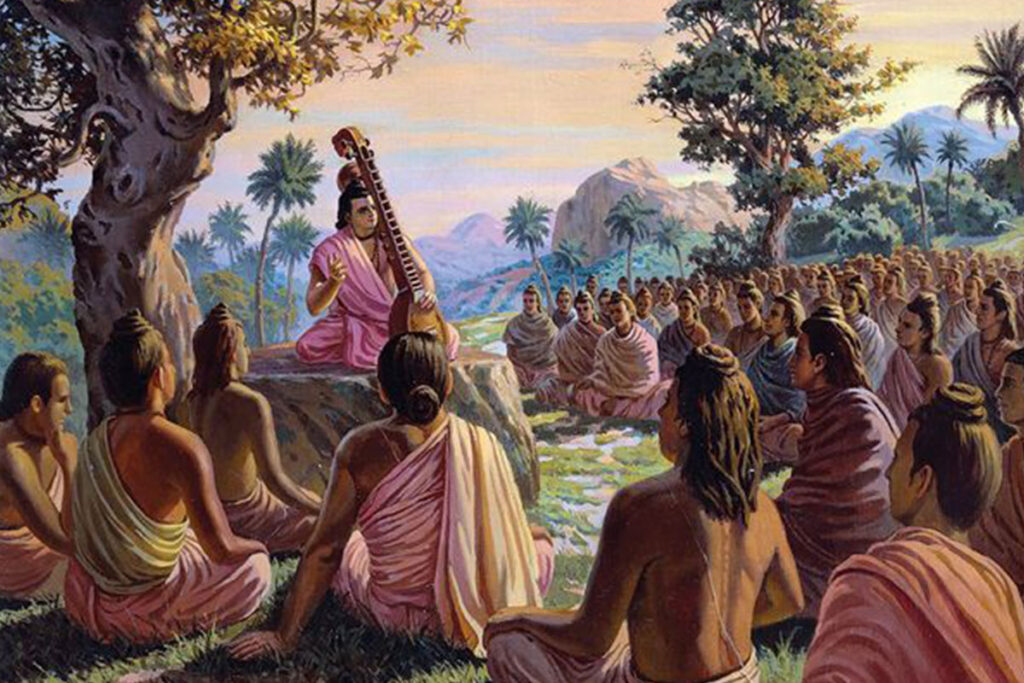


Instead: Try things. Volunteer. Work. Travel. Fail. Succeed. This world was not meant to be a cesspool of insta-gratification; it was designed to be lab for evolution. This process matures us from a state of consumption to one of contribution, from passivity to activity, and from mere potentiality to a concrete reality of living a fulfilled and purposeful life. The choice is ours: Will we get trapped by the next dopamine hit, or will we accept the challenge of gathering our dreams and breathing life into them? It’s worth the risk: You might lose yourself while trying to find yourself, as you shed the past.


After his mother’s demise, Narada was untethered from his old life. He journeyed freely. But he didn’t just roam—he observed, reflected, and remained inwardly connected to the teachings of the sages. This is the difference: outer exploration without inner disintegration.


In our own lives, when we are driven by the purpose to grow, learn, and earn, the sheer number of possibilities can be baffling enough to throw us out of the orbit. Therefore without an inner anchor, we would often find ourselves unanchored. This is exactly where spiritual wisdom serves as a guide, by providing a fixed, internal point of reference—a sense of who we are beyond the fleeting world. This inner stability allows us to navigate life’s possibilities with discernment, rather than being swept away by every passing fads. This discernment will in turn draw us closer to what we are truly called to do.


Step 3: Refine Your Skills and Offerings


We now know who we are and have tested the waters. Now it’s time to develop. Skills aren’t vanity tools; they’re sacred means of offering to the divine. Your writing, coding, travelling, or speaking—all are ways to serve.


Most modern strategies talk of mastery, 10,000 hours, and deep work. These are powerful—but when you refine yourself not for applause but for purpose, your growth becomes sacred.


Narada didn’t manifest as an unrealistic, perfect sage. His endeavor was breathtaking. With great reverence, he served the saints, imbibed the wisdom of devotion, and accepted their remnants. Eventually, he received divine grace and was empowered to influence generations of sages and kings and common men alike. His talent wasn’t his own; it was a gift, refined through silence and surrender.


As the acharyas say, sevaya kalpitam margam anuvarteta yo munih: “By serving the path with sincerity, one becomes a sage.” The world respects excellence, but the divine responds to sincerity. Learn, refine, and offer your skills—not for attention, but as an act of reciprocation.


Step 4: Align Your Path with Inner Calling


The ultimate transformation is this: from being a performer to an instrument, from being a passive accumulator to an active contributor, and from a self-obsessed doer to one who lets the divine will work through them.


· From performer to instrument: Narada Muni’s journey from a young boy who listened and absorbed spiritual wisdom (a passive act) to a sage who delivered messages to Vyasa (an active one) is a perfect example of this. His talent was no longer for his own spiritual growth alone but became an instrument to serve the divine plan.


· From passive accumulator to active contributor: Arjuna’s mastery of archery was a skill he relentlessly practiced (a passive accumulation of skill). This skill became a powerful
instrument when he was empowered by the Lord to win the war against adharma (an active contribution to a divine cause).


· From self-obsessed doer to a channel of divine will: Hanuman’s immense strength was not an end in itself. It was the culmination of a life of devotion that was ultimately used by the Lord to cross the ocean and locate Sita Devi. Hanuman didn’t act on his own will; his actions were a direct channel for the divine will, playing a pivotal role in the victory of good over evil.


The struggle to surrender is often our most profound challenge. It requires us to move beyond our individual desires and recognize that our abilities are gifts to be offered back to the divine. When we achieve this state, our work becomes a means of worship. Our voice carries the holy name, and our mission echoes the will of the Lord. That’s when life stops being a chase in the wilderness. Peace no longer feels like a destination but a state of being, because our inner compass finally points to the eternal. This is the true adventure: to stop running a race you didn’t choose. It’s the profound work of discovering your authentic self, refining your gifts, and finally, committing them with devotion—not for applause, but for the sacred purpose you are called to serve.


Ashutosh Patnaik is a senior associate working in an MNC. He holds a master’s degree in finance. Besides work, he is an avid reader and writer in the genre of contemporary-cum-devotional subjects and a frequent contributor to BTG.
Subscribe to BTG Digital Magazine

Embark on your path to Krishna consciousness with BTG Digital Magazine! Subscribe now and discover inspiring stories of growth, enlightenment, and connection shared by our community.

Subscribe

Discovering a life of True Adventure

Discovering a life of True Adventure
Listen to Article
Press Play to listen

Perhaps, getting lost in life is the only way to truly find yourself. It’s an adventure worth embracing.


By Ashutosh Patnaik


Sometimes, you feel like an actor switching scripts every scene — forgetting who you were playing in the first place. One moment you want to be a coder, the next an investor, then a writer, a speaker, a motivator — all before breakfast. Some mornings, you’re a storm of passion. Other days, you feel like a vehicle stalled without fuel.


They call it being lost, but you’re not lost—you’re layered. You’re not indecisive—you’re at the crossroads of possibilities. You’re not behind—you’re carrying too much meaning without a map. What you’re experiencing isn’t confusion—it’s vision overload. This is a crucial phase of internal growth because the truth no one tells you is this: The fire that burns hottest takes the longest to ignite. Early success looks shiny, but it’s often hollow. In a hyper-competitive environment, it’s easy to get carried away by the numbers, the likes, and the follower count. What gets missed is our individuality.


The case of Karna and Arjuna is a stark example. Contrary to the mainstream projection of Karna being a “victim,” the reality was Karna betrayed himself. Though he earned a place in the best of the academies, Guru Drona’s Archery Academy, he could never earn his guru’s trust. Among all his disciples, Dronacarya perhaps had the best of the two shinning archers budding in front of him—Arjuna and Karna—who would eventually etch their names in the glorious history of Bharat.


But instead of embracing good sportsmanship, Karna harbored a deep envy and even hatred for Arjuna. In his desperate bid to outshine his rival, Karna employed all sorts of underhanded means to gain superiority, resulting in accruing more curses than blessings from all the gurus in his academia. It was indeed a choice by Karna to let his insecurity overshadow his best of warrior virtues. In our journey through life, we too might get carried away by our lower selves—greed, envy, pride, lust, anger. We may achieve something resembling significance, but maybe at the cost of losing ourselves.


Karna’s downfall wasn’t due to a lack of talent, but a lack of self-awareness. His focus wasn’t on becoming the best version of himself, but on surpassing Arjuna. Karna’s envy poisoned his incredible gifts, leading him to make choices that betrayed his own greatness. He had the fire, but misdirected.


This is the very essence of what you’re experiencing. When you feel pulled in a dozen different directions, it’s like you’re trying to outshine a dozen different people, or a dozen different versions of success. It’s a battle against an external standard rather than an internal one.


How do we stop trying to be Karna and find our own path? The answer, it turns out, isn’t found in another battle to be won, but in a completely different story—one of inward discovery. It’s revealed in the becoming of Narada.


From Confusion to Clarity: The Story of Narada’s Becoming


A curious boy, unnamed in his early years, who wandered not with purpose but with readiness. His mother was a simple maidservant. He had no wealth, no prestige, no plan. But what he did have was exposure to the association of Bhaktivedantas—devotees deeply absorbed in spiritual realization.


He listened, he absorbed, he questioned—silently. He wasn’t “planning” his purpose. He was marinating in meaning. Then tragedy struck: his mother, his sole source of warmth and support in a difficult world, died from a snakebite. In an instant, the only anchor in his young life was gone. He was left utterly alone, untethered, and homeless. The world must have felt like it had collapsed around him—a true rock bottom.


Yet, Narada didn’t panic. He explored the world of sages and later ventured through the real world of hustle as a traveler. If you freeze the timeline, it might appear he is lost, all alone! But his purpose became all the more clear as he explored the world. Seeing the fleeting nature all around, his desires gravitated towards the eternal Supreme. He remembered the solace the sages had found in their inner world. He felt an intense, undeniable pull to seek the very source of the peace they had described.


So, he walked into the forest, not in a flight of fancy, but as a deliberate act of surrender. He sat and meditated on the Lord’s form, just as he had heard from the sages. And in that silence, the divine vision of the Lord manifested. Eventually, that boy was reborn—not just physically but spiritually—as Narada Muni, the eternal, transcendental traveler, the cosmic musician, and the motivator of saints and kings alike.


In a world of polarities, seekers wrestling with clarity often prematurely latch on to polarities: those with high aspirations lean towards seeking validation, while those with frustrated dreams praise the glory of humility. None of the above paths are less noble than the other. Problem arises when we follow one externally while deep within seek for the other. Karna’s rivalry-driven path led to a hollow existence, while the boy who became Narada chose quiet receptiveness over competition. The takeaway is this: clarity of purpose comes not from winning battles against others, but from creating space to discover your unique path.


Four steps to re-route our life forward: first principles from Narada’s life


In a fast-paced world that constantly tells us to optimize, hustle, and find our passion, our search for meaning has become a marketplace. Self-help shelves are overflowing with advice—”discover your why,” “live intentionally,” “master your craft.” We read productivity hacks, try habit-stacking, and build vision boards—but the satisfaction seems fleeting. We burn out not from doing too much, but from not doing what truly matters.


This longing isn’t new; it’s ancient. And one of the greatest roadmaps towards integrated, purpose-rich life comes from sage Narada. We will explore the flow of Narada’s life moving from practical life wisdom, into introspective realization, into alignment with spiritual purpose, and towards deeper transformation.


Step 1: Know Yourself Beyond the Noise


In the journey of life, many chase skills, careers, or relationships before understanding who they truly are. But just as a seed carries the blueprint of a tree, you carry within you an identity far greater than roles and labels.


Modern teachings often encourage journaling, solitude, and self-inquiry. These are not ends but means—stepping stones that help silence the mental clutter. When you pause and examine your fears, patterns, and desires, a deeper realization emerges: “Across different episodes of life, I feel I am not this mind, rather a witness of it. I am consciousness.” In the Bhagavad-gita, we find a more profound meaning than that; more than being mere consciousness, we are spiritual beings—the eternal associates of the beloved Lord Krishna. (Gita 15.7).


Step 2: Explore Possibilities with Awareness


Once you’re rooted in identity, the world opens—not as a place to consume but to contribute. In a world where reels, shorts, memes, and scrolls have invaded our private spaces, from boardroom to bedroom to washroom, not becoming a consumer will be an outlier. Unrestrained and unfiltered consumption stunts the ability to create and contribute.


Instead: Try things. Volunteer. Work. Travel. Fail. Succeed. This world was not meant to be a cesspool of insta-gratification; it was designed to be lab for evolution. This process matures us from a state of consumption to one of contribution, from passivity to activity, and from mere potentiality to a concrete reality of living a fulfilled and purposeful life. The choice is ours: Will we get trapped by the next dopamine hit, or will we accept the challenge of gathering our dreams and breathing life into them? It’s worth the risk: You might lose yourself while trying to find yourself, as you shed the past.


After his mother’s demise, Narada was untethered from his old life. He journeyed freely. But he didn’t just roam—he observed, reflected, and remained inwardly connected to the teachings of the sages. This is the difference: outer exploration without inner disintegration.


In our own lives, when we are driven by the purpose to grow, learn, and earn, the sheer number of possibilities can be baffling enough to throw us out of the orbit. Therefore without an inner anchor, we would often find ourselves unanchored. This is exactly where spiritual wisdom serves as a guide, by providing a fixed, internal point of reference—a sense of who we are beyond the fleeting world. This inner stability allows us to navigate life’s possibilities with discernment, rather than being swept away by every passing fads. This discernment will in turn draw us closer to what we are truly called to do.


Step 3: Refine Your Skills and Offerings


We now know who we are and have tested the waters. Now it’s time to develop. Skills aren’t vanity tools; they’re sacred means of offering to the divine. Your writing, coding, travelling, or speaking—all are ways to serve.


Most modern strategies talk of mastery, 10,000 hours, and deep work. These are powerful—but when you refine yourself not for applause but for purpose, your growth becomes sacred.


Narada didn’t manifest as an unrealistic, perfect sage. His endeavor was breathtaking. With great reverence, he served the saints, imbibed the wisdom of devotion, and accepted their remnants. Eventually, he received divine grace and was empowered to influence generations of sages and kings and common men alike. His talent wasn’t his own; it was a gift, refined through silence and surrender.


As the acharyas say, sevaya kalpitam margam anuvarteta yo munih: “By serving the path with sincerity, one becomes a sage.” The world respects excellence, but the divine responds to sincerity. Learn, refine, and offer your skills—not for attention, but as an act of reciprocation.


Step 4: Align Your Path with Inner Calling


The ultimate transformation is this: from being a performer to an instrument, from being a passive accumulator to an active contributor, and from a self-obsessed doer to one who lets the divine will work through them.


· From performer to instrument: Narada Muni’s journey from a young boy who listened and absorbed spiritual wisdom (a passive act) to a sage who delivered messages to Vyasa (an active one) is a perfect example of this. His talent was no longer for his own spiritual growth alone but became an instrument to serve the divine plan.


· From passive accumulator to active contributor: Arjuna’s mastery of archery was a skill he relentlessly practiced (a passive accumulation of skill). This skill became a powerful
instrument when he was empowered by the Lord to win the war against adharma (an active contribution to a divine cause).


· From self-obsessed doer to a channel of divine will: Hanuman’s immense strength was not an end in itself. It was the culmination of a life of devotion that was ultimately used by the Lord to cross the ocean and locate Sita Devi. Hanuman didn’t act on his own will; his actions were a direct channel for the divine will, playing a pivotal role in the victory of good over evil.


The struggle to surrender is often our most profound challenge. It requires us to move beyond our individual desires and recognize that our abilities are gifts to be offered back to the divine. When we achieve this state, our work becomes a means of worship. Our voice carries the holy name, and our mission echoes the will of the Lord. That’s when life stops being a chase in the wilderness. Peace no longer feels like a destination but a state of being, because our inner compass finally points to the eternal. This is the true adventure: to stop running a race you didn’t choose. It’s the profound work of discovering your authentic self, refining your gifts, and finally, committing them with devotion—not for applause, but for the sacred purpose you are called to serve.


Ashutosh Patnaik is a senior associate working in an MNC. He holds a master’s degree in finance. Besides work, he is an avid reader and writer in the genre of contemporary-cum-devotional subjects and a frequent contributor to BTG.