


Beyond passivity and aggression—discovering tolerance as intelligent strength
by Chaitanya Charana Dasa
Wouldn’t it be great if we had a shield in our emotional arsenal, one that protects us from being disturbed by others?
When the climate around us changes, say, the temperature drops, we reach for a sweater. But what protects us when the social climate changes, when people suddenly turn cold? That shield is surprisingly simple, yet powerfully protective. It is tolerance.
In today’s political discourse, tolerance is often framed as religious tolerance: acceptance of diversity in beliefs and practices. However, in the language of the Bhagavad-gita, tolerance is seen not as a political policy but as a personal virtue. It is not just living with something we dislike, but going through and growing through others’ difficult behavior by holding on to a higher purpose. Tolerance enables us not just to endure others’ provocative behavior, but to endure it in a way that helps us evolve spiritually and become better human beings. Put succinctly, it is not reluctant acceptance but resilient endurance.
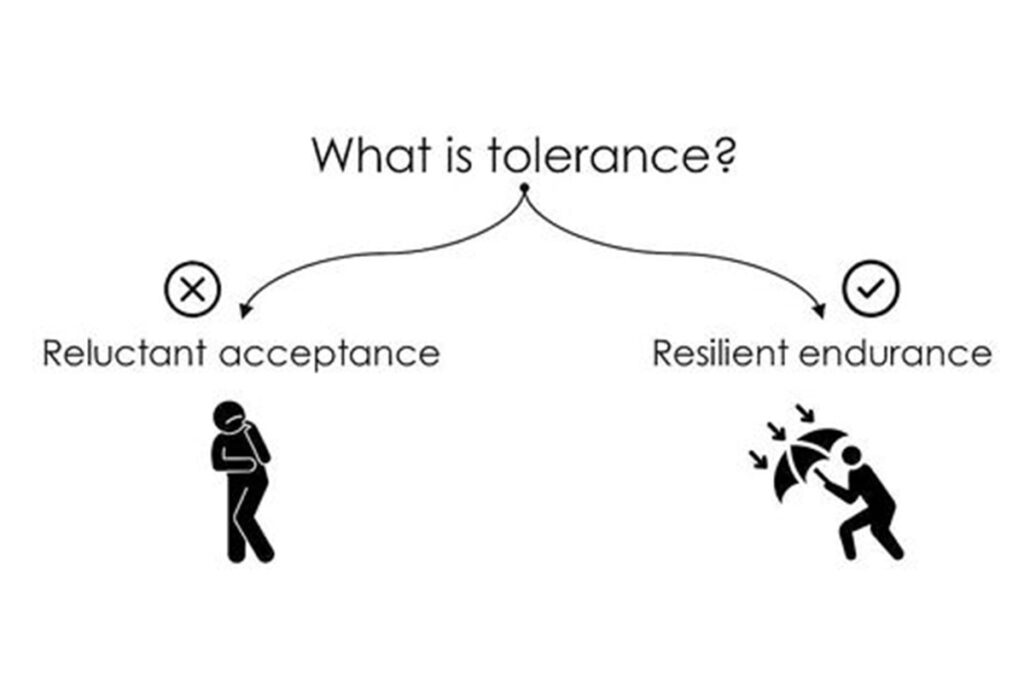
What Tolerance Is Not
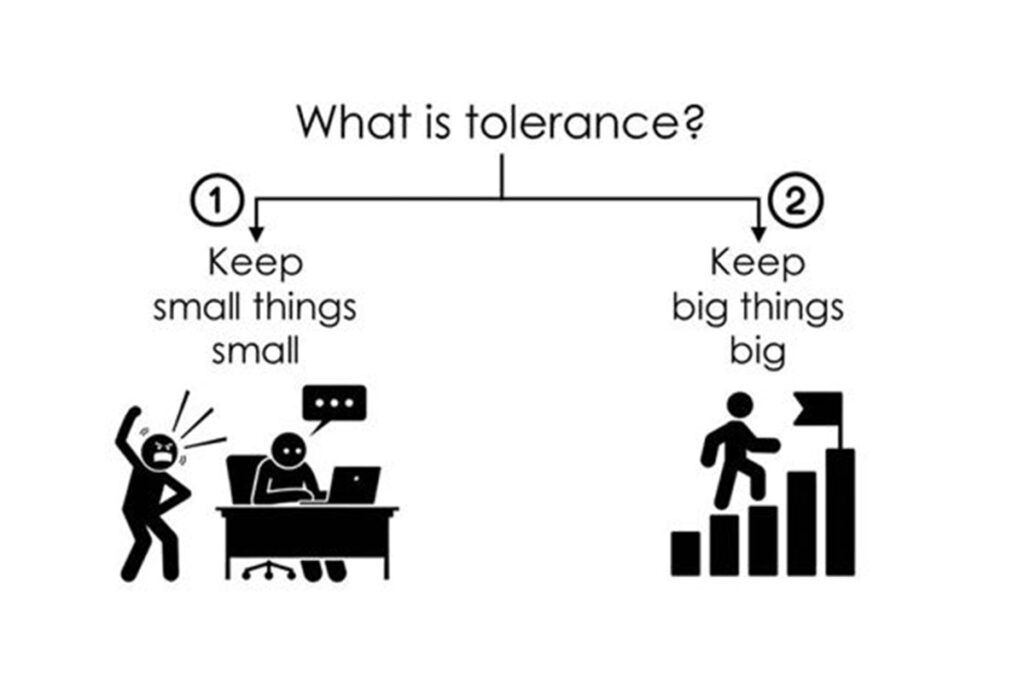
To better understand what tolerance is, let us begin by clarifying what it is not. Tolerance is not passivity; it is not weakness. It is not acquiescence to abuse, not submission to exploitation, not silent surrender to manipulation. Having emphasized what tolerance is not, let us now explore what tolerance is. It is essentially the capacity to keep small things small so that we can keep big things big.
Suppose there is a conflict in our family where one member says something hurtful in the heat of the moment. Tolerance would mean that we do not hold that comment against the person for the rest of their life, repeatedly bringing it up and weaponizing that hurt in future disagreements. In this way, we keep a small issue small.
At the same time, if someone becomes aggressive or violent and harms us or other family members, we cannot and should not remain passive. We should not treat what is a big thing as a small thing. If we do that, we would be failing in our dharma of protecting others. That would not be tolerance; it would be impotence.
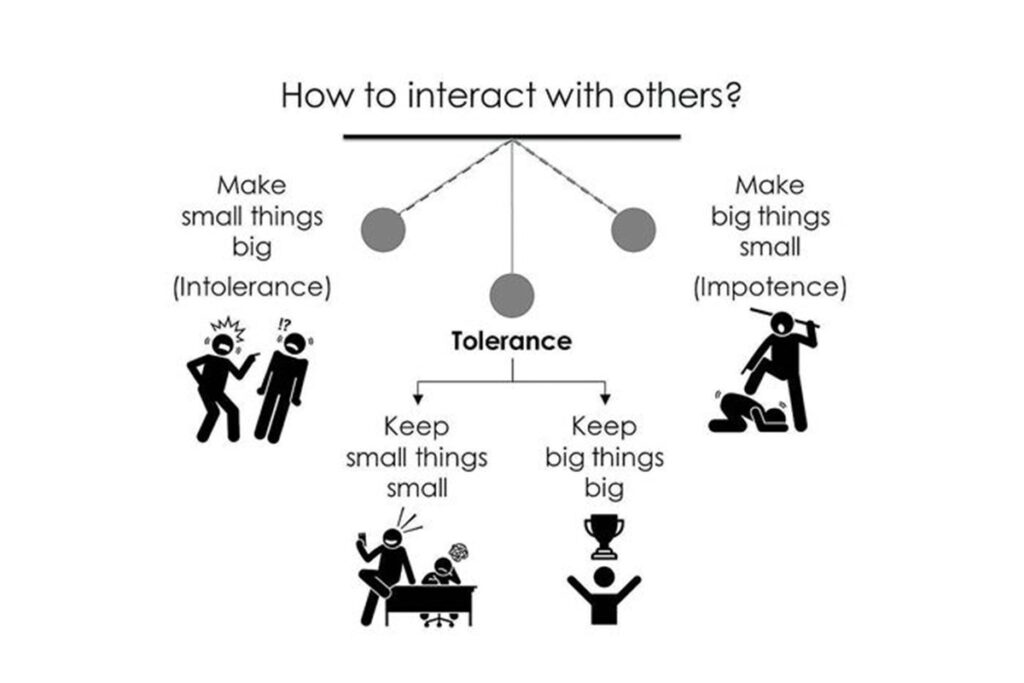
In our interactions with others, we can go to two extremes. We may make small things big, or we may make big things small. Letting small things become big is intolerance. Treating big things as small is impotence. Tolerance lies in balancing these two extremes.
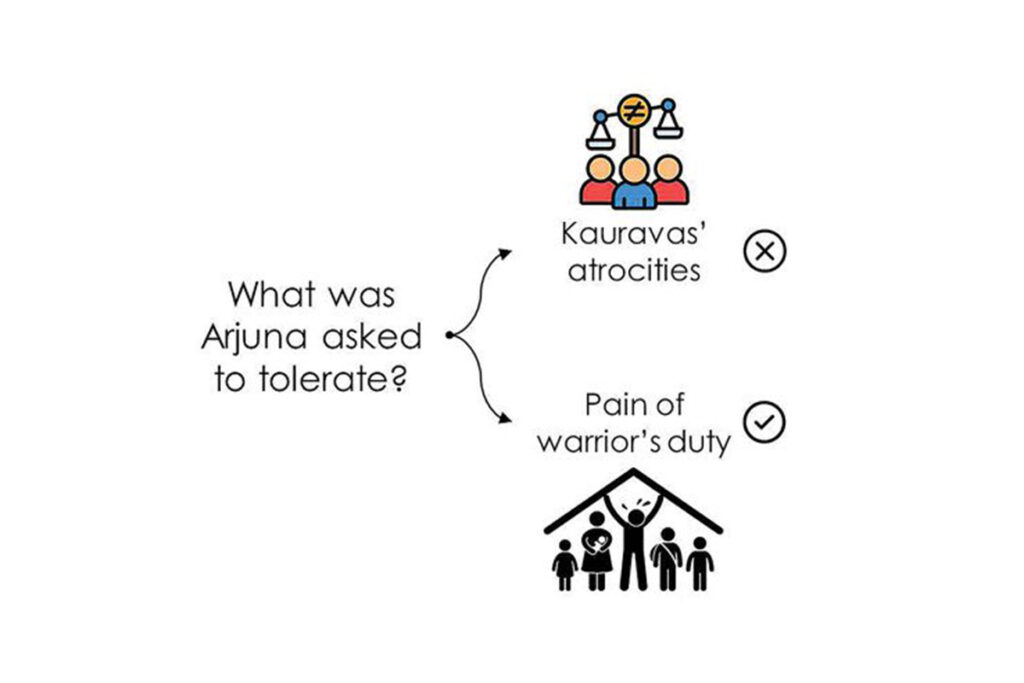
The Bhagavad-gita illustrates this balance in the well-known verse 2.14, where Arjuna is instructed to practice tolerance. But what exactly is he asked to tolerate? He has endured grave injustices at the hands of the Kauravas—his wife was dishonored, his kingdom was stolen, and even Krishna, his friend and Lord, was insulted and threatened. The Gita does not ask him to passively accept such atrocities in the name of tolerance. Instead, it asks him to tolerate the pain of performing his difficult duty—the anguish of fighting against his own relatives, including revered elders like Bhishma and Drona. Tolerance should increase our adherence to dharma, not decrease it.
The Foundation of Tolerance:
Intelligence
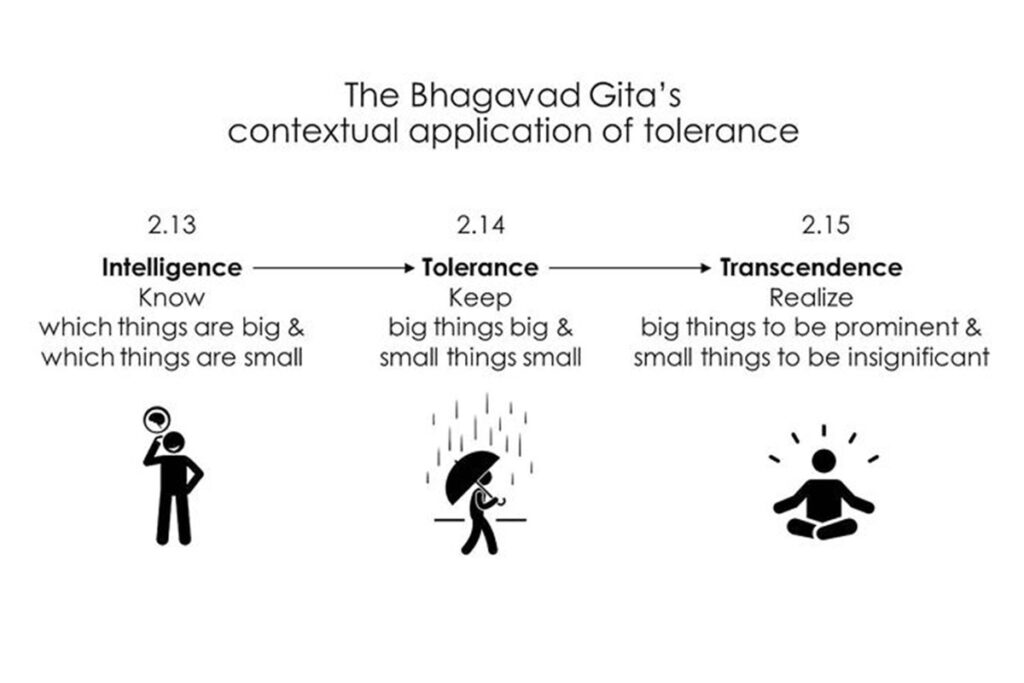
Let us better understand how the Bhagavad Gita gives a grounding and empowering understanding of tolerance by looking beyond the verse about tolerance to its context, namely the verses that precede it (2.13) and succeed it (2.15).
Once we appreciate that tolerance is about keeping small things small so that we can keep big things big, tolerance requires the intelligence to know which things are small and which are big. That emphasis on intelligent discernment is provided by Bhagavad-gita in 2.13, which explains what is big and what is small in terms of the layers of our identity.
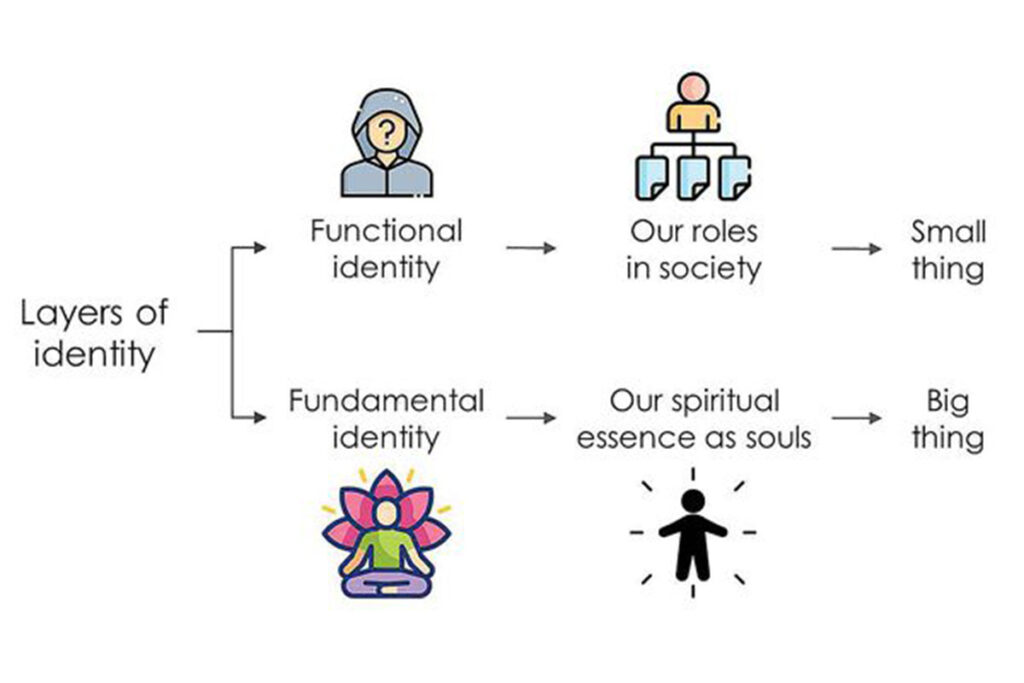
The Gita explains that our identity is multi-layered. We have external functional identities based on our roles in society, and we also have an internal fundamental identity based on our spiritual essence as souls. Our various roles are meant ultimately to nourish our soul. We are not meant to neglect our soul for any role. In terms of our identity, intelligence is to know that the big thing is our fundamental identity, and the relatively small thing is the functional role we are playing. For example, if we define ourselves only by our role—say, as a professional, a parent, or a leader—then any threat to that role can feel overwhelming. But when we see ourselves as souls, those threats become smaller in perspective.
Only when our intelligence is thus clear will our tolerance become constructive, helping us keep small things small and big things big.
The Fruit of Tolerance: Transcendence
Let us now consider the next verse, 2.15, to appreciate what the Bhagavad-gita declares to be the fruit of such intelligent tolerance: transcendence.
When we keep small things small and big things big, those big things become more prominent in our consciousness through our lived experience. As we perceive the potency and the glory of living for those big things, they become our driving and defining realities—not just through our conscious determination to focus on them, but also by our subconscious gravitation toward them. As our consciousness becomes anchored in the big things, our character correspondingly grows deeper and stronger. That is transcendence in action. We go beyond the dualities that would otherwise distract, distress, or even destroy us.
The Bhagavad-gita thus outlines how our intelligence (2.13) refines our tolerance (2.14) and raises us to transcendence (2.15).
Returning to our earlier phrasing of tolerance as resilient endurance, the endurance inherent in tolerance helps us to outlast life’s inevitable challenges by increasing our capacity to treat them as small things that pass with time. The resilience inherent in tolerance enables us not just to bounce back from those challenges, but to outgrow them by increasing our absorption in the big things.
The Lens of the Three Gunas
How can we cultivate such tolerance that enables us to outlast and outgrow life’s challenges?
The Bhagavad-gita explains human psychology through the three gunas: sattva, rajas, and tamas. These three gunas are subtle forces that pervade and animate material nature. They link consciousness with matter and prompt us to think, feel, and act in particular ways.
In the language of contemporary social media, nowadays influencers are said to have immense power. To understand a person, we often seek to know who their influencers are. Similarly, to understand ourselves, we need to know the three gunas as our invisible influencers. Among them, sattva draws us toward clarity, rajas drives us toward hyperactivity, and tamas drags us toward apathy.
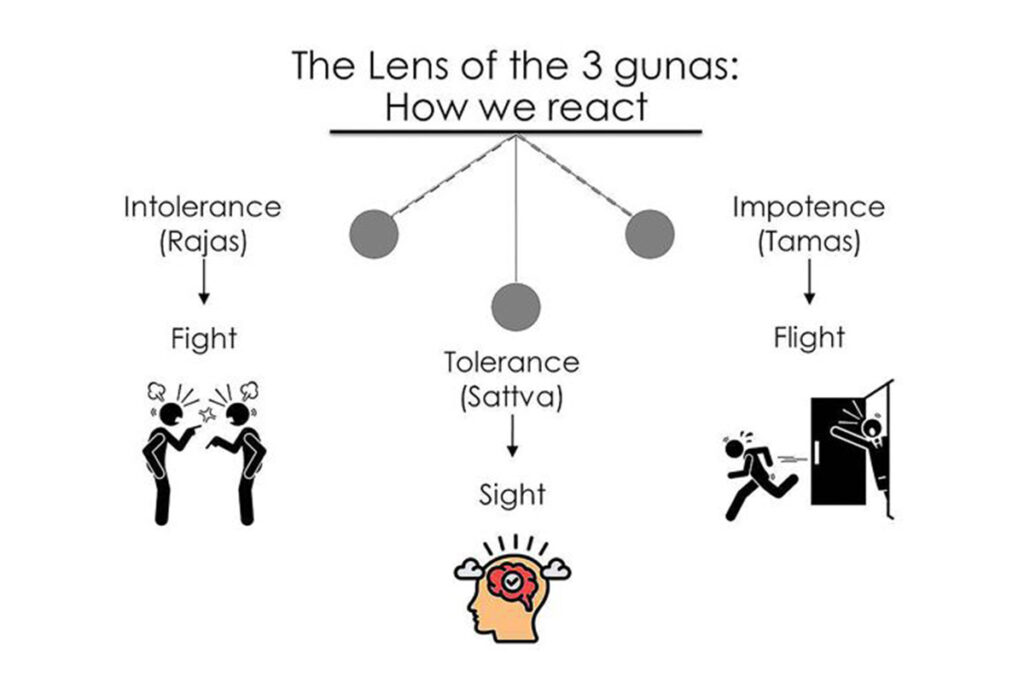
When we are influenced by rajas, we tend to be aggressive, we overreact, and we see every issue as something to fight over. We make small things big; we become intolerant.
Conversely, when we are influenced by tamas, we tend to underreact, we become passive, apathetic and avoid engaging with issues. We make big things small; we become impotent.
When we are influenced by sattva, we react appropriately. We become neither aggressive nor passive, but assertive. We discern which issues are small enough to live with and which are big enough to stand up for. We choose our battles.
The guna lens thus helps us better understand our mood swings: why we sometimes change suddenly from hyper-aggressive to ultra-passive or from ultra-passive to hyper-aggressive.
When framed in the language of modern psychology, intolerance corresponds to the fight response, whereas impotence corresponds to the flight response. As the balance between them, tolerance can be phrased as the sight response. Through seeking sight, we gain clarity about what the issue really is and whether it is big enough to stand up for or small enough to live with.
The Default Is Not Our Fault
We all have our default tendencies by which we may gravitate either toward intolerance or toward impotence. Yet, we do not remain forever fixed in any one state. Our emotional pendulum will eventually swing to the opposite side, sometimes predictably, but often unpredictably.
For example, if we remain constantly silent amid things that disturb and distress us, we will eventually explode when our resentment reaches a tipping point. Sometimes the issue that triggers us may be so small that others may be bewildered at our reaction; even we ourselves may be bewildered. Actually, we explode not because of that particular issue, but because of the 1,357 past issues that we have neglected and buried for days, weeks, months, years, or even decades. All that suppressed anger has now led to our volcanic eruption.
Conversely, if we gravitate toward intolerance, we may keep picking fights over every small issue. Over time, we may become so exhausted that we may occasionally submit feebly to others’ manipulation or domination on an issue that is big for us.
That’s why letting ourselves stay at either extreme is unwise, unsustainable, unsafe.
These extremes are seen not just in individuals, but also in cultures, such as Western cultures and Eastern cultures. (When I refer to Western and Eastern cultures, I do not intend to stereotype them or absolutize their characteristics; I am only pointing to mainstream orientations.)
Western cultures often gravitate toward intolerance, whereby even small differences may lead to the breakdown of relationships. In many Western societies, the family unit, which is the foundation of society, has witnessed widespread fragmentation. While this tragic phenomenon has many sociological causes that vary across contexts, one fundamental factor is the inability to tolerate; the reluctance to keep small things small; the unwillingness to live with inevitable inconveniences such as others’ personality quirks or human weaknesses.
Conversely, Eastern cultures often gravitate toward the opposite extreme of impotence. Because of misunderstanding or misapplying tolerance, abuse and violence may be downplayed, denied, or even covered up. For the sake of preserving family stability or maintaining social appearances, individual emotional well-being or even physical safety may be dangerously damaged or even irrevocably destroyed.
Whatever our default tendency may be, that is not our fault, provided we do not resign ourselves to it as our fatal fate. We can learn to check and counter our default tendencies. We can bring ourselves toward the center, the point of healthy balance. We can rise toward sattva.
Some of us may have stronger conditionings than others and may therefore require more patience and perseverance to overcome our default tendencies. But nonetheless, we can all take heart from this enduring truth: our present default is not our permanent destiny.
Three Ps to the Power of Tolerance
How do we cultivate sattva so that we have the clarity to choose constructively? Raising our consciousness till sattva becomes its default state requires a sustained spiritual journey of purification, which takes time. Bhakti Yoga practices are potent tools of purification that can accelerate our journey toward sattva.
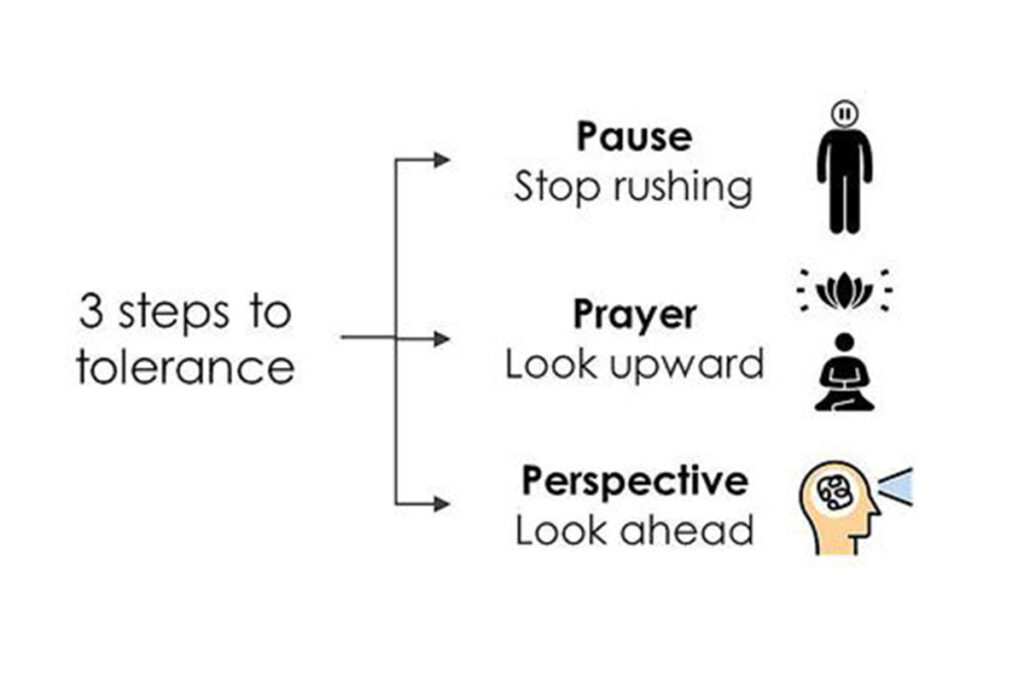
Simultaneously, when we are addressing specific issues at specific times, we can adopt practices that help move us toward sattva. These practices can be summarized as three Ps: pause, prayer, perspective.
Pause
Whenever we are provoked, we may not be immediately able to stop ourselves from rushing toward our default action, be it fight or flight. Still, we can train ourselves to pause as a conscious practice, a regular discipline, a cultivated habit. To that end, we can take a few deep breaths, repeat affirmations, or chant mantras. Essentially, when we train ourselves to pause periodically, we create a protective boundary that prevents us from impulsive actions. As we fortify that boundary by diligent discipline, it will safeguard us from our default behavioral patterns when we are provoked by others.
Prayer
Once we have stopped ourselves from rushing forward by pausing, we can look upward by praying. This directs our attention toward a higher reality that governs whatever is happening in our lives. No matter how confusing or confounding our situation may seem, praying prompts us to look for what is positive. Maybe there is a hidden opportunity for learning and growing. Pertinently, the Bhagavad Gita (10.10) states that when we prayerfully connect with the divine, we receive inner intelligence to make better decisions.
Perspective
After pausing to avoid rushing forward and praying to look upward, we can then look forward with a calmer mind and a clearer head to gain a fresh perspective. Such perspective-seeking can activate our intelligence, helping us discern what is big and what is small in that specific situation.
We may discover that what we by default treat as a big thing, requiring immediate fight or flight reaction, is actually a small thing. Accordingly, we may decide to overlook it. Or we may address it later at an appropriate time, when everyone concerned is in a better state of mind for a candid and constructive conversation.
Conversely, this fresh perspective may help us recognize that something we tend to downplay by default as a small issue may not be so small. We may recognize that the behavior disturbing us at present is not a one-off occurrence, but a recurrent pattern—a pattern that is subtly yet significantly harmful. It is eroding our ability to do our duty and reducing our respect for them, or even our trust in them.
Let’s consider a practical example. Suppose we request a friend to do something and they forget it. If it happens once, we can and should overlook it, giving them the benefit of the doubt. They may be going through a tough time or may have a lot on their mind. But if it happens repeatedly, even regularly, we cannot let things continue the way they are. Accordingly, we may decide to communicate clearly with them, emphasizing what is at stake. They need to take our requests more seriously, or we may need to take our relationship with them less seriously.
Whenever we find ourselves in such high-stakes situations, we undoubtedly need to think carefully before acting. Still, the process of pausing, praying, and perspective-seeking can increase the likelihood that whatever choice we make will be healthier. And we will have diligently done our part in trying to improve the relationship.
Thus, tolerance enables us to avoid overreacting to small things and underreacting to big things—so that we choose wisely, act responsibly, and grow spiritually.
Chaitanya Charana Dasa is the associate-editor of Back to Godhead (US and Indian editions). To read his daily Bhagavad-gita reflections, please subscribe to Gitadaily on his website, thespiritualscientist.com.