Sanatana-dharma

Free to Read
6 mins September, 2026
00:00
00:00

the Foundation of Good Governance


When leadership is guided by eternal dharmic principles, society flourishes
through justice, integrity, and genuine welfare for all.


by Ramananda Nitai Dasa


In modern times, the understanding of governance is often reduced to a sterile arrangement of checks, balances, and bureaucratic efficiencies. Yet, when viewed through the luminous lens of the Vedic tradition, governance reveals itself not as a secular imposition of order, but as a sacred expression of Sanatana-dharma—the eternal nature of the soul in its living relationship with the Supreme. In a world presently grappling with a crisis of leadership and a steady erosion of integrity, the teachings of His Divine Grace A. C. Bhaktivedanta Swami Prabhupada offer a profoundly transformative vision: leadership not as dominion, but as seva, performed in the spirit of selfless devotional service.


THE ETERNAL IDENTITY: THE SOUL OF GOVERNANCE


If one truly seeks to understand governance, one must first grasp the essence of Sanatana-dharma. In modern times, it has become a widespread misconception to regard Sanatana-dharma as merely a set of religious doctrines or cultural affiliations. In this regard, Srila Prabhupada explains that just as liquidity is inseparable from water and heat is inseparable from fire, Sanatana-dharma is the inseparable, constitutional occupation of every living entity. It is the soul’s eternal relationship with Sri Krishna. Sanatana-dharma, therefore, is a way of living that awakens purity, compassion, and loving service.


The fundamental maxim of this spiritual understanding is found in the Chaitanya-caritamrita: jivera ‘svarupa’ haya-krishnera ‘nitya-dasa’. Every living being is, by nature, an eternal servant of the Supreme Personality of Godhead, Lord Sri Krishna. When governance is rooted in this realization, it ceases to be a pursuit of power and becomes a sacred means of facilitating the soul’s journey. When a leader recognizes that every citizen—and indeed every living entity—is a “part and parcel of the Lord,” the act of administration is elevated into a noble and sanctified duty of protection and care.


THE RAJARSHI: THE SAGE-KING IDEAL


Srila Prabhupada repeatedly illuminated the timeless ideal of the rajarshi—the saintly king—as both a historical reality and a profound philosophical model of enlightened governance. In his commentary on the Srimad-Bhagavatam (1.18.41) he writes: “In the Vedic way of life, the king is trained to become a rajarshi, or a great saint, although he is ruling as king. It is the king only by whose good government the citizens can live peacefully and without any fear. The rajarshis would manage their kingdoms so nicely and piously that their subjects would respect them as if they were the Lord.” 


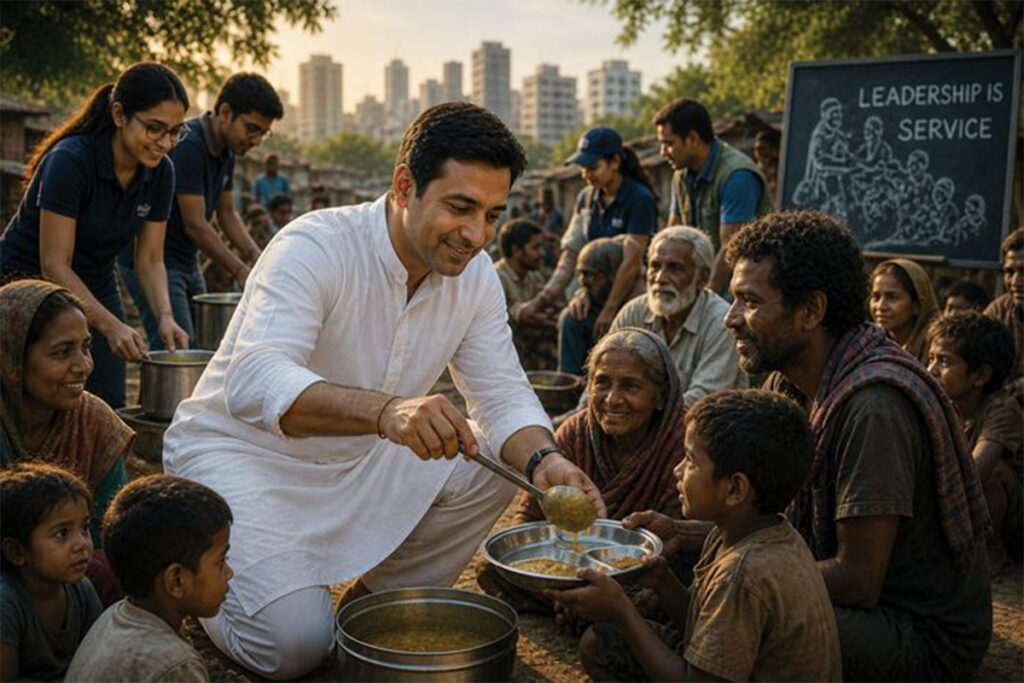
This “sage-king” does not govern through the arrogance of office, but through the radiance of character and inner purity. In our Vaishnava tradition, we find that authority is sanctified by humility; leadership finds its highest expression not in control, but in surrender. The true leader is not a ruler, but a dasanudasa—a servant of the servant. This profound shift from “authority over” to “service to” stands as the defining hallmark of genuine spiritual leadership. In such a way, when a leader’s senses are fully engaged in the service of the Lord, governance naturally becomes steady, compassionate, and quietly transformative.

THE PERILS OF MATERIAL AMBITION


Conversely, the absence of such spiritual grounding gives rise to the unmistakable symptoms of the Age of Kali, marked by mismanagement, discord, and moral disarray. Srila Prabhupada cautioned (SB 1.16.4, purport) that the root cause of societal disharmony lies in the elevation of “worthless men, imbued with the modes of lower-class behaviour,” to positions of authority. It becomes evident that when leadership is driven by material ambition rather than guided by a sense of sacred duty, the very systems of governance gradually turn into instruments of exploitation.


Whether within a spiritual institution or a nation-state, poor governance often reveals itself through a subtle yet profound dilution of the spiritual message, as the pursuit of worldly success and prestige slowly eclipses the original mission of purity and service. Time and again, it is re-emphasized that without the steady anchor of Sanatana-dharma, institutions gradually drift into mechanical routines, losing the warmth, depth, and living spirit that gently awaken and sustain the human heart.


PRINCIPLES OF TRANSCENDENT MANAGEMENT


Srila Prabhupada did not merely articulate abstract ideals; he embodied them in action by founding a global movement—ISKCON—an organization built upon resilient structures carefully designed to ensure the continuity of its sacred mission. His vision of “good governance” can be distilled into a few guiding principles, outlined below, which are as relevant to leaders of nation-states and international corporations as they are to those guiding spiritual institutions.


1. Mission-Centric Leadership: Administration is never an end in itself; it serves as a sacred instrument to uphold the dissemination of Truth and the holistic upliftment of humanity.


2. Character over Competence: While organizational skill is certainly important, it is character that shapes the spiritual atmosphere. A leader must, above all, embody integrity, humility, and genuine compassion, for it is these qualities that quietly inspire trust and lasting transformation.


3. Decentralization and Empowerment: Srila Prabhupada envisioned a system in which local responsibility nurtures initiative and teamwork, helping to avoid the bureaucratic bottlenecks that so often hinder growth.


4. Transparency as Protection: Mismanagement flourishes in shadows. Authentic governance calls for honest audits, clearly defined roles, and open communication, ensuring that all resources are handled with care and reverence, as Krishna’s sacred property.


5. Succession and Continuity: True leadership includes the training of future generations, ensuring that the mission remains steady and resilient long after the original founders have departed.


THE HIDDEN STRENGTH OF HUMILITY


A profound insight into governance emerges from Srila Prabhupada’s reflections on the nature of strength. In the material world, we often perceive a hierarchy in which the strong draw upon the energy of the weak, yet such arrangements are ultimately fleeting and illusory. Prabhupada gently reminds us that even the most powerful leader is, in truth, “ultimately weak,” for no one can command immunity from disease, old age, death, or the relentless forces of material nature.


Recognizing this cosmic order—where the individual stands beneath material nature, and material nature itself remains under the Supreme Controller—naturally awakens humility in leadership. Leaders who govern with an awareness of their own limitations are far less likely to fall into arrogance. Instead, they become natural guardians of the vulnerable, shaping policies guided by divine principles and oriented toward lasting welfare rather than short-term political gain.


CONCLUSION: GOVERNANCE AS SEVA


Good governance is not an administrative burden; it is Sanatana-dharma in action. It is the gentle and practical expression of the soul’s eternal nature within the lived realities of human organization. When an institution or a nation-state aligns its conduct with these timeless teachings, it becomes a sanctuary—a space where every individual feels valued, protected, and spiritually nourished.


The example of Maharaja Yudhishthira, as cited by Srila Prabhupada (Srimad Bhagavatam 1.12.4, purport), remains the gold standard: “Maharaja Yudhishthira, therefore, was constantly engaged in the service of the Lord, and thus the parts and parcels of the Lord, the living beings under his careful administration, were perfectly attended with all comforts in this life and all progress in the next. That is the way of perfect management of state administration.” 


In an age marked by fragmentation, the call of Sanatana-dharma is a call toward unity, integrity, and a heartfelt return to the spirit of service. May the leaders of nation-states and our global communities draw inspiration from these elevated principles, transforming management into kindness and structure into a living vehicle for the Divine. By honouring the eternal identity of the soul, we can build nations and institutions that do not merely manage affairs, but gently uplift and ennoble the very consciousness of human society.


Ramananda Nitai Dasa (Rajesh Kumar Mishra), a disciple of His Holiness Gopala Krishna Gosvami Maharaja, is a senior scientist at Bhabha Atomic Research Centre, Mumbai. He also serves as the editor of the annual souvenir of ISKCON Navi Mumbai, while overseeing its publication department.


Spread the love

Subscribe to BTG Digital Magazine

Embark on your path to Krishna consciousness with BTG Digital Magazine! Subscribe now and discover inspiring stories of growth, enlightenment, and connection shared by our community.

Subscribe

Sanatana-dharma

Sanatana-dharma
Listen to Article
Press Play to listen

the Foundation of Good Governance


When leadership is guided by eternal dharmic principles, society flourishes
through justice, integrity, and genuine welfare for all.


by Ramananda Nitai Dasa


In modern times, the understanding of governance is often reduced to a sterile arrangement of checks, balances, and bureaucratic efficiencies. Yet, when viewed through the luminous lens of the Vedic tradition, governance reveals itself not as a secular imposition of order, but as a sacred expression of Sanatana-dharma—the eternal nature of the soul in its living relationship with the Supreme. In a world presently grappling with a crisis of leadership and a steady erosion of integrity, the teachings of His Divine Grace A. C. Bhaktivedanta Swami Prabhupada offer a profoundly transformative vision: leadership not as dominion, but as seva, performed in the spirit of selfless devotional service.


THE ETERNAL IDENTITY: THE SOUL OF GOVERNANCE


If one truly seeks to understand governance, one must first grasp the essence of Sanatana-dharma. In modern times, it has become a widespread misconception to regard Sanatana-dharma as merely a set of religious doctrines or cultural affiliations. In this regard, Srila Prabhupada explains that just as liquidity is inseparable from water and heat is inseparable from fire, Sanatana-dharma is the inseparable, constitutional occupation of every living entity. It is the soul’s eternal relationship with Sri Krishna. Sanatana-dharma, therefore, is a way of living that awakens purity, compassion, and loving service.


The fundamental maxim of this spiritual understanding is found in the Chaitanya-caritamrita: jivera ‘svarupa’ haya-krishnera ‘nitya-dasa’. Every living being is, by nature, an eternal servant of the Supreme Personality of Godhead, Lord Sri Krishna. When governance is rooted in this realization, it ceases to be a pursuit of power and becomes a sacred means of facilitating the soul’s journey. When a leader recognizes that every citizen—and indeed every living entity—is a “part and parcel of the Lord,” the act of administration is elevated into a noble and sanctified duty of protection and care.


THE RAJARSHI: THE SAGE-KING IDEAL


Srila Prabhupada repeatedly illuminated the timeless ideal of the rajarshi—the saintly king—as both a historical reality and a profound philosophical model of enlightened governance. In his commentary on the Srimad-Bhagavatam (1.18.41) he writes: “In the Vedic way of life, the king is trained to become a rajarshi, or a great saint, although he is ruling as king. It is the king only by whose good government the citizens can live peacefully and without any fear. The rajarshis would manage their kingdoms so nicely and piously that their subjects would respect them as if they were the Lord.” 


This “sage-king” does not govern through the arrogance of office, but through the radiance of character and inner purity. In our Vaishnava tradition, we find that authority is sanctified by humility; leadership finds its highest expression not in control, but in surrender. The true leader is not a ruler, but a dasanudasa—a servant of the servant. This profound shift from “authority over” to “service to” stands as the defining hallmark of genuine spiritual leadership. In such a way, when a leader’s senses are fully engaged in the service of the Lord, governance naturally becomes steady, compassionate, and quietly transformative.


THE PERILS OF MATERIAL AMBITION


Conversely, the absence of such spiritual grounding gives rise to the unmistakable symptoms of the Age of Kali, marked by mismanagement, discord, and moral disarray. Srila Prabhupada cautioned (SB 1.16.4, purport) that the root cause of societal disharmony lies in the elevation of “worthless men, imbued with the modes of lower-class behaviour,” to positions of authority. It becomes evident that when leadership is driven by material ambition rather than guided by a sense of sacred duty, the very systems of governance gradually turn into instruments of exploitation.


Whether within a spiritual institution or a nation-state, poor governance often reveals itself through a subtle yet profound dilution of the spiritual message, as the pursuit of worldly success and prestige slowly eclipses the original mission of purity and service. Time and again, it is re-emphasized that without the steady anchor of Sanatana-dharma, institutions gradually drift into mechanical routines, losing the warmth, depth, and living spirit that gently awaken and sustain the human heart.


PRINCIPLES OF TRANSCENDENT MANAGEMENT


Srila Prabhupada did not merely articulate abstract ideals; he embodied them in action by founding a global movement—ISKCON—an organization built upon resilient structures carefully designed to ensure the continuity of its sacred mission. His vision of “good governance” can be distilled into a few guiding principles, outlined below, which are as relevant to leaders of nation-states and international corporations as they are to those guiding spiritual institutions.


1. Mission-Centric Leadership: Administration is never an end in itself; it serves as a sacred instrument to uphold the dissemination of Truth and the holistic upliftment of humanity.


2. Character over Competence: While organizational skill is certainly important, it is character that shapes the spiritual atmosphere. A leader must, above all, embody integrity, humility, and genuine compassion, for it is these qualities that quietly inspire trust and lasting transformation.


3. Decentralization and Empowerment: Srila Prabhupada envisioned a system in which local responsibility nurtures initiative and teamwork, helping to avoid the bureaucratic bottlenecks that so often hinder growth.


4. Transparency as Protection: Mismanagement flourishes in shadows. Authentic governance calls for honest audits, clearly defined roles, and open communication, ensuring that all resources are handled with care and reverence, as Krishna’s sacred property.


5. Succession and Continuity: True leadership includes the training of future generations, ensuring that the mission remains steady and resilient long after the original founders have departed.


THE HIDDEN STRENGTH OF HUMILITY


A profound insight into governance emerges from Srila Prabhupada’s reflections on the nature of strength. In the material world, we often perceive a hierarchy in which the strong draw upon the energy of the weak, yet such arrangements are ultimately fleeting and illusory. Prabhupada gently reminds us that even the most powerful leader is, in truth, “ultimately weak,” for no one can command immunity from disease, old age, death, or the relentless forces of material nature.


Recognizing this cosmic order—where the individual stands beneath material nature, and material nature itself remains under the Supreme Controller—naturally awakens humility in leadership. Leaders who govern with an awareness of their own limitations are far less likely to fall into arrogance. Instead, they become natural guardians of the vulnerable, shaping policies guided by divine principles and oriented toward lasting welfare rather than short-term political gain.


CONCLUSION: GOVERNANCE AS SEVA


Good governance is not an administrative burden; it is Sanatana-dharma in action. It is the gentle and practical expression of the soul’s eternal nature within the lived realities of human organization. When an institution or a nation-state aligns its conduct with these timeless teachings, it becomes a sanctuary—a space where every individual feels valued, protected, and spiritually nourished.


The example of Maharaja Yudhishthira, as cited by Srila Prabhupada (Srimad Bhagavatam 1.12.4, purport), remains the gold standard: “Maharaja Yudhishthira, therefore, was constantly engaged in the service of the Lord, and thus the parts and parcels of the Lord, the living beings under his careful administration, were perfectly attended with all comforts in this life and all progress in the next. That is the way of perfect management of state administration.” 


In an age marked by fragmentation, the call of Sanatana-dharma is a call toward unity, integrity, and a heartfelt return to the spirit of service. May the leaders of nation-states and our global communities draw inspiration from these elevated principles, transforming management into kindness and structure into a living vehicle for the Divine. By honouring the eternal identity of the soul, we can build nations and institutions that do not merely manage affairs, but gently uplift and ennoble the very consciousness of human society.


Ramananda Nitai Dasa (Rajesh Kumar Mishra), a disciple of His Holiness Gopala Krishna Gosvami Maharaja, is a senior scientist at Bhabha Atomic Research Centre, Mumbai. He also serves as the editor of the annual souvenir of ISKCON Navi Mumbai, while overseeing its publication department.


Spread the love