


By Rukmini Vallabha Dasa
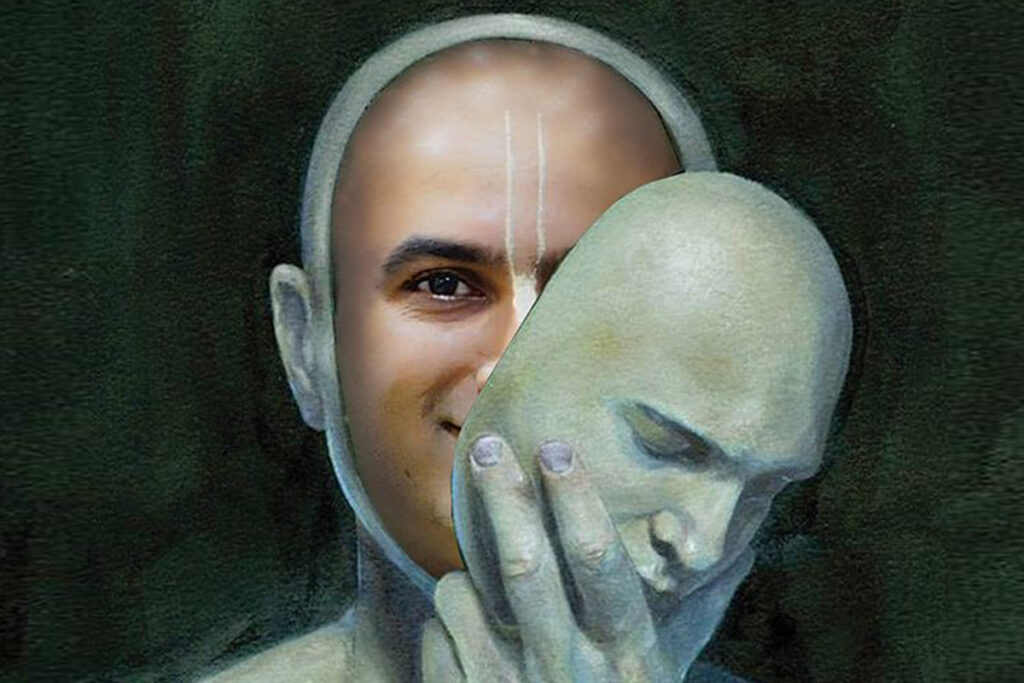
Ego is often considered a vice and is often despised. Everyone wants us to let go of our ego. However, at a deeper note, ego also denotes our sense of identity which is intrinsic to being a human. In this article, we shall explore ego as a sense of identity, the various ways in which it manifests and its relationship with the type of happiness we pursue.
Ego not only gives us a sense of identity but also binds us to that identity. It reinforces that identity by focusing our desires, thoughts and actions around that identity. If an individual identifies with profession, then all the desires, thoughts and actions get centered around improving and enjoying the profession and family is considered as a support to profession. On the other hand, for an individual who identifies with family, all the desires, thoughts and actions get centered around family and profession is considered as a support to family. The focus of our ego can be decoded by analysing the focal point of our desires, emotions and activities.
Ego can point either to an individual identity or a collective identity. An individual identity can refer to an individual role or an individual trait. One may identify with a profession like a manager, an engineer and a scientist. One may also identify with traits like intelligence, beauty and strength. A collective identity refer to feeling belongingness to a group like an organization, a race, and a country. While working at a company, one may identify oneself as an engineer whereas while watching an international sport event, one may identify oneself as citizen of a country.
Ego gives rise to different emotions like anger, greed, pride and envy. One becomes angry and insecure when a cherished identity gets threatened. Greed arises out of a desire to prolong and enhance a cherished identity. Someone may like to be identified as being wealthy and wants to become wealthier. Pride arises when one tends to seek recognition based on an identity. Envy arises when one perceives someone as a threat to a cherished identity and tries to destroy them. One generally likes participants from one’s own nation to win an international sports event and wish that participants from other nations to lose.
Ego And The Pursuit Of Happiness
An individual, in course of time, assumes different identities owing to different activities and relationships. For example, a grown up adult can have identities like employee, citizen, child, parent, spouse and a community member. However, at a given time, one focuses on a particular identity which influences one’s desires, thoughts, emotions and actions at that time. What determines the choice for such an identity? It is the amount of happiness, a particular identity promises to an individual. Every one of us is innately seeking happiness. At a given time, an individual focusses on that identity which he/she considers as the source of the greatest happiness at that given time. If someone feels that profession makes them more happy than family, they identify themselves as an employee rather than as a family member. If someone finds music more interesting than studies, then they identify themselves more as a musician than as a student. As a result, they put more energy and emotion in learning music than on studies.
Whatever identity, one adopts at a given time for seeking happiness, one wants to enhance the happiness and perpetuate that identity by all means. For instance, a youth wants to remain young forever. Whenever one finds that a particular identity is threatened, then one will try to adopt another identity that will fetch happiness. For instance, citizens of a war-torn country don’t mind immigrating to the neighbouring countries. One may also change identity when one finds another identity can fetch more happiness than the current one. For instance, a politician may not mind changing the party for better political prospects.
The ego can be either directed to oneself or others. When the ego is directed to oneself, the focus is on one’s own physical, emotional or intellectual gratification. When the ego is selfless or directed towards others, then one seeks to find happiness by making others happy through a given identity. An individual can identify oneself as an engineer either to make money or contribute to society. A group of students can come together either to enjoy themselves through indulgences and partying or offer service to the poor and needy.
There are two types of elements in nature – material and spiritual (Gita 7.4). Ego can be based on either a material identity or a spiritual identity. When it comes to material identity, the first thing which an individual identifies is the material body. Based on the desire to enjoy through material body, material identification and possessiveness expands (Bhag. 5.5.8). One begins to identify oneself as a spouse, friend, relative and parent and possessor of a house, vehicle and wealth. When it comes to spiritual identity, one understands oneself as atma, a spiritual being, covered externally by a body made of matter. A spiritualist focuses on detachment from body and other material identities and strive for emancipation or deepen one’s relationship with God.
False Ego Vs True Ego
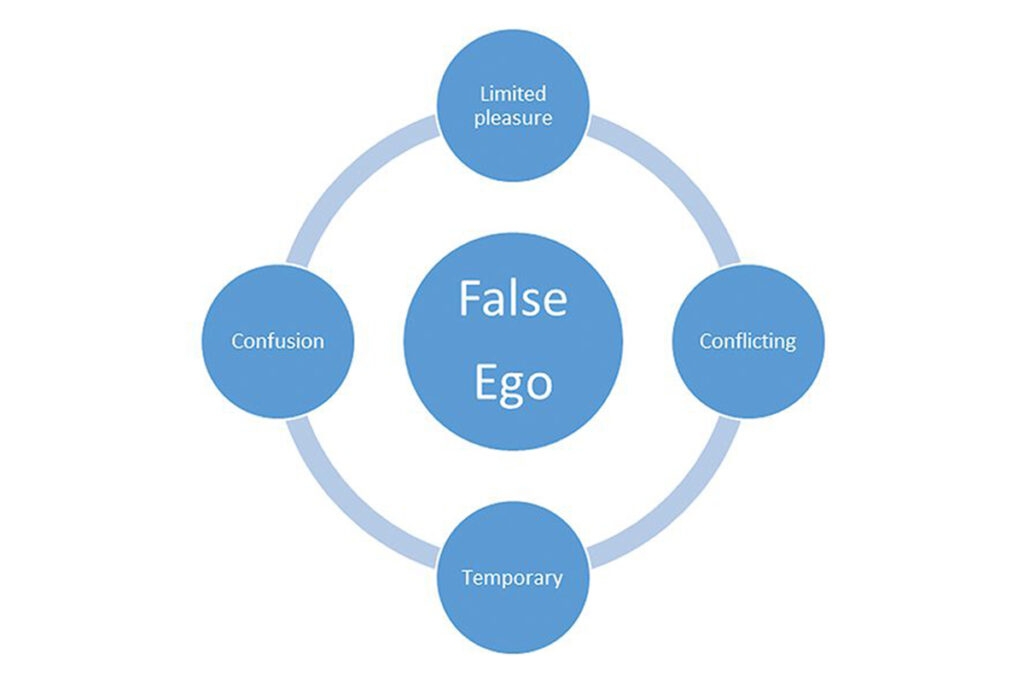
The material identities offer only limited pleasure, and the pleasure is also mixed with pain. For instance, for someone identifying as a child, parent can only provide a limited amount of pleasure in terms of toys, eatables and outings. In addition, the child experiences pain in form of competition from siblings and misunderstanding with parent and expectations getting frustrated. To ensure constant happiness, one must juggle between different material identities. One may like to be a successful employee and cherish the success and wealth it rewards. But, when some problems come up with boss and colleagues, one will switch to being a spouse. When some misunderstanding ensues with the spouse, one will switch to being a material body and binge on fast food and try to forget the pains of the past.
The material identities also often conflict with each other. A person is a son to his parents and a husband to his wife. If his wife and parents are not in good terms with each other, then he is forced to make a choice between the two. At a collective level, for a nation, its own interests may come in conflict with the interests of its allies, and it is forced to choose between the two or it may have to choose between two allies. The material identities are also temporary. One can be a child as long as the parent is there. One can be an employee only till retirement. One can imagine oneself a hero as long as the movie goes on. It is possible for one to identify with imaginary characters like in a movie, play and novel. Therefore, the ego based on material identity is called as false ego. Owing to this temporary and dual nature, an individual cannot cling on to a one material identity throughout. One is forced to choose between several identities at different times in life. This creates confusion, restlessness and lack of coherence.
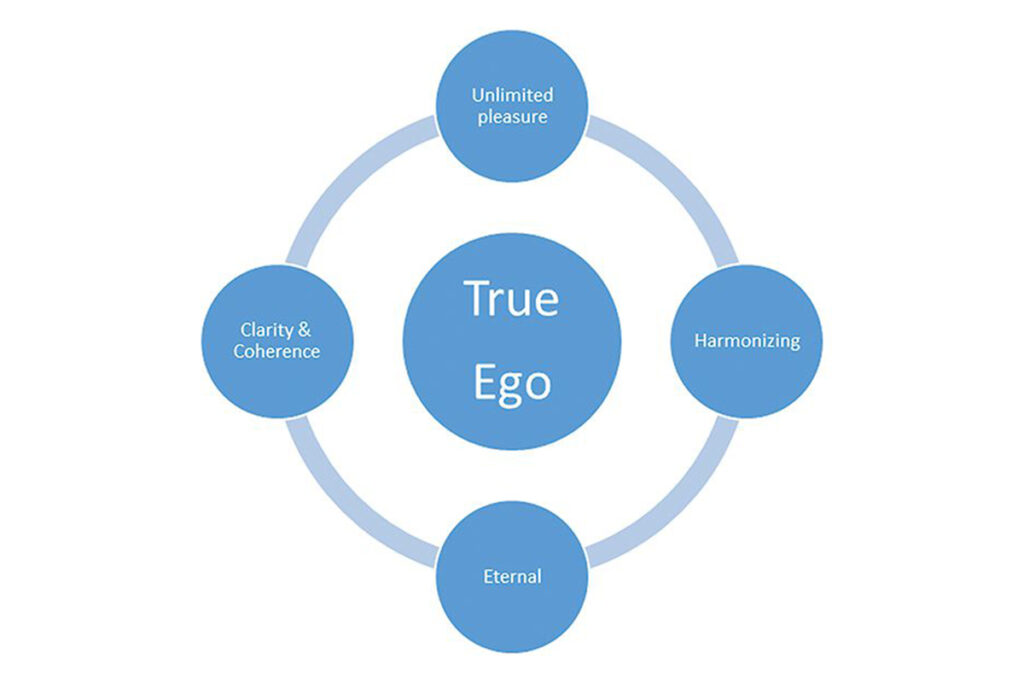
On the other hand, spiritual identity is rooted on an eternal platform. Both atma and God are eternal. The pleasure experienced in realization of atma and in relationship with God is eternal and never ending. It is not constrained by limitations of space and time. Therefore, the ego based on spiritual identity is called true ego. Moreover, since God is infinite, the pleasure experienced in relationship with God is also ever-increasing and infinite. Since God is the source of all creation, different worldly roles like of being an employee, child, parent, spouse and citizen can be harmonized when they are seen as different duties to God (BG 3.30). It becomes easy to resolve apparent conflicts between different roles. Conflicts can be resolved by re-orienting the conflicting parties towards the common purpose and highlighting the superficiality and temporary nature of the differences. This also helps one to get clarity and have a fixed purpose in life. One will be able to find coherence in various roles and various activities in life.
The Current Predicament
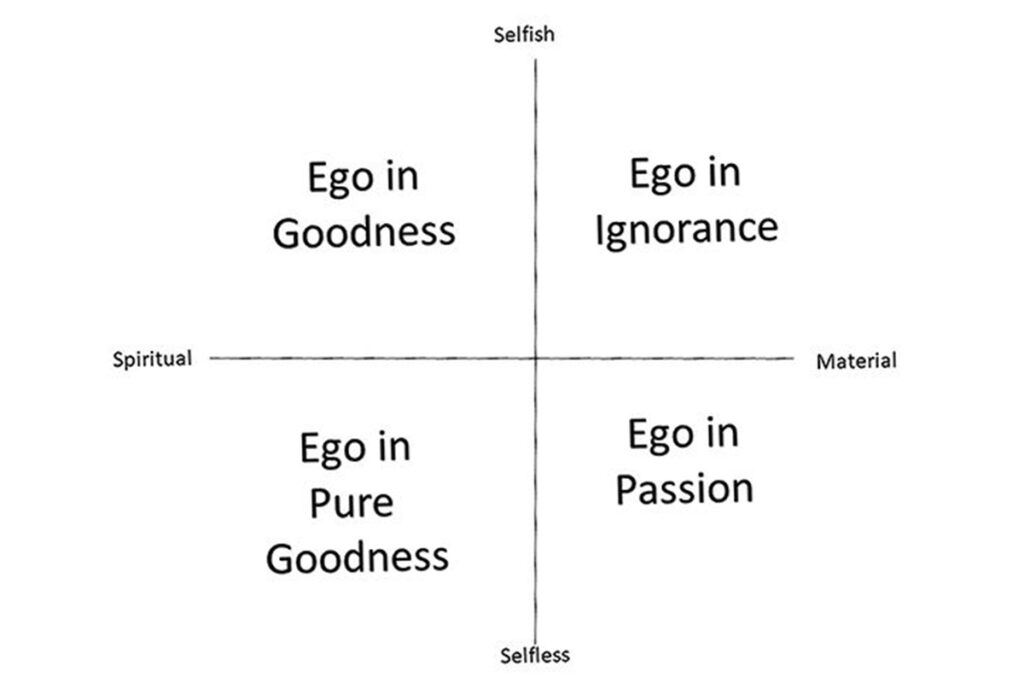
Both the material ego as well as the spiritual ego can be selfish or selfless. Let us first consider the case of material ego being selfish. In this case, one strongly identifies with one’s body and is concerned with one’s own sensual pleasure. Here, the individual is ready to forego ethics and inflict pain on others for sake of one’s own pleasure. This is called as egoistic hedonism. This can be considered as ego in mode of ignorance since there is no consideration of ethics and purpose is completely selfish (Gita 14.13). This can be possible at a collective also like in case of criminal gangs and extremist groups.
In the case of material selfless ego, the individual performs selfless acts like being charitable, dutiful and ethical but for hidden material motives like recognition, self-promotion and ethics washing (to whitewash a previous mistake). The main motivation here is the material outcome and not the intention of helping others. This is called as ethical hedonism. Since the motivation here is selfish enjoyment, this can be considered as ego in mode of passion (Gita 14.12). At a collective level, this can be present in an organization green washing its illegal practices and a country externally waging a war on terrorism but with an intention to increase its world dominance and acquire more resources.
When the ego is spiritual but selfish, one is focussed on one’s own purification from material contamination and emancipation from the material realm. One is also committed to worshipping God but with prime intention of getting emancipation. The individual is well-versed in the spiritual texts and follows the laws of God with respect to acting in the world like being truthful, kind and moral, but with the sole intention of avoiding further entanglement with matter and achieving liberation. This can be seen in devout spiritual practitioners who has simple lifestyle with minimal interaction with the outside world and focus on study and meditation. Since this includes spiritual knowledge and pursuit of self-realization, this can be considered as ego in mode of goodness.
When the ego is spiritual and selfless, one identifies oneself as a servant of the all-attractive God – Krishna. One devotes all of one’s activities (both spiritual and worldly) for worship of Krishna with sole intention of pleasing Krishna and deepening one’s devotion. The individual sees all the living beings as children of God and deals with them with compassion and morality. This can be seen in those who devote their life in service to God and spreading the message of God to others. This can be considered as ego in mode of pure goodness which is beyond the influence of goodness, passion and ignorance.
The current society is dominated by the modes of passion and ignorance. As a result, there is predominance of selfishness and hypocrisy in relationships. This is evident in the increasing divorce rate at an individual level and the increasing instability and war-like situations between various nations at a collective level. Because of rampant materialism and one-sided focus on material ego and negligence in development of spiritual ego, there is lot of stress, confusion and lack of purpose in the lives of people. It is important to focus on the development of spiritual ego both at an individual as well as collective level.
Transforming Material Ego
Transforming material ego into spiritual ego needs detachment and practice (BG 6.35). One needs to regulate and restrict activities that reinforce material ego. The activities in mode of ignorance which are unethical need to be completely avoided. The activities in mode of passion which are ethical but selfish like sensual indulgence need to be regulated. One also needs to reduce exposure to people and stimuli that incite material selfishness like advertisements and other forms of such entertainment. As long as, one has a material body, one will have material ego but that should not dictate the purpose of life. It should be a means to achieve the purpose of life defined by spiritual ego.
Cultivation of spiritual ego entails identifying oneself as servant of God and acting in that capacity. Our attraction to Krishna and service to Krishna is enhanced by chanting God’s names, hearing about God from devotional texts like Srimad-Bhagavatam and Bhagavad-gita and worship of God in his deity form. This also purifies one from the misidentification with the body. One need abstain from worldly activities and worldly relationships but carry them in divine consciousness with a mood of contribution rather than gratification.
Rukmini Vallabha Dasa, a disciple of His Holiness Radhanath Swami, began practicing Krishna consciouness in 2010 and serves full time at ISKCON Pune. He is a research student at Bhaktivedanta Research Center, Mumbai and blogs at https://spiritualwisdomonline.com