Stop Calling It Love. If it’s Dependency!

Free to Read
9 mins September, 2026
00:00
00:00

The more you need someone to feel whole,  
the more you trade love for dependency. 


By Ashutosh Patnaik 


People often claim they love fish. But do they really? If they loved the fish, they wouldn’t hook it, drag it out of its world, let it suffocate, throw it on ice, and consume it. Love, by nature, preserves—it doesn’t exploit. What they actually love is the taste, not the fish. A rather sadistic expression of love, isn’t it? 


That’s a fundamental psychological mislabeling—we confuse what pleases us with what we love. And that confusion is all over our relationships. 


When someone says, “I love you,” too often they mean, “I love how you make me feel.” But when the emotional high fades—and it inevitably does—they say, “I fell out of love.” That phrase reveals something deeper: they didn’t truly love the person; they loved the experience that person gave them, because initial experiences in any relationship are akin to sugar rush—one that tends to crush. Therefore, in the Bhagavad-gita, Krishna doesn’t endorse that kind of emotional intoxication. He exposes it for what it is — fleeting & fragile. “The pleasures that arise from contact with the senses are sources of suffering. They have a beginning and an end.” (Gita 5.22) 


That’s a bitter truth. The high wears off. And when people are immature, when they’ve never faced themselves, they confuse that emotional withdrawal with the end of love. The Gita advocates for something else—what we might call conscious, sacrificial love. Not falling in love but walking in love. That’s not easy. Walking takes attention, discipline, and responsibility. You don’t “fall” into a meaningful love. You grow and you build it. 


This ideal of love — intentional, enduring, and selfless — is vividly portrayed in the Srimad-Bhagavatam through the gopis of Vrindavan. Their love for Krishna wasn’t impulsive or dependent on fleeting emotion. It was unwavering, rooted in spiritual connection rather than personal gratification. When Krishna left to fulfill His divine duties, they neither replaced Him nor resented Him. Their love didn’t diminish; in fact, it deepened. Why? Because it wasn’t transactional. They didn’t love Him for validation or emotional comfort. They loved Him for who He is — their eternal beloved, the Supreme Lord. 


This kind of love stands in stark contrast to today’s relationship culture, shaped by overhyped portrayals of romance and dramatized affection. We are conditioned to believe love is about being completed by someone else — without ever completing ourselves first. That’s why so many enter relationships hoping to feel “full,” but end up feeling emptier than before.


From Loneliness to Endearing Love: The Path of Surrender


Here’s an unsettling but necessary truth: when a person constantly seeks a partner to fix their loneliness, they’re already in danger, not just emotionally but existentially. That kind of emptiness sends a signal out into the world — and the sharks of lust, addiction, and codependency circle in. They feed on that kind of ache. 


But loneliness is not necessarily a sign that one needs another person. More often, it is a deeper call — a call to know about our spiritual nature, and ultimately, our eternal relationship with the Supreme Lord. 


The Bhagavad-gita, though set on a battlefield, speaks not just to warriors, but to all who stand at the crossroads of confusion and longing. It does not urge the seeker to find a soulmate, but to find the soul’s true beloved: the all-attractive Lord, Sri Krishna. 


Rather than chasing love in the external world, Krishna urges the cultivation of refined spiritual intelligence that sees through illusion and turns inward. He directs the heart toward sva-dharma — to engage in devotion wherein He reveals a higher vision of duty, selflessness, and divine connection. And at the heart of that vision is saranagati — seeking devotional shelter of the Lord. 


Because without surrender, the alternatives — ego, desire, control — bind us. We keep chasing love, power, recognition, security… and still feel empty. Krishna calls for surrender not to take anything from us, but to give us everything that’s real. He’s not a taker; He’s the supreme reciprocator. When we surrender, it means we stop placing ourselves at the center and let the actual center — God — take His rightful place. That shift changes everything. 


Srila Bhaktivinoda Thakur writes: Atma-nivedana, tuwa pade kori, eho mana-sukha pai: “I offer my soul unto Your lotus feet, and in that surrender, I find real happiness.” To him, surrender is not the end of desire but its purification. It transforms love from a need-based emotion into a divine offering. Instead of seeking love to fill a void, the surrendered soul becomes an instrument of love itself. 


The saranagati path teaches us to stop chasing love in the world and start anchoring love in divine service. And once we learn that, our human relationships begin reflecting it — less grasping, more giving; less judging, more understanding; less hurting, more healing. Such love, rooted in surrender and free from self-centered desire, is not a distant ideal — it’s a lived reality in the bhakti tradition. 


Be the Voice That Sparks True Love


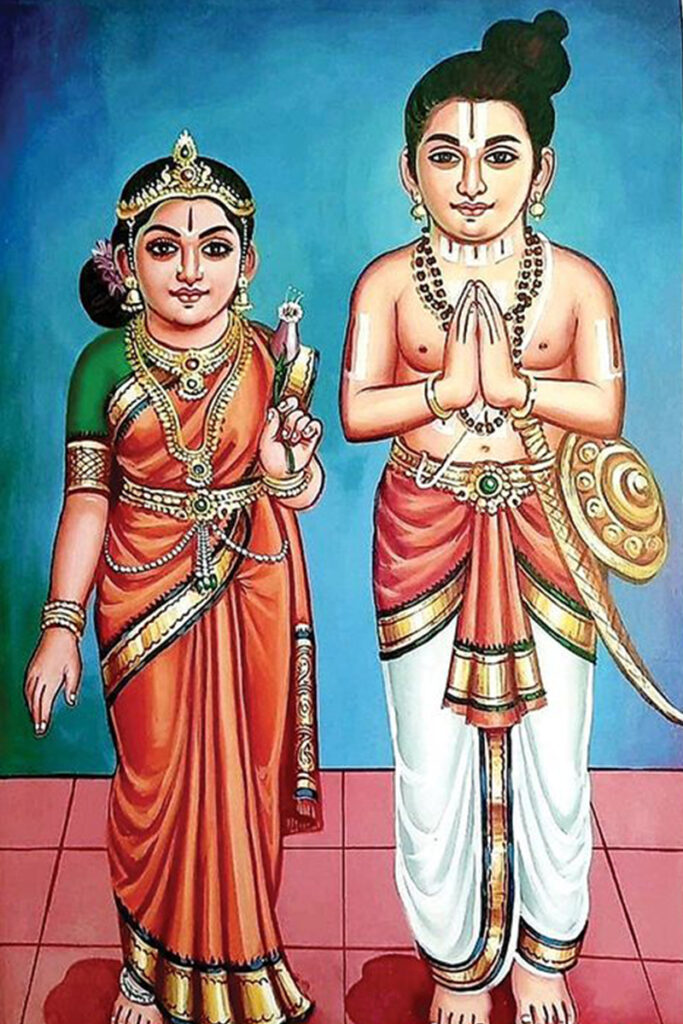
A shining example is the story of Thirumangai Alvar, one of the twelve revered poet-saints of South India. Born as Neelan, a proud and powerful chieftain under Chola royalty, he was renowned for his valor and ambition. But everything changed when he encountered Kumudavalli, a humble and devout Vaishnavi. 


Captivated by her simplicity, he proposed to marry her. But as an independent woman of respect in society and with her heart centered on Lord Narayana, she agreed to marry him only under one condition: not wealth, not prestige, not attention but devotional service. He must feed 1,000 Vaishnavas every day for an extended period as an act of devotion to Lord Narayana. 


Neelan, inspired by love, cultivated the desire to serve the Vaishnavas, agreed and began this massive charity. As time went on, his wealth couldn’t sustain it. That’s the power of service. Neelan for the first time found helpless to serve the devotees of the Lord.  


During one such desperate days where he had exhausted his resources, he tried to exact valuables from a group of travelers. But it was in fact, Lord Narayana and His consort disguised as travelers to test Neelan. As he tried to draw their ornaments, he couldn’t remove the anklet from the lotus feet of the Lord. Perplexed, he tried all his means, but to no avail. That’s when the Lordships revealed their true form and granted Neelan divine wisdom and grace — transforming him into Thirumangai Alvar.  


What began as a romantic pursuit became a spiritual awakening. Neelan’s love evolved from possession to sacrifice, from attraction to realization. Through devotional service, his heart softened and, in time he was blessed with divine grace — becoming Thirumangai Alvar, a saint whose poetry and surrender continue to inspire seekers even today. 


Kumudavalli wasn’t just a woman he loved—she was the light that redirected his passion toward divine purpose. Her spiritual conviction awakened within Neelan the dormant service spirit towards the Lord.  


Don’t Look for Completion—Look for Connection


Before connecting with another soul, the Vaishnava acaryas tell us to connect with the Supreme Soul first, because only a heart full of devotion has enough strength to fully love another human being unconditionally. In a world where relationships often revolve around need, chemistry, or comfort, Kumudavalli’s example reminds us that the highest love calls us to become more, not just feel more. 


Kumudavalli was that voice for Thirumangai Alvar. Who are we becoming in the name of love? And are we, like her, courageous enough to motivate our loved ones to come closer to the divine? Or are we critical and mean or perhaps too secular to connect our loved ones with the Lord?  


Here’s the brutal reality: if we enter a relationship hoping it will heal our trauma, we’re setting ourself and our partner up for failure. Romance doesn’t resolve our existential crisis. If anything, it magnifies it. That’s the principle: marriage is a magnifier. If we’re anxious, insecure, addicted, those issues will not magically dissolve in marriage. They will metastasize. 


Love that doesn’t elevate will eventually exhaust. Kumudavalli’s life shows that the most fulfilling relationships are not about completing each other. They’re about connecting both hearts to something higher—to the Lord, the perennial fountainhead of all that is love. 


And this isn’t just abstract theology—it’s practical psychology. We project our unmet emotional needs onto our partners. We expect them to be gods. There’s an old story about a woman who said, “Before we got married, he called me a goddess. After we got married, he became an atheist.” That’s what happens when we confuse romance for fulfillment. 

Love Is Not Dependency!


It won’t be an overreach to say that many men look for a wife who can mother them, and women look for a husband who can father them. At its core, this reflects an unspoken expectation: the desire for a partner to nurture, heal, and protect. But here’s the truth: no human being, no matter how loving or capable, can truly fill those deep emotional or spiritual voids. 


When we meet our Creator first, our heart is filled, and we no longer expect our mate to serve our emotional vacuum. We don’t seek validation or solace from them. Instead, we learn to serve them with grace, with the heart of a partner who is already full of love. We can give them our best without expecting anything in return, because our heart is already at peace with the Divine. 


This is how real love operates—not out of need, but out of overflow. It’s about serving, not seeking to be served. It’s about walking with someone, not clinging to them to feel whole. True love doesn’t demand—it gives, carries, uplifts. 


True Intimacy Isn’t Just Based on Needs!


Real intimacy comes when both partners are walking their own paths of spiritual growth and are equally devoted to something greater than themselves. That’s when love becomes more than just emotional comfort — it becomes a sacred partnership. 


Popular self-help advice often centers around meeting each other’s “love languages”: time, gifts, words, or touch. While these are helpful tools, they’re incomplete if the relationship lacks spiritual orientation. Because here’s the truth: even if one gives someone quality time, thoughtful gifts, or affectionate touch, if that love is rooted in expectation or subtle emotional debt (“I did this, so I should get that”), then you’re still operating in the realm of transaction, not transformation. 


This is not to dismiss emotional needs—but to reframe them. Instead of treating a partner as a source of constant validation or healing, both individuals are invited to become a witness and supporter of each other’s growth. You’re not just trying to be understood—you’re trying to become someone worth understanding. 


And ironically, when you’re not clinging to your needs, your partner becomes freer to meet them—not out of obligation, but out of love. 


So perhaps, before demanding to be loved—by partners, friends, or even the world— it’s worth asking a more basic question: have we first turned toward the Source of Love itself? Because unless we begin there, unless we willingly shoulder the responsibility of aligning with that which is higher, we remain lost — seeking validation from those just as broken as we are. 


Love in its purest sense is not merely an emotion; it is a sacred offering of self in the service of the Lord. And maybe — just maybe — the order we crave in our fractured lives begins not by chasing human affection, but by anchoring ourselves in devoted surrender to the all-loving Krishna, the Supreme Personality of Godhead, from whom all love eternally flows. 


Ashutosh Patnaik is a senior associate working in an MNC. He holds a master’s degree in finance. Besides work, he is an avid reader and writer in the genre of contemporary-cum-devotional subjects and a frequent contributor to BTG. 

Subscribe to BTG Digital Magazine

Embark on your path to Krishna consciousness with BTG Digital Magazine! Subscribe now and discover inspiring stories of growth, enlightenment, and connection shared by our community.

Subscribe

Stop Calling It Love. If it’s Dependency!

Stop Calling It Love.  If it’s Dependency!
Listen to Article
Press Play to listen

The more you need someone to feel whole,  
the more you trade love for dependency. 


By Ashutosh Patnaik 


People often claim they love fish. But do they really? If they loved the fish, they wouldn’t hook it, drag it out of its world, let it suffocate, throw it on ice, and consume it. Love, by nature, preserves—it doesn’t exploit. What they actually love is the taste, not the fish. A rather sadistic expression of love, isn’t it? 


That’s a fundamental psychological mislabeling—we confuse what pleases us with what we love. And that confusion is all over our relationships. 


When someone says, “I love you,” too often they mean, “I love how you make me feel.” But when the emotional high fades—and it inevitably does—they say, “I fell out of love.” That phrase reveals something deeper: they didn’t truly love the person; they loved the experience that person gave them, because initial experiences in any relationship are akin to sugar rush—one that tends to crush. Therefore, in the Bhagavad-gita, Krishna doesn’t endorse that kind of emotional intoxication. He exposes it for what it is — fleeting & fragile. “The pleasures that arise from contact with the senses are sources of suffering. They have a beginning and an end.” (Gita 5.22) 


That’s a bitter truth. The high wears off. And when people are immature, when they’ve never faced themselves, they confuse that emotional withdrawal with the end of love. The Gita advocates for something else—what we might call conscious, sacrificial love. Not falling in love but walking in love. That’s not easy. Walking takes attention, discipline, and responsibility. You don’t “fall” into a meaningful love. You grow and you build it. 


This ideal of love — intentional, enduring, and selfless — is vividly portrayed in the Srimad-Bhagavatam through the gopis of Vrindavan. Their love for Krishna wasn’t impulsive or dependent on fleeting emotion. It was unwavering, rooted in spiritual connection rather than personal gratification. When Krishna left to fulfill His divine duties, they neither replaced Him nor resented Him. Their love didn’t diminish; in fact, it deepened. Why? Because it wasn’t transactional. They didn’t love Him for validation or emotional comfort. They loved Him for who He is — their eternal beloved, the Supreme Lord. 


This kind of love stands in stark contrast to today’s relationship culture, shaped by overhyped portrayals of romance and dramatized affection. We are conditioned to believe love is about being completed by someone else — without ever completing ourselves first. That’s why so many enter relationships hoping to feel “full,” but end up feeling emptier than before.


From Loneliness to Endearing Love: The Path of Surrender


Here’s an unsettling but necessary truth: when a person constantly seeks a partner to fix their loneliness, they’re already in danger, not just emotionally but existentially. That kind of emptiness sends a signal out into the world — and the sharks of lust, addiction, and codependency circle in. They feed on that kind of ache. 


But loneliness is not necessarily a sign that one needs another person. More often, it is a deeper call — a call to know about our spiritual nature, and ultimately, our eternal relationship with the Supreme Lord. 


The Bhagavad-gita, though set on a battlefield, speaks not just to warriors, but to all who stand at the crossroads of confusion and longing. It does not urge the seeker to find a soulmate, but to find the soul’s true beloved: the all-attractive Lord, Sri Krishna. 


Rather than chasing love in the external world, Krishna urges the cultivation of refined spiritual intelligence that sees through illusion and turns inward. He directs the heart toward sva-dharma — to engage in devotion wherein He reveals a higher vision of duty, selflessness, and divine connection. And at the heart of that vision is saranagati — seeking devotional shelter of the Lord. 


Because without surrender, the alternatives — ego, desire, control — bind us. We keep chasing love, power, recognition, security… and still feel empty. Krishna calls for surrender not to take anything from us, but to give us everything that’s real. He’s not a taker; He’s the supreme reciprocator. When we surrender, it means we stop placing ourselves at the center and let the actual center — God — take His rightful place. That shift changes everything. 


Srila Bhaktivinoda Thakur writes: Atma-nivedana, tuwa pade kori, eho mana-sukha pai: “I offer my soul unto Your lotus feet, and in that surrender, I find real happiness.” To him, surrender is not the end of desire but its purification. It transforms love from a need-based emotion into a divine offering. Instead of seeking love to fill a void, the surrendered soul becomes an instrument of love itself. 


The saranagati path teaches us to stop chasing love in the world and start anchoring love in divine service. And once we learn that, our human relationships begin reflecting it — less grasping, more giving; less judging, more understanding; less hurting, more healing. Such love, rooted in surrender and free from self-centered desire, is not a distant ideal — it’s a lived reality in the bhakti tradition. 


Be the Voice That Sparks True Love


A shining example is the story of Thirumangai Alvar, one of the twelve revered poet-saints of South India. Born as Neelan, a proud and powerful chieftain under Chola royalty, he was renowned for his valor and ambition. But everything changed when he encountered Kumudavalli, a humble and devout Vaishnavi. 


Captivated by her simplicity, he proposed to marry her. But as an independent woman of respect in society and with her heart centered on Lord Narayana, she agreed to marry him only under one condition: not wealth, not prestige, not attention but devotional service. He must feed 1,000 Vaishnavas every day for an extended period as an act of devotion to Lord Narayana. 


Neelan, inspired by love, cultivated the desire to serve the Vaishnavas, agreed and began this massive charity. As time went on, his wealth couldn’t sustain it. That’s the power of service. Neelan for the first time found helpless to serve the devotees of the Lord.  


During one such desperate days where he had exhausted his resources, he tried to exact valuables from a group of travelers. But it was in fact, Lord Narayana and His consort disguised as travelers to test Neelan. As he tried to draw their ornaments, he couldn’t remove the anklet from the lotus feet of the Lord. Perplexed, he tried all his means, but to no avail. That’s when the Lordships revealed their true form and granted Neelan divine wisdom and grace — transforming him into Thirumangai Alvar.  


What began as a romantic pursuit became a spiritual awakening. Neelan’s love evolved from possession to sacrifice, from attraction to realization. Through devotional service, his heart softened and, in time he was blessed with divine grace — becoming Thirumangai Alvar, a saint whose poetry and surrender continue to inspire seekers even today. 


Kumudavalli wasn’t just a woman he loved—she was the light that redirected his passion toward divine purpose. Her spiritual conviction awakened within Neelan the dormant service spirit towards the Lord.  


Don’t Look for Completion—Look for Connection


Before connecting with another soul, the Vaishnava acaryas tell us to connect with the Supreme Soul first, because only a heart full of devotion has enough strength to fully love another human being unconditionally. In a world where relationships often revolve around need, chemistry, or comfort, Kumudavalli’s example reminds us that the highest love calls us to become more, not just feel more. 


Kumudavalli was that voice for Thirumangai Alvar. Who are we becoming in the name of love? And are we, like her, courageous enough to motivate our loved ones to come closer to the divine? Or are we critical and mean or perhaps too secular to connect our loved ones with the Lord?  


Here’s the brutal reality: if we enter a relationship hoping it will heal our trauma, we’re setting ourself and our partner up for failure. Romance doesn’t resolve our existential crisis. If anything, it magnifies it. That’s the principle: marriage is a magnifier. If we’re anxious, insecure, addicted, those issues will not magically dissolve in marriage. They will metastasize. 


Love that doesn’t elevate will eventually exhaust. Kumudavalli’s life shows that the most fulfilling relationships are not about completing each other. They’re about connecting both hearts to something higher—to the Lord, the perennial fountainhead of all that is love. 


And this isn’t just abstract theology—it’s practical psychology. We project our unmet emotional needs onto our partners. We expect them to be gods. There’s an old story about a woman who said, “Before we got married, he called me a goddess. After we got married, he became an atheist.” That’s what happens when we confuse romance for fulfillment. 


Love Is Not Dependency!


It won’t be an overreach to say that many men look for a wife who can mother them, and women look for a husband who can father them. At its core, this reflects an unspoken expectation: the desire for a partner to nurture, heal, and protect. But here’s the truth: no human being, no matter how loving or capable, can truly fill those deep emotional or spiritual voids. 


When we meet our Creator first, our heart is filled, and we no longer expect our mate to serve our emotional vacuum. We don’t seek validation or solace from them. Instead, we learn to serve them with grace, with the heart of a partner who is already full of love. We can give them our best without expecting anything in return, because our heart is already at peace with the Divine. 


This is how real love operates—not out of need, but out of overflow. It’s about serving, not seeking to be served. It’s about walking with someone, not clinging to them to feel whole. True love doesn’t demand—it gives, carries, uplifts. 


True Intimacy Isn’t Just Based on Needs!


Real intimacy comes when both partners are walking their own paths of spiritual growth and are equally devoted to something greater than themselves. That’s when love becomes more than just emotional comfort — it becomes a sacred partnership. 


Popular self-help advice often centers around meeting each other’s “love languages”: time, gifts, words, or touch. While these are helpful tools, they’re incomplete if the relationship lacks spiritual orientation. Because here’s the truth: even if one gives someone quality time, thoughtful gifts, or affectionate touch, if that love is rooted in expectation or subtle emotional debt (“I did this, so I should get that”), then you’re still operating in the realm of transaction, not transformation. 


This is not to dismiss emotional needs—but to reframe them. Instead of treating a partner as a source of constant validation or healing, both individuals are invited to become a witness and supporter of each other’s growth. You’re not just trying to be understood—you’re trying to become someone worth understanding. 


And ironically, when you’re not clinging to your needs, your partner becomes freer to meet them—not out of obligation, but out of love. 


So perhaps, before demanding to be loved—by partners, friends, or even the world— it’s worth asking a more basic question: have we first turned toward the Source of Love itself? Because unless we begin there, unless we willingly shoulder the responsibility of aligning with that which is higher, we remain lost — seeking validation from those just as broken as we are. 


Love in its purest sense is not merely an emotion; it is a sacred offering of self in the service of the Lord. And maybe — just maybe — the order we crave in our fractured lives begins not by chasing human affection, but by anchoring ourselves in devoted surrender to the all-loving Krishna, the Supreme Personality of Godhead, from whom all love eternally flows. 


Ashutosh Patnaik is a senior associate working in an MNC. He holds a master’s degree in finance. Besides work, he is an avid reader and writer in the genre of contemporary-cum-devotional subjects and a frequent contributor to BTG.