


What if detachment could make us more loving, not less?
The Bhagavad-gita’s wisdom reveals how emotional steadiness
and purposeful commitment can transform our relationships.
By Chaitanya Carana Dasa
When we face difficulties in relationships, we may wonder, “Should I just become detached?”
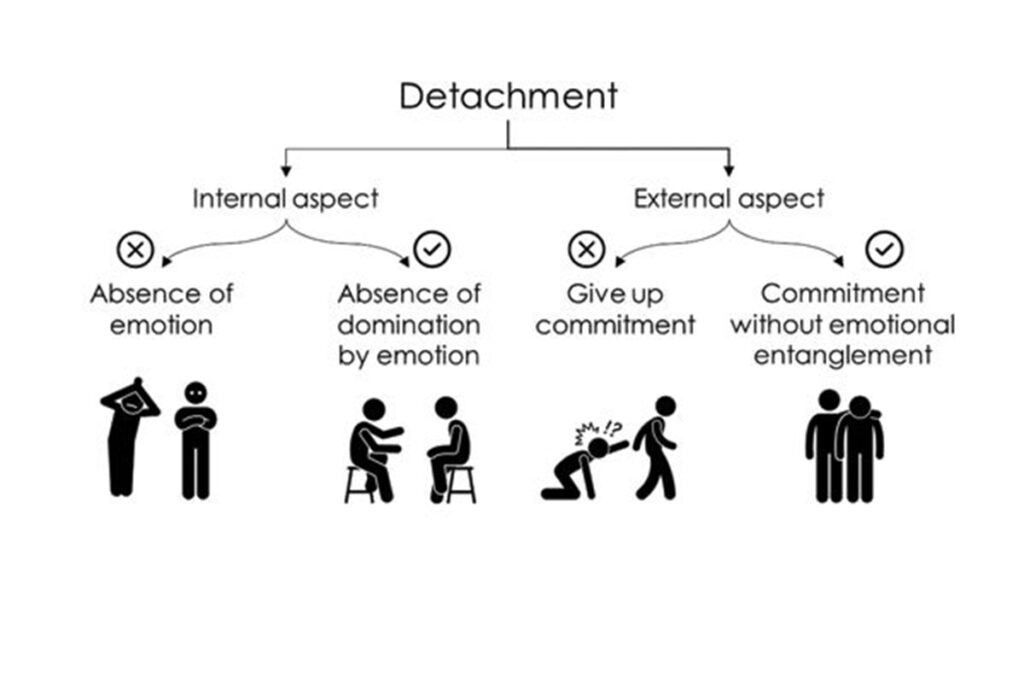
Before answering that question, we need to first understand what detachment is and what it isn’t. Let’s explore a two-part understanding of detachment based on its internal and external aspects. Internally, detachment is not absence of emotion; it is absence of domination by emotion. Externally, such detachment manifests as commitment without emotional entanglement.
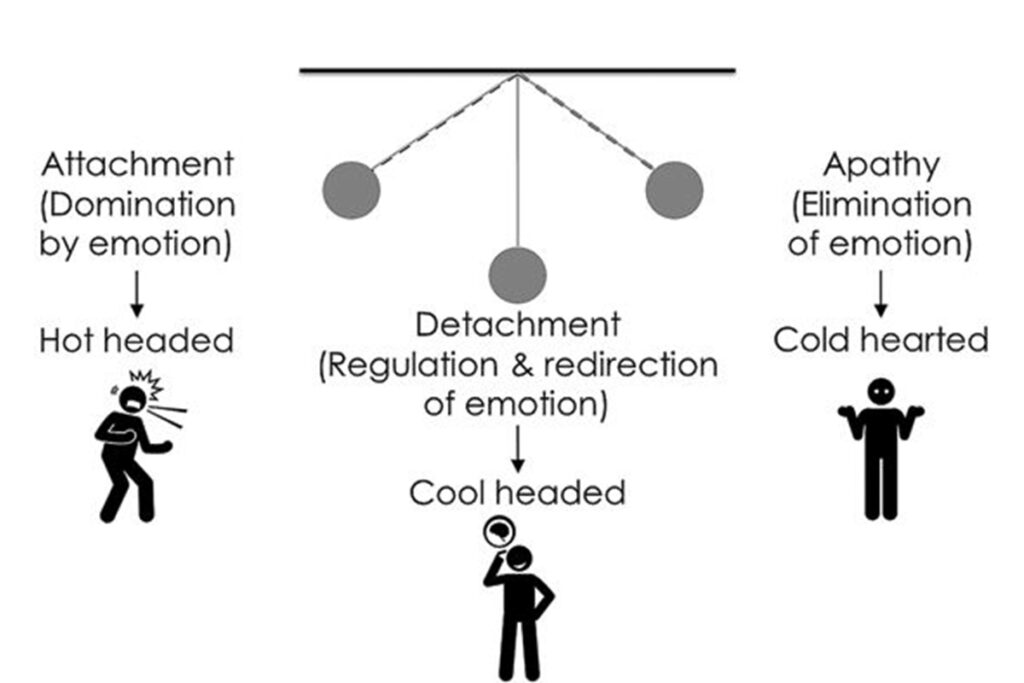
To better appreciate these two aspects of detachment, let’s first explore its opposite: attachment. We all have probably seen someone who is excessively emotionally entangled in some relationship. Maybe a parent who pampers their child so much that the child becomes entitled and spoiled. Maybe a spouse who submits to every demand of their partner, no matter how unreasonable. Attached people think with their feelings alone, even at the cost of reason and responsibility. Thus, their feelings become their failings.
What would be the opposite of attachment? The answer might seem obvious: detachment.
Not necessarily.
Whenever there is an excess of something—in this case, emotion—its opposite may manifest in different ways. This is where the Bhagavad-gita’s framework of the three gunas can help us.
APATHY: THE TAMASIC REACTION TO ATTACHMENT
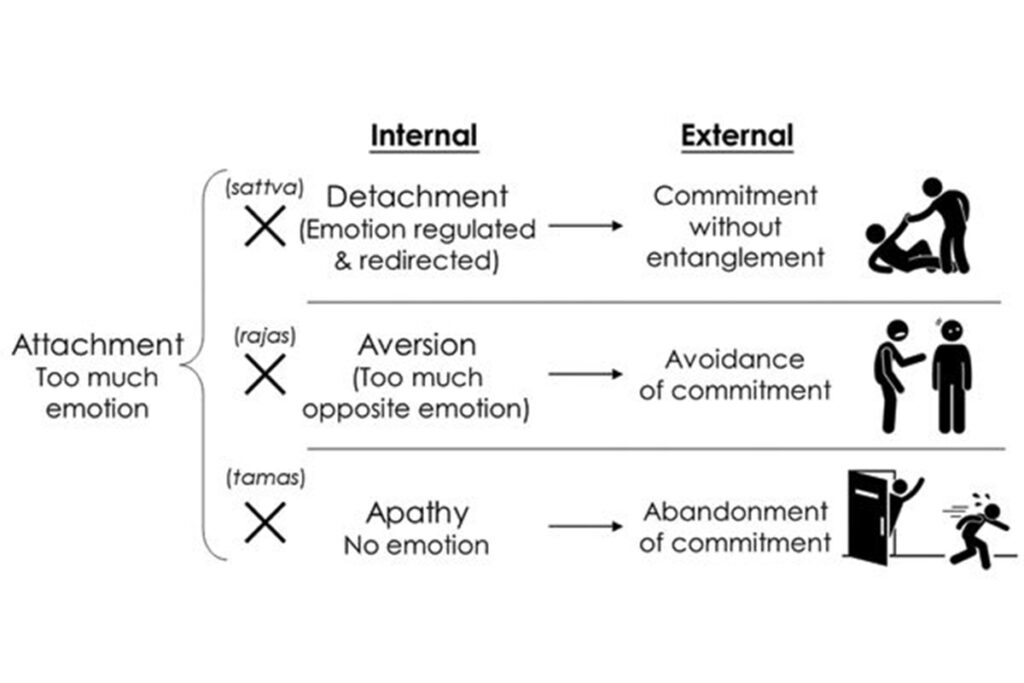
Suppose a person is inordinately influenced by tamas. If they become frustrated by the excessive emotion that characterizes attachment, they may gravitate toward giving up emotion altogether. They may think they have become detached, but what they have actually become is apathetic. To protect themselves from being further disappointed or hurt, they make themselves numb—emotionally deadened toward the very person they were previously obsessed with.
Suppose a parent is very attached to a child and does a great deal for that child. However, the child not only fails to reciprocate but, on becoming an adult, rejects the parent and wants nothing to do with them. Then the attached parent may be so stung by that rejection that they stop caring for the child.
Their internal apathy expresses itself externally as the abandonment of responsibility. If the child needs the parent during some emergency, the parent may simply refuse to get involved. Thus, frustrated attachment in tamas is characterized by no emotion and no motion. Pertinently, the Bhagavad-gita 18.7 cautions against such numbness, describing it as renunciation in tamas.
Apathy is often rooted not in detachment but in frustration. A person may stop investing emotionally in relationships, not because they have transcended the desire for connection, but because repeated disappointments have left them feeling that meaningful connection is unattainable. They may still desire affection, understanding, and companionship, yet feel unable to obtain them.
In this sense, apathy is like starving, whereas detachment is like fasting. A starving person still desires food but lacks the ability to obtain it. A fasting person has the ability to eat but voluntarily chooses not to. Similarly, an apathetic person still longs for emotional connection but feels incapable of attaining it, whereas a detached person has the capacity to connect deeply yet can choose not to become emotionally dependent. Thus, frustration is no more detachment than starving is fasting.
AVERSION: THE RAJASIC REACTION TO ATTACHMENT
Suppose a person is inordinately influenced by rajas. When their attachment is frustrated, they will find apathy or abandonment too passive; the energy triggered by rajas will make them want to feel and do something. Thus, they may go from being forcefully attracted to the other person to becoming forcefully repelled by that person. For them, the opposite of attachment becomes aversion. While apathy removes emotion, aversion reverses the direction of emotion.
Attachment drives a person to please, placate, or pander to the other, but aversion drives a person to avoid, reject, or push them away—even at the cost of reason and responsibility. Thus, attachment and aversion both operate at the same level of consciousness where emotion determines actions. The Bhagavad-gita 18.8 cautions against such rajasic renunciation.
This attachment–aversion oscillation is often seen in love-hate relationships, especially in romantic contexts. Two people may once have looked at each other with unconcealed longing while exchanging engagement rings. Later, those very people may glare across an attorney’s table with unconcealed hatred.
Their aversion, which is an internal emotion, may frequently express itself externally through avoidance, where the person refuses to go anywhere the other person is likely to be present. In its more aggressive versions, aversion may manifest as vengefulness or vindictiveness. One person may constantly bad-mouth the other person or even connive to plant rumors, damage their reputation, or assassinate their character.
When aversion turns into aggression in a marital relationship where children are involved, the effects can be toxic. If the children are in shared custody and each parent bad-mouths the other while the child is with them, the poor child may suffer severe or even irreparable emotional damage by being caught in the crossfire of the parents’ mutual animosity.
DETACHMENT: THE SATTVIKA RESPONSE TO ATTACHMENT
When one is steadily situated in sattva, their response to attachment is the healthiest. When attachment decreases, they do not descend into apathy or aversion. Instead, they move toward authentic detachment, where they regulate their emotions when necessary according to their obligations and redirect their emotions when necessary according to their higher purpose.
Detachment frees us from the drama and trauma that arise when we are dominated by emotions, whether attraction or repulsion. It raises us to a level where emotion remains a component of decision-making, but not its sole decider. Emotion never overrides all other considerations; it gets neither the autocratic power to say yes, nor the veto power to say no.
When emotions are regulated, a person can externally engage in healthy relationships and discharge responsibilities even if the other person does not reciprocate properly. Thus, for example, a husband may continue to take care of his wife and children even if they don’t appreciate him adequately. The Bhagavad-gita (18.9) commends such detached dutifulness as renunciation in sattva.
Thus, detachment enables us to act rationally and responsibly. And that is the external manifestation of detachment—commitment without emotional entanglement.
How can we know that our engagement and commitment are free from emotional entanglement? The test is time; when the proper time comes, can we disengage from commitment without too much emotional upheaval?
This was, in fact, the principle behind retirement (vanaprastha) and renunciation (sannyasa) in the traditional Vedic system of varnasrama. A householder, after duly discharging responsibilities through appropriate regulation of emotions, redirects emotions toward higher spiritual pursuits and ultimately toward the divine.
COOL HEAD, NOT COLD HEART
Among these three opposites of attachment—apathy (nirveda) in tamas, aversion (dvesha) in rajas, and detachment (anasakti) in sattva—aversion is rarely misunderstood to be detachment because it features such strong emotions. However, apathy can sometimes be mistaken for detachment. To clearly differentiate between apathy and actual detachment, let us consider the role emotion plays in a relationship through the metaphor of a pendulum.
At the left extreme of the pendulum is domination by emotion. The further left we move, the more emotion dominates us, and at the extreme left lies attachment. On the right side of the pendulum is too little emotion. At the extreme right is the absence of emotion, which is apathy. The balanced middle state of the pendulum is detachment, where emotion is regulated and redirected.
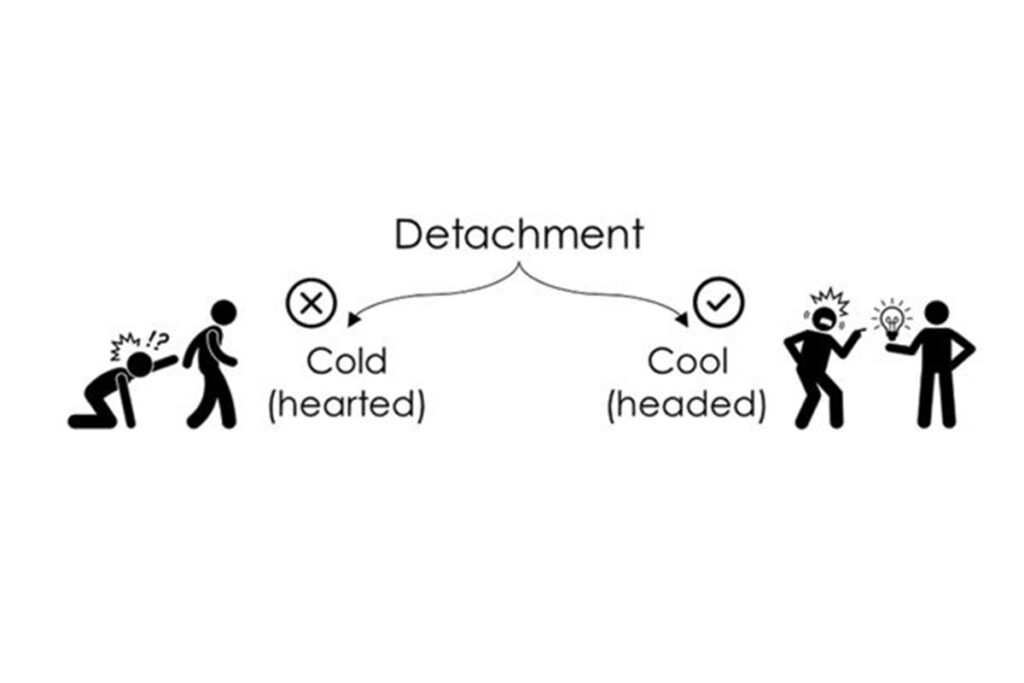
Whereas detachment makes our head cool, apathy makes our heart cold. Apathy can make us callous in relationships and careless in responsibilities.
A detached person can both regulate and redirect their emotions. When they are in a relationship, they do not let their emotions dominate them or determine their actions. They are able to use their rational and moral compass to make judicious decisions. By being able to regulate their emotions, they can commit to a particular relationship if that’s what is required. And they can also redirect their emotions toward some other responsibility if that is the best course of action.
COMMITMENT BEYOND REJECTION
To better understand this idea of detached commitment, let’s consider Vidura’s relationship with Dhritarashtra. As discussed earlier in the chapter on transformation, Vidura moderated his expectations of Dhritarashtra, recognizing the king’s disproportionate attachment to his son. And he waited for the time when his brother would become ready to receive his help. Let us now look at his commitment through one particular incident that occurred on the night after the fateful gambling match, in which the Panòavas were exiled to the forest for thirteen years.
The Panòavas, enraged by the Kauravas’ humiliation of Draupadi, took fierce vows. Bhima vowed to cut off the hand of Duhsasana, by which he had dragged and attempted to disrobe Draupadi, and then kill him. He also vowed to break the thigh of Duryodhana, who had sneeringly invited her to reject her husbands and sit on his thigh while exposing it to her. Bhima vowed to kill not just Duryodhana, but also all the hundred Kauravas.
That night, Dhritarashtra could not sleep, with Bhima’s words replaying in his mind. Feeling disturbed, he summoned Vidura.
When his younger brother and minister arrived, Dhritarashtra said, “O Vidura, my mind is disturbed by what transpired in the assembly today. Please speak words that will calm me.”
Vidura had been devastated by the heartlessness and shamelessness with which the Kauravas had treated Draupadi. He had also felt infuriated by Dhritarashtra’s partisanship in supporting his sons’ atrocious actions. Trying to keep his temper under control, he replied, “O King, how can you have any peace of mind when you have allowed your sons to sign their pact with death today?”
Dhritarashtra replied fearfully, “That is my fear too. Please tell me how this can be avoided.”
Vidura said, “What hope is there for the survival of your sons after the way they treated Draupadi?”
Seeing Dhritarashtra tremble in fear, Vidura spoke more kindly, “O King, there may still be one way. Prevail upon Duryodhana to go to Yudhishthira, fall at his feet, and beg for forgiveness. That virtuous king is soft-hearted. If he agrees to overlook Duryodhana’s heinous actions, he will persuade Bhima to desist from taking revenge. That is the only way Duryodhana can survive.”
Hearing these words, Dhritarashtra surged in shock and anger. “How can you expect Duryodhana to lower himself like this before Yudhishthira? By recommending such a degrading course of action, you have shown that you are partial to the Panòavas and averse to Duryodhana. He had warned me about your partiality, but I had refused to believe it. But today, your words have exposed your bias. I have no desire to take any counsel from you. Go wherever you like.” With these words, Dhritarashtra dismissed Vidura.
Feeling stung by the accusation and rejection, Vidura left not only the court but also the kingdom. He chose to stay with the virtuous Yudhishthira. When he reached the forest where Yudhishthira was staying, that dethroned monarch welcomed him graciously. On hearing what had transpired, Yudhishthira said, “It will be our fortune to have your company during our stay in the forest.” Vidura could not but compare this warm reception with the cold dismissal he had received from Dhritarashtra, the brother he had served for decades.
The next morning, when Dhritarashtra woke up and remembered what he had said to Vidura, he decided to call for him. When he came to know that Vidura had left for the forest to be with the Panòavas, he began to lament.
Because of his weakness, he was prone to mood swings—and even moral swings. At times he dreamt of his sons’ ascent to the throne; at other times he feared their destruction. His emotions tossed him between hoping for the impossible and dreading the inevitable. Beyond such mood swings, he also had moral swings. In Vidura’s presence, or when his own better sense awakened, he would try to do what was right. Under Duryodhana’s pressure, he would succumb to wrongdoing.
On the previous day, he had sided with Duryodhana. This morning, he felt the need for Vidura. Going along with that mood swing, he asked his assistant Sanjaya to go to Vidura in the forest and request him to return.
When Sanjaya conveyed the request, Vidura’s commitment was seen in his willingness to return, for he still believed that Dhritarashtra’s better sense could prevail. Setting aside the pain of rejection and accusation, he returned.
When Dhritarashtra offered a partial apology, saying that he had spoken harshly out of concern for his sons and for the dynasty at large, Vidura accepted that apology graciously. Nonetheless, he responded, “I desire the well-being of both my nephews—your sons and Panòu’s sons. But because the Panòavas do not have their father, I feel a special responsibility toward them. And when I speak in their favor, it is because they are not the ones provoking your sons. They are the ones being targeted by your sons’ provocations.”
Vidura’s commitment did help him to eventually elevate Dhritarashtra after Duryodhana was killed, as we have discussed in the chapter on transformation.
COMMITMENT-AVERSE?
Vidura’s example shows how detachment is not aversion to commitment. The inability or unwillingness to commit is a sign not of detachment, but of fear, frustration or immaturity: fear born from past hurts; frustration arising from repeated disappointments; or immaturity that seeks the pleasures of relationships without accepting their responsibilities.
In sharp contrast to such commitment-aversion is detachment. It is primarily an inner freedom from dependence on external objects, situations, or people. It may express itself either through engagement or disengagement or re-engagement, as seen in Vidura’s dealings with Dhritarashtra. Vidura stayed as long as there remained some hope of Dhritarashtra’s redemption. He left when Dhritarashtra’s repeated actions—or inaction—showed that meaningful change was unlikely, at least in the near future. And he returned when the factor holding Dhritarashtra back—Duryodhana—was removed and the likelihood of his listening to good advice increased. Detached people can engage without becoming entangled, and disengage without becoming bitter.
HOW TO DEVELOP DETACHMENT
This involves growth in both its dimensions: becoming free from domination by emotions and learning to stay committed in our actions without emotional entanglement.
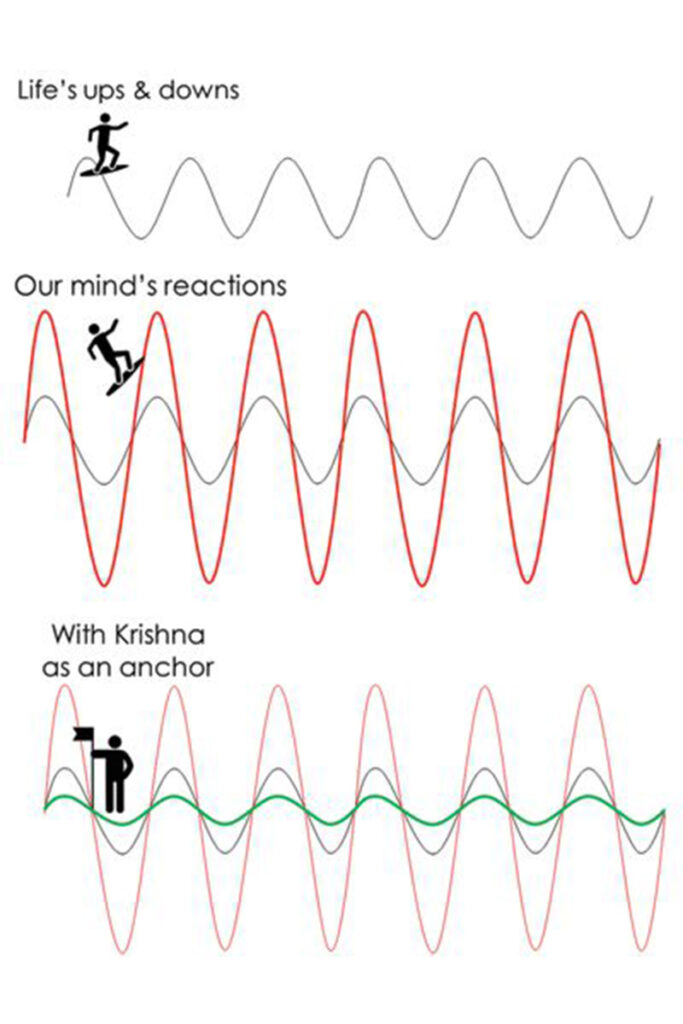
The first—emotional steadiness—can be developed through sadhana, regulated spiritual practice that connects us with the divine. Such practice acts like an anchor for our mind. Our present position in this world is like that of a person in an ocean. The endless waves in the ocean are like the dualities of life—happiness and distress, honor and dishonor, health and sickness, bonding and breaking. If our mind is unsteady, then every duality tosses us way up and way down. For example, when two people feel attracted to one another, they may say, “I can’t live without you.” Later, when they may feel repelled because of the duality of emotions, they may say, “I can’t live with you.” We may not want to be affected by the waves of the ocean, but we cannot stop those waves. If we do not want to be swept away by the unstoppable waves, then we need an anchor. The divine is that anchor. And our sadhana is the practice that helps us hold on to the divine, thereby stabilizing our mind and strengthening us.
When sadhana protects us from domination by emotions, then we can cultivate commitment without emotional entanglement by developing a service attitude, or seva-bhava. This service attitude is based on the understanding that we are all parts of the divine and that, whatever relationships we may presently be in, we are all participating in a higher plan. Our relationships are meant ultimately for our spiritual evolution, not merely for our material gratification.
This spiritual purposefulness prevents us from chasing after relationships that allure us with material gratification, and it protects us from running away from relationships when they stop offering such gratification. We learn to peacefully play our role and perform our responsibilities in a mood of service to the divine. Thus, we grow spiritually and come closer to the divine, regardless of whether we come closer to the other person or don’t. This service attitude enables us to make our relationships less emotion-driven and more commitment-driven.
Chaitanya Carana Dasa is the associate-editor of Back to Godhead (US and Indian editions). To read his daily Bhagavad-gita reflections, please subscribe to Gitadaily on his website, thespiritualscientist.com.