Alphabets of the Absolute

Free to Read
11 mins September, 2026
00:00
00:00

A-H of Lord Krishna’s Divine Qualities

by Gauranga Darsana Dasa


Among the countless attributes that make Sri Krishna the most captivating personality in existence, sixty-four qualities have been exquisitely described by Srila Rupa Gosvami in the Bhakti-rasamrita-sindhu. These qualities together define the boundless charm of the Supreme Lord—why He alone is called Krishna, “the all-attractive one.”


Of these sixty-four, the first fifty can also manifest to some extent in the jivas—the living beings who are tiny fragments of His energy. Up to fifty-five shine in Lord Siva, up to sixty in Lord Vishnu, and all sixty-four dwell perfectly and eternally in Sri Krishna. Even the smallest reflection of any of these virtues can beautify the human heart and draw it nearer to the divine.


The reflections that follow—drawn from the Bhakti-rasamrita-sindhu and allied scriptures—offer a meditation on eight qualities that invite practical cultivation. While the Lord’s perfections are inimitable and cannot be reproduced by ordinary beings, many of the first fifty can be humbly pursued “in His footsteps,” as aspiring followers of His example. Presented here as an alphabet—A through H: Affection, Benevolence, Courage, Detachment, Empowerment, Forgiveness, Gratitude, and Humility—these virtues provide both a glimpse into Krishna’s personality and a mirror for our own spiritual cultivation.Top of Form 


Bottom of Form


A — Affection


The Srimad-Bhagavatam and other scriptures repeatedly praise Krishna as bhakta-vatsala—deeply affectionate toward His devotees. His love is not distant or conditional; it is intimate, protective, and overflowing with tenderness.


Suniti, the mother of prince Dhruva, once expressed this truth to her son: “My dear child, I am only one mother and can give limited affection. But the Supreme Lord, Sri Krishna, is bhritya-vatsala – He possesses the affection of ten million mothers combined. Therefore, please take shelter of Him.”


Lord Krishna’s affection for His devotees is often expressed through His desire to glorify them. When Bhishma was misunderstood for fighting on Duryodhana’s side, Krishna arranged for him to be honored before the world. He inspired Yudhishthira to approach Bhishma on his deathbed, thus allowing Bhishma to expound the principles of dharma to kings, sages, and even the devas. In this way, Krishna ensured that Bhishma’s true devotion and wisdom were revealed to all.


Krishna’s affection is the devotee’s greatest hope. Even when a devotee falters unintentionally, Krishna’s love remains steadfast. As He declares in the Bhagavad-gita (9.30):

api cet su-duracaro
bhajate mam ananya-bhak
sadhur eva sa mantavyah
samyag vyavasito hi sah


“Even if one commits the most abominable act, if he is devoted to Me without deviation, he is to be considered saintly, for he is rightly resolved.”


A father’s affection does not vanish when his child errs; it deepens with compassion. Krishna’s affection similarly embraces His children, yet He delights when they grow in discipline and devotion, striving to please Him, and be affectionate in their dealings with other devotees. When we consciously cultivate affection in our words and actions, we become living reflections of Krishna’s affection in this world.


B — Benevolence


Krishna is not only affectionate to His devotees, He is benevolent and magnanimous even to those who oppose Him. His compassion does not discriminate between friend and foe.


During the battle of Kurukshetra, countless warriors perished before Arjuna’s arrows. Yet the Bhagavatam reveals that many of them attained liberation merely by beholding Krishna:

tathaiva canye nara-loka-vira
ya ahave krishna-mukharavindam
netraih pibanto nayanabhiramam
parthastra-putah padam apur asya


“Certainly others who were fighters on the Battlefield of Kurukshetra were purified by the onslaught of Arjuna’s arrows, and while seeing the lotuslike face of Krishna, so pleasing to the eyes, they achieved the abode of the Lord.” (SB 3.2.20)


His mercy also reached the demoness Putana, who came disguised as a loving mother to poison the infant Krishna. Instead of punishing her, He granted her a place as His nurse in the spiritual world. Uddhava marvels at this unparalleled compassion:

aho baki yam stana-kala-kutam
jighamsayapayayad apy asadhvi
lebhe gatim dhatry-ucitam tato ’nyam
kam va dayalum saranam vrajema


“Alas, how shall I take shelter of one more merciful than He who granted the position of mother to a she-demon (Putana) although she was unfaithful and she prepared deadly poison to be sucked from her breast?” (SB 3.2.23)


When Krishna descends as Sri Chaitanya Mahaprabhu, His benevolence expands beyond measure:

namo maha-vadanyaya
krishna-prema-pradaya te
krishnaya krishna-Chaitanya-
namne gaura-tvishe namah


“O most munificent incarnation! You are Krishna Himself appearing as Sri Krishna Chaitanya Mahaprabhu. You have assumed the golden color of Srimati Radharani, and You are widely distributing pure love of Krishna. We offer our respectful obeisances unto You.” (CC Madhya 19.53) 


Such is the nature of divine benevolence—it flows freely, without expectation or prejudice. To imbibe this quality, we can learn to serve without seeking return, and to wish well even for those who misunderstand us.


C — Courage


Courage is another hallmark of Krishna’s character. From His earliest days in Vrindavana, He faced formidable foes—Putana, Trinavarta, Bakasura, Aghasura, Arishtasura, and many others. Yet each demon also symbolized an inner impurity—pride, hypocrisy, greed, or envy—that Krishna came to vanquish, not only externally but within the hearts of His devotees.


True courage, therefore, is not merely physical bravery but the spiritual strength to confront one’s own weaknesses and life’s reversals. The dualities of success and failure, joy and sorrow, victory and defeat can overwhelm anyone. Krishna teaches that such dualities must be faced with courage born of faith in His protection.
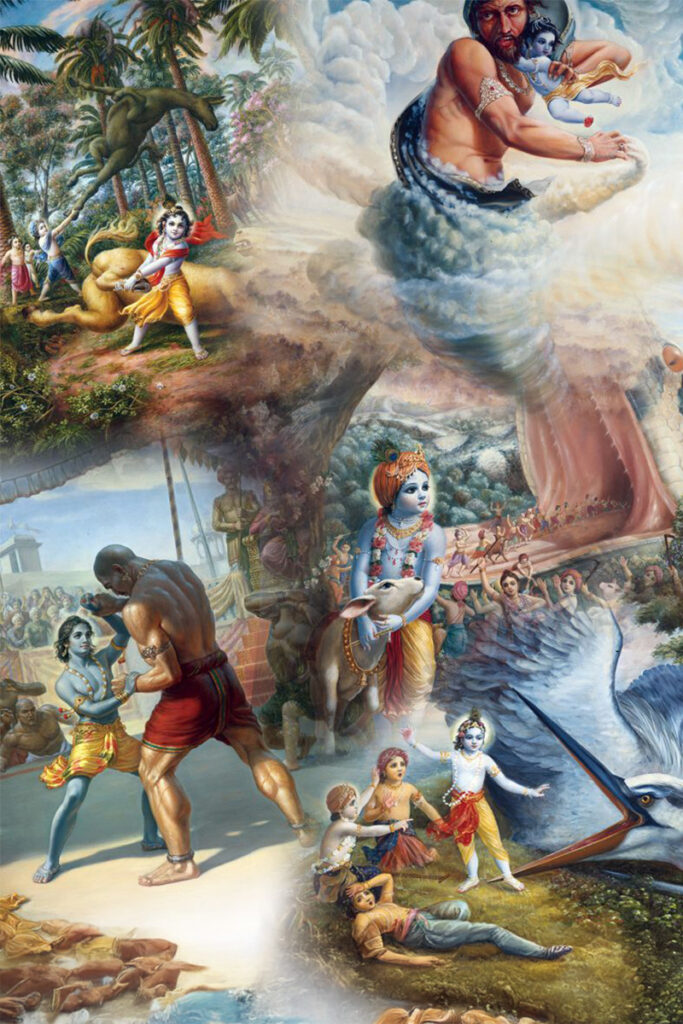

Srila Prabhupada compared the life of devotion to “a declaration of war against maya.” Temptations will come, he warned, and yielding to them is weakness; resisting them with determination is courage.


Like a tortoise that withdraws its limbs within its shell, a devotee demonstrates courage by withdrawing the senses from harmful engagement. Courage is not in indulgence but in restraint when necessary, not in dominating the world but in mastering oneself.


Even fame, wealth, and opportunity can test courage. One must have the boldness to say “no” to whatever cannot be used in Krishna’s service, and the humility to accept only what deepens remembrance of Him.

D — Detachment


Lord Krishna’s detachment stands as the foundation of His sovereignty. Although He possesses everything, He remains untouched by all He creates. He is shaò-aisvarya-purna—complete in six opulences: wealth, strength, fame, knowledge, beauty, and detachment. His detachment, in fact, magnifies the other five.


Narada Muni glorifies this aspect of the Lord: “Although He creates and sustains the universe, He remains unbound by His actions, and detached from all its affairs. He is the unattached pure witness of all.” (SB 5.19.12) 


Krishna’s detachment is vividly demonstrated in His earthly pastimes. After slaying Kamsa, He installed Ugrasena on the throne instead of ruling Himself. After defeating Narakasura, He crowned the demon’s son as king. Even in Dvaraka, though revered as Dvarakadhisa, He allowed Ugrasena to remain ruler. The Lord creates, conquers, and sustains—but never claims.


For human beings, detachment means remembering that worldly possessions, prestige, and pleasure are transient. The only enduring wealth is devotion—the love we cultivate for Krishna’s lotus feet. Everything else fades with time, but devotion accompanies the soul eternally.


E — Empowerment


A remarkable expression of Krishna’s greatness is His ability to empower others. Though He is the ultimate doer, He grants His devotees the joy and dignity of being His instruments.


During the Kurukshetra war, Krishna guided every movement, yet He appeared merely as Arjuna’s charioteer. He orchestrated the victory while allowing Arjuna to receive the glory.


Similarly, He could have slain Jarasandha Himself, yet He chose to empower Bhima. After twenty-eight days of exhausting battle, Bhima still couldn’t defeat Jarasandha. Krishna then subtly demonstrated how to tear a twig into two pieces in opposite directions—imparting, through a simple gesture, the secret to Jarasandha’s defeat.


Srila Prabhupada notes that true leaders willingly empower others. Ancient kings would pass on responsibilities to worthy successors and retire to pursue spiritual realization. In contrast, Kali yuga leaders who cling to power often do so out of attachment or insecurity. Krishna, being completely detached, joyfully empowers His devotees.


Empowerment is thus a divine expression of love. When we empower others—students, children, or colleagues—to grow and succeed, we reflect Krishna’s magnanimity. True leadership, in the Vaishnava spirit, is not about holding privileges or control but about uplifting others and creating opportunities for them to shine.

F — Forgiveness


Among all the divine interactions recorded in scripture, few display Lord Krishna’s amazing forgiving nature towards those who make mistakes – big or small.


When the residents of Vrindavana stopped performing Indra’s sacrifice and instead worshiped Govardhana Hill, the proud king of heaven unleashed torrents of rain to punish them. Lord Krishna lifted Govardhana effortlessly and sheltered the entire community for seven days. Yet when Indra realized his arrogance and sought forgiveness, Krishna’s response was not anger but mercy. He accepted Indra’s apology and restored him to his post, teaching that divine forgiveness flows from love, not from weakness.


Similarly, when Lord Brahma attempted to test Krishna by stealing the cowherd boys and calves, he caused separation between the Lord and His beloved companions for an entire year. Yet when Brahma repented, Krishna welcomed him with warmth.


The Bhagavatam (9.15.40) extols this quality:

kshamaya rocate lakshmir
brahmi sauri yatha prabha
kshaminam asu bhagavams
tushyate harir isvarah


“The duty of a brahmana is to culture the quality of forgiveness, which is illuminating like the sun. The Supreme Personality of Godhead, Hari, is pleased with those who are forgiving.”


Forgiveness purifies the heart and draws the soul closer to Krishna. To forgive is to reflect His nature—to rise above resentment and see others with compassion rather than judgment.


G — Gratitude


Gratitude is the fragrance of devotion—the recognition that every blessing is Krishna’s grace and every service an opportunity granted by Him.


Lord Krishna’s own gratitude toward His devotees is astonishing. Even the smallest act of devotion evokes His complete reciprocation:

tulasi-dala-matrena
jalasya culukena va
vikrinite svam atmanam
bhaktebhyo bhakta-vatsalah


“Sri Krishna, who is very affectionate toward His devotees, sells Himself to a devotee who offers Him merely a tulasi leaf and a palmful of water.” (CC Adi 3.104) 


The Lord’s gratitude is so profound that He feels indebted even for imagined service. Srila Rupa Gosvami narrates the story of a brahmana from Pratishthanapura who daily worshiped Krishna within his mind, mentally offering elaborate feasts. When, in meditation, he touched the sweet rice to test its warmth and felt his finger burn, Lord Vishnu sent an airplane in delight and took him to Vaikuntha.


Such gratitude reveals the Lord’s heart. He values the intention more than the act, the love more than the gift.


As His servants, we too must cultivate gratitude—toward Krishna, His devotees, and all who assist us on the spiritual path. Gratitude guards against pride and nurtures humility, the soil in which devotion grows.


H — Humility


Humility is the crown of all virtues, and Lord Krishna embodies it perfectly. Though the Supreme Lord, He repeatedly takes the position of a servant.


At Yudhishthira’s Rajasuya yajna, Krishna personally washed the feet of arriving guests. When His impoverished friend Sudama visited Dvaraka, Krishna received him with tears, seated him on His royal couch, and bathed his feet. Despite ruling a magnificent city, He served His friend with the tenderness of a brother.


In the Mahabharata, Krishna displayed similar humility by accepting the role of Arjuna’s charioteer. He went as a messenger of His devotees, endured insults from the proud without protest, placing service to His devotees above His own prestige.


This humility does not diminish His majesty—it reveals its depth. The greater the power, the greater the beauty of selflessness.


Sri Chaitanya Mahaprabhu taught that without humility one cannot truly chant Krishna’s names:

trinad api sunicena
taror iva sahishnuna
amanina manadena
kirtaniyah sada harih


“One should be humbler than a blade of grass, more tolerant than a tree, devoid of pride, and always ready to offer respect to others; in such a state one can constantly chant the holy name of the Lord.”


Krishna’s humility draws the world to Him. It transforms reverence into love, awe into intimacy. For the devotee, humility is not self-deprecation but joyful recognition of the Lord’s greatness and one’s own dependence upon Him.


THE SYMPHONY OF DIVINE CHARACTER


Affection reveals Krishna’s love for His devotees. Benevolence displays His mercy even on demons. Courage reflects His fearlessness. Detachment proclaims His sovereignty. Empowerment manifests His leadership. Forgiveness shows His accommodative nature. Gratitude unveils His tenderness. Humility crowns them all.


These eight qualities—A through H—offer a concise glimpse into the Supreme Lord’s personality. To contemplate them is to glimpse the perfection of character that even liberated souls find irresistible.


The Srimad-Bhagavatam (1.7.10) says:

atmaramas ca munayo
nirgrantha apy urukrame
kurvanty ahaitukim bhaktim
ittham-bhuta-guno harih


“All different varieties of atmaramas [those who take pleasure in the atma, or spirit self], especially those established on the path of self-realization, though freed from all kinds of material bondage, desire to render unalloyed devotional service unto the Personality of Godhead. This means that the Lord possesses transcendental qualities and therefore can attract everyone, including liberated souls. Even the self-satisfied sages, free from all material bondage, are drawn to Krishna because of His transcendental qualities.”


To imbibe them is to begin walking the path from ordinary humanity toward divinity, from self-centeredness toward selfless love. For in learning the A, B, C, D, E, F, G, and H of Krishna, one begins to spell the language of devotion—the language that unites the soul eternally with the all-attractive Lord.


Gauranga Darsana Dasa (www.gaurangadarshan.com), a disciple of His Holiness Radhanath Swami, is the dean of Bhaktivedanta Vidyapitha at ISKCON Govardhan Eco Village, outside Mumbai, and a member of ISKCON Board of Examinations. He is a sastric teacher and is the author of Gita Subodhini, Bhagavata Subodhini, Chaitanya Subodhini, Disapproved but Not Disowned, Bhagavata Pravaha, and other books.

Subscribe to BTG Digital Magazine

Embark on your path to Krishna consciousness with BTG Digital Magazine! Subscribe now and discover inspiring stories of growth, enlightenment, and connection shared by our community.

Subscribe

Alphabets of the Absolute

Alphabets of the Absolute
Listen to Article
Press Play to listen

A-H of Lord Krishna’s Divine Qualities

by Gauranga Darsana Dasa


Among the countless attributes that make Sri Krishna the most captivating personality in existence, sixty-four qualities have been exquisitely described by Srila Rupa Gosvami in the Bhakti-rasamrita-sindhu. These qualities together define the boundless charm of the Supreme Lord—why He alone is called Krishna, “the all-attractive one.”


Of these sixty-four, the first fifty can also manifest to some extent in the jivas—the living beings who are tiny fragments of His energy. Up to fifty-five shine in Lord Siva, up to sixty in Lord Vishnu, and all sixty-four dwell perfectly and eternally in Sri Krishna. Even the smallest reflection of any of these virtues can beautify the human heart and draw it nearer to the divine.


The reflections that follow—drawn from the Bhakti-rasamrita-sindhu and allied scriptures—offer a meditation on eight qualities that invite practical cultivation. While the Lord’s perfections are inimitable and cannot be reproduced by ordinary beings, many of the first fifty can be humbly pursued “in His footsteps,” as aspiring followers of His example. Presented here as an alphabet—A through H: Affection, Benevolence, Courage, Detachment, Empowerment, Forgiveness, Gratitude, and Humility—these virtues provide both a glimpse into Krishna’s personality and a mirror for our own spiritual cultivation.Top of Form 


Bottom of Form


A — Affection


The Srimad-Bhagavatam and other scriptures repeatedly praise Krishna as bhakta-vatsala—deeply affectionate toward His devotees. His love is not distant or conditional; it is intimate, protective, and overflowing with tenderness.


Suniti, the mother of prince Dhruva, once expressed this truth to her son: “My dear child, I am only one mother and can give limited affection. But the Supreme Lord, Sri Krishna, is bhritya-vatsala – He possesses the affection of ten million mothers combined. Therefore, please take shelter of Him.”


Lord Krishna’s affection for His devotees is often expressed through His desire to glorify them. When Bhishma was misunderstood for fighting on Duryodhana’s side, Krishna arranged for him to be honored before the world. He inspired Yudhishthira to approach Bhishma on his deathbed, thus allowing Bhishma to expound the principles of dharma to kings, sages, and even the devas. In this way, Krishna ensured that Bhishma’s true devotion and wisdom were revealed to all.


Krishna’s affection is the devotee’s greatest hope. Even when a devotee falters unintentionally, Krishna’s love remains steadfast. As He declares in the Bhagavad-gita (9.30):

api cet su-duracaro
bhajate mam ananya-bhak
sadhur eva sa mantavyah
samyag vyavasito hi sah


“Even if one commits the most abominable act, if he is devoted to Me without deviation, he is to be considered saintly, for he is rightly resolved.”


A father’s affection does not vanish when his child errs; it deepens with compassion. Krishna’s affection similarly embraces His children, yet He delights when they grow in discipline and devotion, striving to please Him, and be affectionate in their dealings with other devotees. When we consciously cultivate affection in our words and actions, we become living reflections of Krishna’s affection in this world.


B — Benevolence


Krishna is not only affectionate to His devotees, He is benevolent and magnanimous even to those who oppose Him. His compassion does not discriminate between friend and foe.


During the battle of Kurukshetra, countless warriors perished before Arjuna’s arrows. Yet the Bhagavatam reveals that many of them attained liberation merely by beholding Krishna:

tathaiva canye nara-loka-vira
ya ahave krishna-mukharavindam
netraih pibanto nayanabhiramam
parthastra-putah padam apur asya


“Certainly others who were fighters on the Battlefield of Kurukshetra were purified by the onslaught of Arjuna’s arrows, and while seeing the lotuslike face of Krishna, so pleasing to the eyes, they achieved the abode of the Lord.” (SB 3.2.20)


His mercy also reached the demoness Putana, who came disguised as a loving mother to poison the infant Krishna. Instead of punishing her, He granted her a place as His nurse in the spiritual world. Uddhava marvels at this unparalleled compassion:

aho baki yam stana-kala-kutam
jighamsayapayayad apy asadhvi
lebhe gatim dhatry-ucitam tato ’nyam
kam va dayalum saranam vrajema


“Alas, how shall I take shelter of one more merciful than He who granted the position of mother to a she-demon (Putana) although she was unfaithful and she prepared deadly poison to be sucked from her breast?” (SB 3.2.23)


When Krishna descends as Sri Chaitanya Mahaprabhu, His benevolence expands beyond measure:

namo maha-vadanyaya
krishna-prema-pradaya te
krishnaya krishna-Chaitanya-
namne gaura-tvishe namah


“O most munificent incarnation! You are Krishna Himself appearing as Sri Krishna Chaitanya Mahaprabhu. You have assumed the golden color of Srimati Radharani, and You are widely distributing pure love of Krishna. We offer our respectful obeisances unto You.” (CC Madhya 19.53) 


Such is the nature of divine benevolence—it flows freely, without expectation or prejudice. To imbibe this quality, we can learn to serve without seeking return, and to wish well even for those who misunderstand us.


C — Courage


Courage is another hallmark of Krishna’s character. From His earliest days in Vrindavana, He faced formidable foes—Putana, Trinavarta, Bakasura, Aghasura, Arishtasura, and many others. Yet each demon also symbolized an inner impurity—pride, hypocrisy, greed, or envy—that Krishna came to vanquish, not only externally but within the hearts of His devotees.


True courage, therefore, is not merely physical bravery but the spiritual strength to confront one’s own weaknesses and life’s reversals. The dualities of success and failure, joy and sorrow, victory and defeat can overwhelm anyone. Krishna teaches that such dualities must be faced with courage born of faith in His protection.


Srila Prabhupada compared the life of devotion to “a declaration of war against maya.” Temptations will come, he warned, and yielding to them is weakness; resisting them with determination is courage.


Like a tortoise that withdraws its limbs within its shell, a devotee demonstrates courage by withdrawing the senses from harmful engagement. Courage is not in indulgence but in restraint when necessary, not in dominating the world but in mastering oneself.


Even fame, wealth, and opportunity can test courage. One must have the boldness to say “no” to whatever cannot be used in Krishna’s service, and the humility to accept only what deepens remembrance of Him.

D — Detachment


Lord Krishna’s detachment stands as the foundation of His sovereignty. Although He possesses everything, He remains untouched by all He creates. He is shaò-aisvarya-purna—complete in six opulences: wealth, strength, fame, knowledge, beauty, and detachment. His detachment, in fact, magnifies the other five.


Narada Muni glorifies this aspect of the Lord: “Although He creates and sustains the universe, He remains unbound by His actions, and detached from all its affairs. He is the unattached pure witness of all.” (SB 5.19.12) 


Krishna’s detachment is vividly demonstrated in His earthly pastimes. After slaying Kamsa, He installed Ugrasena on the throne instead of ruling Himself. After defeating Narakasura, He crowned the demon’s son as king. Even in Dvaraka, though revered as Dvarakadhisa, He allowed Ugrasena to remain ruler. The Lord creates, conquers, and sustains—but never claims.


For human beings, detachment means remembering that worldly possessions, prestige, and pleasure are transient. The only enduring wealth is devotion—the love we cultivate for Krishna’s lotus feet. Everything else fades with time, but devotion accompanies the soul eternally.


E — Empowerment


A remarkable expression of Krishna’s greatness is His ability to empower others. Though He is the ultimate doer, He grants His devotees the joy and dignity of being His instruments.


During the Kurukshetra war, Krishna guided every movement, yet He appeared merely as Arjuna’s charioteer. He orchestrated the victory while allowing Arjuna to receive the glory.


Similarly, He could have slain Jarasandha Himself, yet He chose to empower Bhima. After twenty-eight days of exhausting battle, Bhima still couldn’t defeat Jarasandha. Krishna then subtly demonstrated how to tear a twig into two pieces in opposite directions—imparting, through a simple gesture, the secret to Jarasandha’s defeat.


Srila Prabhupada notes that true leaders willingly empower others. Ancient kings would pass on responsibilities to worthy successors and retire to pursue spiritual realization. In contrast, Kali yuga leaders who cling to power often do so out of attachment or insecurity. Krishna, being completely detached, joyfully empowers His devotees.


Empowerment is thus a divine expression of love. When we empower others—students, children, or colleagues—to grow and succeed, we reflect Krishna’s magnanimity. True leadership, in the Vaishnava spirit, is not about holding privileges or control but about uplifting others and creating opportunities for them to shine.


F — Forgiveness


Among all the divine interactions recorded in scripture, few display Lord Krishna’s amazing forgiving nature towards those who make mistakes – big or small.


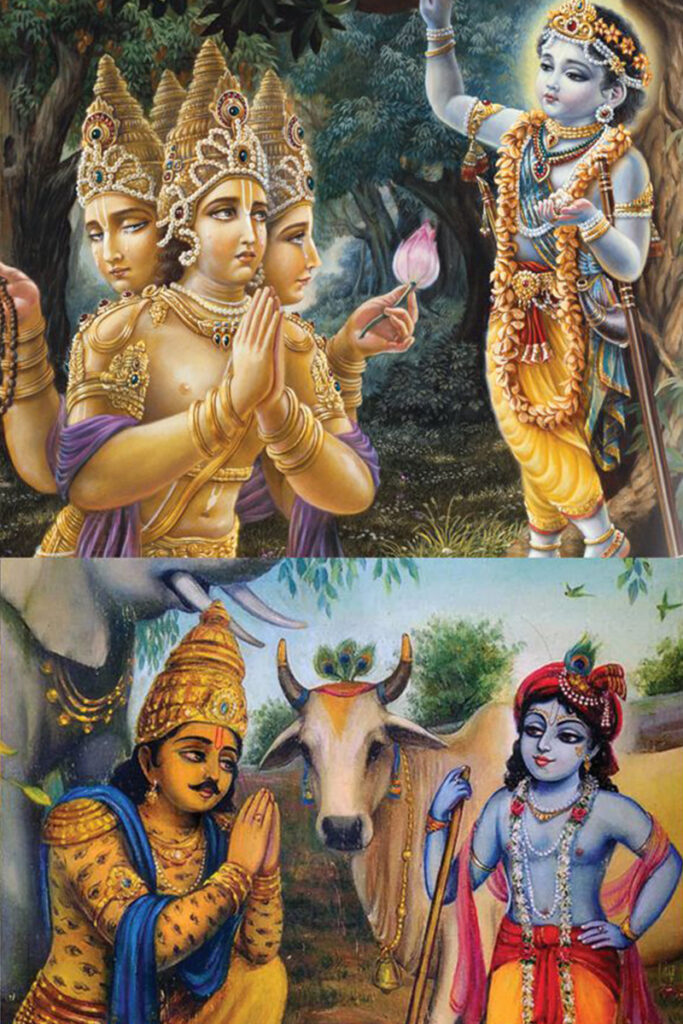
When the residents of Vrindavana stopped performing Indra’s sacrifice and instead worshiped Govardhana Hill, the proud king of heaven unleashed torrents of rain to punish them. Lord Krishna lifted Govardhana effortlessly and sheltered the entire community for seven days. Yet when Indra realized his arrogance and sought forgiveness, Krishna’s response was not anger but mercy. He accepted Indra’s apology and restored him to his post, teaching that divine forgiveness flows from love, not from weakness.


Similarly, when Lord Brahma attempted to test Krishna by stealing the cowherd boys and calves, he caused separation between the Lord and His beloved companions for an entire year. Yet when Brahma repented, Krishna welcomed him with warmth.


The Bhagavatam (9.15.40) extols this quality:

kshamaya rocate lakshmir
brahmi sauri yatha prabha
kshaminam asu bhagavams
tushyate harir isvarah


“The duty of a brahmana is to culture the quality of forgiveness, which is illuminating like the sun. The Supreme Personality of Godhead, Hari, is pleased with those who are forgiving.”


Forgiveness purifies the heart and draws the soul closer to Krishna. To forgive is to reflect His nature—to rise above resentment and see others with compassion rather than judgment.


G — Gratitude


Gratitude is the fragrance of devotion—the recognition that every blessing is Krishna’s grace and every service an opportunity granted by Him.


Lord Krishna’s own gratitude toward His devotees is astonishing. Even the smallest act of devotion evokes His complete reciprocation:

tulasi-dala-matrena
jalasya culukena va
vikrinite svam atmanam
bhaktebhyo bhakta-vatsalah


“Sri Krishna, who is very affectionate toward His devotees, sells Himself to a devotee who offers Him merely a tulasi leaf and a palmful of water.” (CC Adi 3.104) 


The Lord’s gratitude is so profound that He feels indebted even for imagined service. Srila Rupa Gosvami narrates the story of a brahmana from Pratishthanapura who daily worshiped Krishna within his mind, mentally offering elaborate feasts. When, in meditation, he touched the sweet rice to test its warmth and felt his finger burn, Lord Vishnu sent an airplane in delight and took him to Vaikuntha.


Such gratitude reveals the Lord’s heart. He values the intention more than the act, the love more than the gift.


As His servants, we too must cultivate gratitude—toward Krishna, His devotees, and all who assist us on the spiritual path. Gratitude guards against pride and nurtures humility, the soil in which devotion grows.


H — Humility


Humility is the crown of all virtues, and Lord Krishna embodies it perfectly. Though the Supreme Lord, He repeatedly takes the position of a servant.


At Yudhishthira’s Rajasuya yajna, Krishna personally washed the feet of arriving guests. When His impoverished friend Sudama visited Dvaraka, Krishna received him with tears, seated him on His royal couch, and bathed his feet. Despite ruling a magnificent city, He served His friend with the tenderness of a brother.


In the Mahabharata, Krishna displayed similar humility by accepting the role of Arjuna’s charioteer. He went as a messenger of His devotees, endured insults from the proud without protest, placing service to His devotees above His own prestige.


This humility does not diminish His majesty—it reveals its depth. The greater the power, the greater the beauty of selflessness.


Sri Chaitanya Mahaprabhu taught that without humility one cannot truly chant Krishna’s names:

trinad api sunicena
taror iva sahishnuna
amanina manadena
kirtaniyah sada harih


“One should be humbler than a blade of grass, more tolerant than a tree, devoid of pride, and always ready to offer respect to others; in such a state one can constantly chant the holy name of the Lord.”


Krishna’s humility draws the world to Him. It transforms reverence into love, awe into intimacy. For the devotee, humility is not self-deprecation but joyful recognition of the Lord’s greatness and one’s own dependence upon Him.


THE SYMPHONY OF DIVINE CHARACTER


Affection reveals Krishna’s love for His devotees. Benevolence displays His mercy even on demons. Courage reflects His fearlessness. Detachment proclaims His sovereignty. Empowerment manifests His leadership. Forgiveness shows His accommodative nature. Gratitude unveils His tenderness. Humility crowns them all.


These eight qualities—A through H—offer a concise glimpse into the Supreme Lord’s personality. To contemplate them is to glimpse the perfection of character that even liberated souls find irresistible.


The Srimad-Bhagavatam (1.7.10) says:

atmaramas ca munayo
nirgrantha apy urukrame
kurvanty ahaitukim bhaktim
ittham-bhuta-guno harih


“All different varieties of atmaramas [those who take pleasure in the atma, or spirit self], especially those established on the path of self-realization, though freed from all kinds of material bondage, desire to render unalloyed devotional service unto the Personality of Godhead. This means that the Lord possesses transcendental qualities and therefore can attract everyone, including liberated souls. Even the self-satisfied sages, free from all material bondage, are drawn to Krishna because of His transcendental qualities.”


To imbibe them is to begin walking the path from ordinary humanity toward divinity, from self-centeredness toward selfless love. For in learning the A, B, C, D, E, F, G, and H of Krishna, one begins to spell the language of devotion—the language that unites the soul eternally with the all-attractive Lord.


Gauranga Darsana Dasa (www.gaurangadarshan.com), a disciple of His Holiness Radhanath Swami, is the dean of Bhaktivedanta Vidyapitha at ISKCON Govardhan Eco Village, outside Mumbai, and a member of ISKCON Board of Examinations. He is a sastric teacher and is the author of Gita Subodhini, Bhagavata Subodhini, Chaitanya Subodhini, Disapproved but Not Disowned, Bhagavata Pravaha, and other books.