Three Worldviews That Fail Us

Free to Read
10 mins September, 2026
00:00
00:00

and One That Frees Us


How the Gita’s worldview is most empowering


by Chaitanya Charana Dasa


In many cultures, there’s a common notion that thinking too much can be dangerous. The underlying idea is that if we ponder over fundamental questions like the meaning of life, we may end up frustrated and cynical. This cynicism can lead to inaction, as we conclude that everything is ultimately meaningless. We may see life as futile, given that death erases all, and refuse to join the blind pursuit of worldly goals that others engage in.


Alternatively, such intense thinking might evoke dread. This dread could drive us to feverishly pursue spiritual reality while abandoning this world. Viewing the material realm as treacherous and filled with illusions, we might focus only on protecting ourselves from its entanglements and securing our liberation.
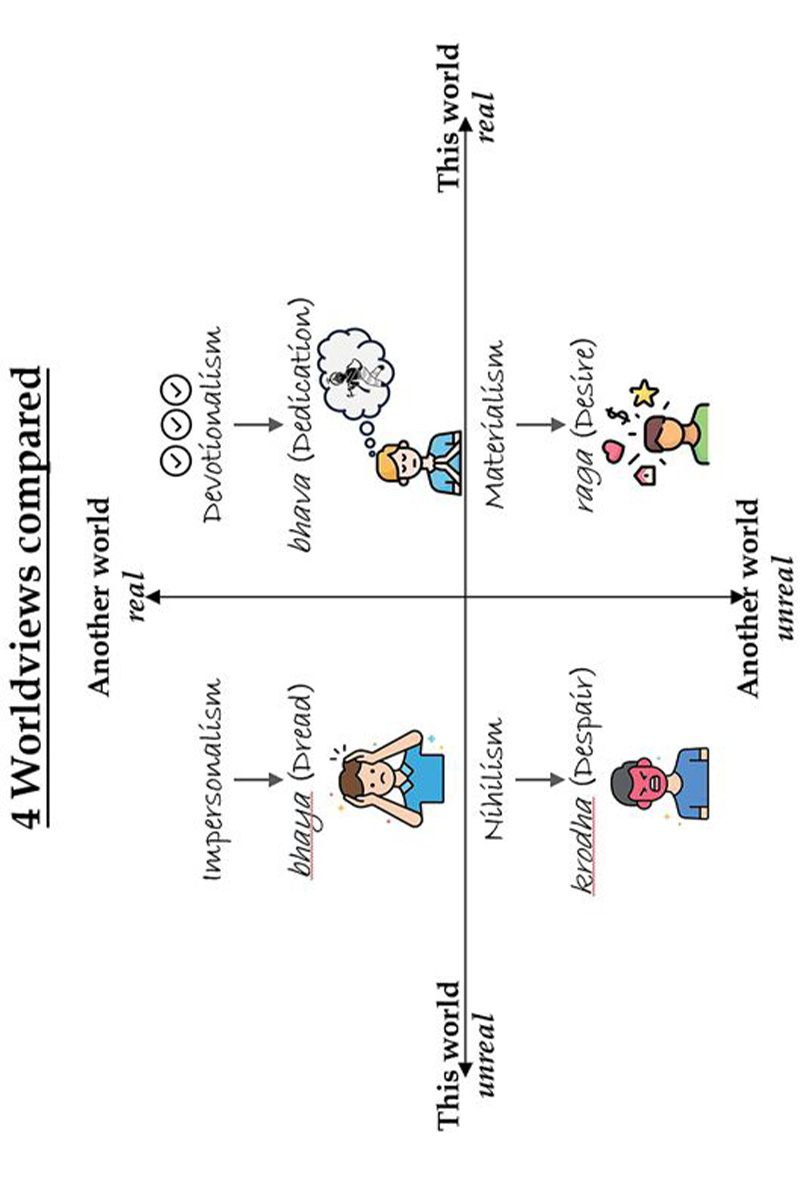


Faced with these two extremes—despair or dread—many people consider the default worldview of desire more practical. This perspective involves avoiding deep reflection and instead centering life around worldly pursuits.


The Bhagavad-gita (4.10) outlines these three responses to the world:

  • 1. Desire (raga): A craving for material possessions and pleasures. In this materialistic worldview, this material world is considered to be the only reality.
  • 2. Dread (bhaya): A fear-driven detachment from the material world. In this impersonalist worldview, this world is considered to be unreal, whereas only another world—the spiritual domain of nondifferentiated oneness is considered to be the only reality.
  • 3. Despair (krodha): Existential frustration that leads to cynicism, anger and despair. In this nihilistic worldview, neither this world nor any other world are considered real; everything is deemed illusory.


The Gita encourages going beyond these three responses to embrace devotion, wherein both this material world and another world—the spiritual world—are both considered real, with the material world being an ephemeral yet essential pathway to the spiritual world. Let’s look at each of these worldviews systematically.


What’s wrong with the worldview of desire


The worldview of desire refers to a materialistic outlook, where individuals are driven by desires for various things in the world. While specific desires may vary from person to person based on their inclinations, the common denominator remains the pursuit of worldly gratification. These desires often revolve around physical possessions, sensual pleasures, prestige, fame, and similar aspirations.


This worldview has been prominent throughout history but is now increasingly facilitated and glamorized in our modern high-tech world. While this materialistic worldview has always had its challenges, its amplification today creates additional problems.


Key flaws in the worldview of desire


1. The inevitability of death

The most glaring problem with the worldview of desire is the inescapable reality of death, which acts as the ultimate frustration of all desires. No matter how much one acquires or enjoys, everything can be taken away in an instant. A microscopic germ or an unforeseen accident can end one’s life at any moment. Even if one escapes premature death, old age and eventual death are unavoidable. At that point, everything lived for and achieved becomes meaningless, leaving one utterly frustrated.


Many people psychologically deny the reality of death by living as if they will not die, or at least not for a long time. Yet this denial does not change the fact that death is an inescapable truth.


2. The finiteness of desirable resources


The limited availability of desirable objects poses another problem. Resources such as wealth, which are essential for acquiring objects of desire, are never equally or fairly distributed. Even if resources were distributed equally, they would not suffice to fulfill everyone’s major desires, let alone all desires.


Wealth disparity: Those without sufficient wealth to acquire their desires remain perpetually frustrated, feeling deprived of life’s purpose.


Scarcity of desirable objects: Even for those with resources, not all desirable objects are abundant. For instance, not everyone can have the most attractive partners or the rarest possessions. Fierce competition for these limited resources leaves many disappointed.


Diminished sensory capacity: Even when individuals acquire highly desirable objects, their sensory capacity to enjoy is limited. For instance, the enjoyment of delicious food or other sensual pleasures lasts only a few moments or minutes. Over time, the body’s aging process further reduces the ability to enjoy, compounding the frustration.


3. The transient nature of enjoyment

Sensory pleasures are inherently temporary and cannot provide lasting satisfaction. As Bhagavad-gita (5.22) cautions, sensual pleasures inevitably lead to misery. The brief moments of pleasure are followed by aGitation, dissatisfaction, and the craving for more, creating a never-ending cycle of unfulfilled desires.


Why this worldview needs rethinking


Despite the majority embracing this worldview, its inherent futility makes it unsuitable for thoughtful individuals. The inevitable frustrations—death, resource scarcity, and the transient nature of enjoyment—render the pursuit of desires ultimately meaningless. Recognizing this, pragmatic individuals should explore alternative worldviews that offer deeper meaning and sustainable satisfaction.


What’s wrong with the worldview of despair?


The worldview of despair arises when individuals believe that life has no inherent meaning. This outlook often emerges when people recognize the futility of materialistic pleasures and advancements but reject the possibility of any higher spiritual reality. Consequently, they conclude that existence is ultimately a meaningless struggle.


Philosophical embrace of despair:

Philosophically, despair often stems from an extreme application of skepticism. While healthy skepticism can foster intellectual inquiry, excessive doubt leads to a rejection of all frameworks of meaning:


Overreliance on doubt: Such individuals doubt everything, often dismissing belief systems, philosophies, and religious frameworks as deceptions or manipulations. Ironically, they place blind faith in doubt itself, believing it to be the ultimate path to truth.


Intellectual stagnation: Doubt can identify flaws but cannot reveal what is right. This leads to an inability to construct a meaningful worldview, trapping individuals in existential nihilism.


Cynical dismissal: Those with this worldview often mock others who propose meaningful frameworks, viewing them as power-seekers or nanve idealists.


This philosophical embrace of despair is akin to trying to drive a car by relying solely on the brakes. It halts progress and leaves individuals stranded in intellectual and emotional inertia.


Psychological embrace of despair:


Psychologically, the worldview of despair has become increasingly prevalent, especially among younger generations, as traditional sources of meaning have been deconstructed or dismissed:


Loss of traditional anchors: Structures like family, patriotism, and faith, which historically provided meaning, have been destabilized or destroyed. Without these anchors, individuals struggle to find purpose.


Emotional void: This void often manifests as a deep sense of meaninglessness, leading individuals to seek distractions or escapes.


Desperate coping mechanisms: Many turn to excessive entertainment (video games, TV shows) or harmful addictions to cope with the angst of purposelessness. These activities provide temporary relief but deepen the cycle of despair.


Consequences of despair:


Whether embraced philosophically or psychologically, the worldview of despair is deeply damaging:


Philosophical despair: Leads to existential nihilism, intellectual stagnation, and emotional detachment.


Psychological despair: Results in mental health crises, social disconnection, and harmful escapism.


The worldview of despair is not just injurious to individuals but also to society, as it erodes the collective fabric of meaning and purpose.


What’s wrong with the worldview of dread?


The worldview of dread refers to a deep-rooted fear of the entangling nature of existence, characterized by a constant avoidance of the world to protect one’s spirituality and pursue liberation. While this worldview recognizes certain truths about the material world, it is flawed in its perspective on both material and spiritual realities.


This worldview is built on insights that are undeniably accurate:


Futility of material pursuits: It acknowledges the inherent limitations of material pleasures, which are fleeting and finite. Those who chase such pleasures often face frustration and suffering.

Illusory nature of material promises: It exposes the falsehood of materialistic propaganda that glamorizes worldly success and pleasure, luring people into a cycle of desire and despair.


Recognizing the emptiness of material gratification requires a certain level of intellectual depth, especially in a world dominated by the technological amplification of temptations.


Flaws in the worldview of dread


While this worldview highlights the negativity of material existence, it fails to offer a compelling alternative. This failure leads to significant shortcomings:


1. A deficient vision of spiritual reality:


The spiritual reality presented by this worldview is often impersonal and devoid of any attributes that appeal to the human heart. While it may seem intellectually coherent, it lacks emotional resonance.


Such a vision leaves individuals unable to connect with or be attracted to a higher reality, leaving them focused solely on avoiding material entanglements.


2. Living in constant fear:


Without an attractive alternative, adherents are left in perpetual dread of the material world and its temptations. They live in fear of being ensnared by worldly allurements, leading to a restrictive and joyless existence.


This dread often turns into a morbid obsession with avoiding the world rather than engaging with it meaningfully.


3. Apathy towards the world:


Those with this worldview often feel that the world’s miseries are illusions that do not deserve attention. This leads to a lack of empathy for the suffering of others and an unwillingness to contribute to alleviating distress.


In extreme cases, adherents may even believe that amplifying the world’s distress is beneficial, as it may jolt people out of their illusions. While the worldview of dread offers valuable insights into the limitations of material existence, it disempowers individuals by:

  • Focusing solely on the negatives of the material world without providing a positive, engaging vision of spiritual growth.
  • Rendering adherents apathetic or even hostile to constructive contributions in the world.


How the worldview of devotion is holistic and wholesome

The worldview of devotion centers on the understanding that there is a transcendental person, Krishna, who exists as the supreme divinity at the pinnacle of all reality. From Krishna emanate both the material and spiritual domains of existence (10.8). This worldview is holistic in its vision and wholesome in its impact, offering both philosophical depth and psychological enrichment.


The holistic nature of the worldview of devotion


The worldview of devotion recognizes the reality of both the material and spiritual realms:


Integration of realities: Unlike the worldview of desire, which denies any reality beyond the material, the worldview of dread, which rejects the material, and the worldview of despair, which rejects both, the worldview of devotion embraces both the material and spiritual realms. It places the material world in a lower but significant position, subordinate to the eternal spiritual domain.


Balanced perspective: This perspective provides a coherent understanding of existence, acknowledging the material world’s temporality while emphasizing the eternal nature of the spiritual domain. The spiritual realm is portrayed as the space where humanity’s deepest longings for love, life, and meaning can be eternally fulfilled.


The wholesome impact of the worldview of devotion

The worldview of devotion enriches and empowers individuals both in their present lives and beyond:


1. Enrichment through divine connection:


Krishna is described as the reservoir of all attractiveness, embodying every quality that makes anything in this world appealing. Bhagavad-gita 10.41 explains that the beauty and charm in this world are mere sparks of Krishna’s infinite splendor.


By focusing consciousness on Krishna through practices like prayer, mantra meditation, and deity worship, individuals gain access to a higher source of happiness. This connection provides deep emotional fulfillment, creating a sanctuary within, even amidst worldly distresses.


2. Empowerment for purposeful living:

The worldview of devotion transforms our relationship with the world. Instead of seeking gratification through material objects, devotees use their abilities, interests, and resources in a spirit of service—to glorify Krishna and benefit others as part of the divine family.


This shift in perspective minimizes avoidable miseries caused by overindulgence and contextualizes unavoidable miseries as opportunities for learning and growth. Pain, when viewed as a tool for redirection from material pursuits to spiritual connection, is never wasted.


3. A positive vision for engagement:


Devotion fosters an affirmative view of worldly actions. It empowers individuals to see their efforts as part of a greater divine plan, aimed at uplifting human consciousness.


With this perspective, devotees become instruments of divine love and wisdom, contributing constructively to the world. They see themselves not as fragile, insignificant beings in a chaotic world but as valued participants in a meaningful cosmic order.


While the world remains inherently distressful, the worldview of devotion teaches individuals to live in the world without being overwhelmed by it. The devoted learn to “live with pain, not in pain,” ensuring that pain remains a component of consciousness without becoming its entirety. By redirecting their consciousness to Krishna, devotees draw strength and resilience from their spiritual connection, enabling them to navigate life’s challenges gracefully.


Chaitanya Charana Dasa is the associate-editor of Back to Godhead (US and Indian editions). To read his daily Bhagavad-gita reflections, please subscribe to Gitadaily on his website, thespiritualscientist.com.

Subscribe to BTG Digital Magazine

Embark on your path to Krishna consciousness with BTG Digital Magazine! Subscribe now and discover inspiring stories of growth, enlightenment, and connection shared by our community.

Subscribe

Three Worldviews That Fail Us

Three Worldviews That Fail Us
Listen to Article
Press Play to listen

and One That Frees Us


How the Gita’s worldview is most empowering


by Chaitanya Charana Dasa


In many cultures, there’s a common notion that thinking too much can be dangerous. The underlying idea is that if we ponder over fundamental questions like the meaning of life, we may end up frustrated and cynical. This cynicism can lead to inaction, as we conclude that everything is ultimately meaningless. We may see life as futile, given that death erases all, and refuse to join the blind pursuit of worldly goals that others engage in.


Alternatively, such intense thinking might evoke dread. This dread could drive us to feverishly pursue spiritual reality while abandoning this world. Viewing the material realm as treacherous and filled with illusions, we might focus only on protecting ourselves from its entanglements and securing our liberation.


Faced with these two extremes—despair or dread—many people consider the default worldview of desire more practical. This perspective involves avoiding deep reflection and instead centering life around worldly pursuits.


The Bhagavad-gita (4.10) outlines these three responses to the world:

  • 1. Desire (raga): A craving for material possessions and pleasures. In this materialistic worldview, this material world is considered to be the only reality.
  • 2. Dread (bhaya): A fear-driven detachment from the material world. In this impersonalist worldview, this world is considered to be unreal, whereas only another world—the spiritual domain of nondifferentiated oneness is considered to be the only reality.
  • 3. Despair (krodha): Existential frustration that leads to cynicism, anger and despair. In this nihilistic worldview, neither this world nor any other world are considered real; everything is deemed illusory.


The Gita encourages going beyond these three responses to embrace devotion, wherein both this material world and another world—the spiritual world—are both considered real, with the material world being an ephemeral yet essential pathway to the spiritual world. Let’s look at each of these worldviews systematically.


What’s wrong with the worldview of desire


The worldview of desire refers to a materialistic outlook, where individuals are driven by desires for various things in the world. While specific desires may vary from person to person based on their inclinations, the common denominator remains the pursuit of worldly gratification. These desires often revolve around physical possessions, sensual pleasures, prestige, fame, and similar aspirations.


This worldview has been prominent throughout history but is now increasingly facilitated and glamorized in our modern high-tech world. While this materialistic worldview has always had its challenges, its amplification today creates additional problems.


Key flaws in the worldview of desire


1. The inevitability of death

The most glaring problem with the worldview of desire is the inescapable reality of death, which acts as the ultimate frustration of all desires. No matter how much one acquires or enjoys, everything can be taken away in an instant. A microscopic germ or an unforeseen accident can end one’s life at any moment. Even if one escapes premature death, old age and eventual death are unavoidable. At that point, everything lived for and achieved becomes meaningless, leaving one utterly frustrated.


Many people psychologically deny the reality of death by living as if they will not die, or at least not for a long time. Yet this denial does not change the fact that death is an inescapable truth.


2. The finiteness of desirable resources


The limited availability of desirable objects poses another problem. Resources such as wealth, which are essential for acquiring objects of desire, are never equally or fairly distributed. Even if resources were distributed equally, they would not suffice to fulfill everyone’s major desires, let alone all desires.


Wealth disparity: Those without sufficient wealth to acquire their desires remain perpetually frustrated, feeling deprived of life’s purpose.


Scarcity of desirable objects: Even for those with resources, not all desirable objects are abundant. For instance, not everyone can have the most attractive partners or the rarest possessions. Fierce competition for these limited resources leaves many disappointed.


Diminished sensory capacity: Even when individuals acquire highly desirable objects, their sensory capacity to enjoy is limited. For instance, the enjoyment of delicious food or other sensual pleasures lasts only a few moments or minutes. Over time, the body’s aging process further reduces the ability to enjoy, compounding the frustration.


3. The transient nature of enjoyment

Sensory pleasures are inherently temporary and cannot provide lasting satisfaction. As Bhagavad-gita (5.22) cautions, sensual pleasures inevitably lead to misery. The brief moments of pleasure are followed by aGitation, dissatisfaction, and the craving for more, creating a never-ending cycle of unfulfilled desires.


Why this worldview needs rethinking


Despite the majority embracing this worldview, its inherent futility makes it unsuitable for thoughtful individuals. The inevitable frustrations—death, resource scarcity, and the transient nature of enjoyment—render the pursuit of desires ultimately meaningless. Recognizing this, pragmatic individuals should explore alternative worldviews that offer deeper meaning and sustainable satisfaction.


What’s wrong with the worldview of despair?


The worldview of despair arises when individuals believe that life has no inherent meaning. This outlook often emerges when people recognize the futility of materialistic pleasures and advancements but reject the possibility of any higher spiritual reality. Consequently, they conclude that existence is ultimately a meaningless struggle.


Philosophical embrace of despair:

Philosophically, despair often stems from an extreme application of skepticism. While healthy skepticism can foster intellectual inquiry, excessive doubt leads to a rejection of all frameworks of meaning:


Overreliance on doubt: Such individuals doubt everything, often dismissing belief systems, philosophies, and religious frameworks as deceptions or manipulations. Ironically, they place blind faith in doubt itself, believing it to be the ultimate path to truth.


Intellectual stagnation: Doubt can identify flaws but cannot reveal what is right. This leads to an inability to construct a meaningful worldview, trapping individuals in existential nihilism.


Cynical dismissal: Those with this worldview often mock others who propose meaningful frameworks, viewing them as power-seekers or nanve idealists.


This philosophical embrace of despair is akin to trying to drive a car by relying solely on the brakes. It halts progress and leaves individuals stranded in intellectual and emotional inertia.


Psychological embrace of despair:


Psychologically, the worldview of despair has become increasingly prevalent, especially among younger generations, as traditional sources of meaning have been deconstructed or dismissed:


Loss of traditional anchors: Structures like family, patriotism, and faith, which historically provided meaning, have been destabilized or destroyed. Without these anchors, individuals struggle to find purpose.


Emotional void: This void often manifests as a deep sense of meaninglessness, leading individuals to seek distractions or escapes.


Desperate coping mechanisms: Many turn to excessive entertainment (video games, TV shows) or harmful addictions to cope with the angst of purposelessness. These activities provide temporary relief but deepen the cycle of despair.


Consequences of despair:


Whether embraced philosophically or psychologically, the worldview of despair is deeply damaging:


Philosophical despair: Leads to existential nihilism, intellectual stagnation, and emotional detachment.


Psychological despair: Results in mental health crises, social disconnection, and harmful escapism.


The worldview of despair is not just injurious to individuals but also to society, as it erodes the collective fabric of meaning and purpose.


What’s wrong with the worldview of dread?


The worldview of dread refers to a deep-rooted fear of the entangling nature of existence, characterized by a constant avoidance of the world to protect one’s spirituality and pursue liberation. While this worldview recognizes certain truths about the material world, it is flawed in its perspective on both material and spiritual realities.


This worldview is built on insights that are undeniably accurate:


Futility of material pursuits: It acknowledges the inherent limitations of material pleasures, which are fleeting and finite. Those who chase such pleasures often face frustration and suffering.

Illusory nature of material promises: It exposes the falsehood of materialistic propaganda that glamorizes worldly success and pleasure, luring people into a cycle of desire and despair.


Recognizing the emptiness of material gratification requires a certain level of intellectual depth, especially in a world dominated by the technological amplification of temptations.


Flaws in the worldview of dread


While this worldview highlights the negativity of material existence, it fails to offer a compelling alternative. This failure leads to significant shortcomings:


1. A deficient vision of spiritual reality:


The spiritual reality presented by this worldview is often impersonal and devoid of any attributes that appeal to the human heart. While it may seem intellectually coherent, it lacks emotional resonance.


Such a vision leaves individuals unable to connect with or be attracted to a higher reality, leaving them focused solely on avoiding material entanglements.


2. Living in constant fear:


Without an attractive alternative, adherents are left in perpetual dread of the material world and its temptations. They live in fear of being ensnared by worldly allurements, leading to a restrictive and joyless existence.


This dread often turns into a morbid obsession with avoiding the world rather than engaging with it meaningfully.


3. Apathy towards the world:


Those with this worldview often feel that the world’s miseries are illusions that do not deserve attention. This leads to a lack of empathy for the suffering of others and an unwillingness to contribute to alleviating distress.


In extreme cases, adherents may even believe that amplifying the world’s distress is beneficial, as it may jolt people out of their illusions. While the worldview of dread offers valuable insights into the limitations of material existence, it disempowers individuals by:

  • Focusing solely on the negatives of the material world without providing a positive, engaging vision of spiritual growth.
  • Rendering adherents apathetic or even hostile to constructive contributions in the world.


How the worldview of devotion is holistic and wholesome

The worldview of devotion centers on the understanding that there is a transcendental person, Krishna, who exists as the supreme divinity at the pinnacle of all reality. From Krishna emanate both the material and spiritual domains of existence (10.8). This worldview is holistic in its vision and wholesome in its impact, offering both philosophical depth and psychological enrichment.


The holistic nature of the worldview of devotion


The worldview of devotion recognizes the reality of both the material and spiritual realms:


Integration of realities: Unlike the worldview of desire, which denies any reality beyond the material, the worldview of dread, which rejects the material, and the worldview of despair, which rejects both, the worldview of devotion embraces both the material and spiritual realms. It places the material world in a lower but significant position, subordinate to the eternal spiritual domain.


Balanced perspective: This perspective provides a coherent understanding of existence, acknowledging the material world’s temporality while emphasizing the eternal nature of the spiritual domain. The spiritual realm is portrayed as the space where humanity’s deepest longings for love, life, and meaning can be eternally fulfilled.


The wholesome impact of the worldview of devotion

The worldview of devotion enriches and empowers individuals both in their present lives and beyond:


1. Enrichment through divine connection:


Krishna is described as the reservoir of all attractiveness, embodying every quality that makes anything in this world appealing. Bhagavad-gita 10.41 explains that the beauty and charm in this world are mere sparks of Krishna’s infinite splendor.


By focusing consciousness on Krishna through practices like prayer, mantra meditation, and deity worship, individuals gain access to a higher source of happiness. This connection provides deep emotional fulfillment, creating a sanctuary within, even amidst worldly distresses.


2. Empowerment for purposeful living:

The worldview of devotion transforms our relationship with the world. Instead of seeking gratification through material objects, devotees use their abilities, interests, and resources in a spirit of service—to glorify Krishna and benefit others as part of the divine family.


This shift in perspective minimizes avoidable miseries caused by overindulgence and contextualizes unavoidable miseries as opportunities for learning and growth. Pain, when viewed as a tool for redirection from material pursuits to spiritual connection, is never wasted.


3. A positive vision for engagement:


Devotion fosters an affirmative view of worldly actions. It empowers individuals to see their efforts as part of a greater divine plan, aimed at uplifting human consciousness.


With this perspective, devotees become instruments of divine love and wisdom, contributing constructively to the world. They see themselves not as fragile, insignificant beings in a chaotic world but as valued participants in a meaningful cosmic order.


While the world remains inherently distressful, the worldview of devotion teaches individuals to live in the world without being overwhelmed by it. The devoted learn to “live with pain, not in pain,” ensuring that pain remains a component of consciousness without becoming its entirety. By redirecting their consciousness to Krishna, devotees draw strength and resilience from their spiritual connection, enabling them to navigate life’s challenges gracefully.


Chaitanya Charana Dasa is the associate-editor of Back to Godhead (US and Indian editions). To read his daily Bhagavad-gita reflections, please subscribe to Gitadaily on his website, thespiritualscientist.com.