
Sita After Being Abducted

Resourcefulness Amid Helplessness
By Chaitanya Charana Dasa
When things go wrong, our mind often reacts with a prognosis of gloom and doom. Generally, things can go wrong due to three main causes: others’ mistakes, our mistakes or factors beyond human control. When things go wrong due to others’ mistakes, we tend to blame them for being foolish or irresponsible. When things go wrong due to our own mistakes, we tend to beat ourselves up as worthless losers. When things go wrong due to factors beyond human control, we tend to become cynical and start deeming the whole world as cruel or even evil. When things go wrong due to all these three causes combining together sequentially or worse still simultaneously, we may be overwhelmed by feelings of resentfulness and hopelessness.
Such were the series of adversities that befell Sita when she was abducted by Ravana. How she remained positive and resourceful can be instructive for all of us. Let’s quickly review those incidents from her perspective.
When everything seems to go wrong…
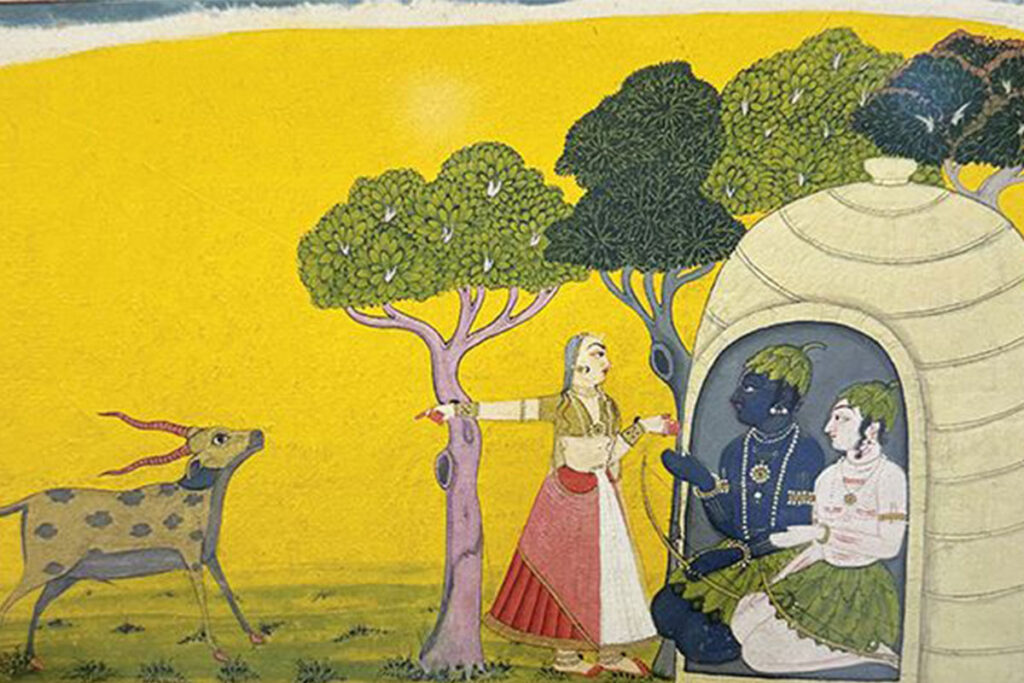
When Sita had insisted on accompanying Rama to the forest, Rama had alerted her to the many dangers in the wilderness, including especially the danger of deadly demons. During the forest stay, she had learnt to take the necessary precautions and had survived unhurt for nearly thirteen of the fourteen years. Even when sometimes a demon had appeared suddenly and seized her, Rama and Lakshmana had promptly rescued her.
After enduring an austere forest exile for thirteen years, Sita had for the first time allowed herself to indulge a little. And even that indulgence was motivated not by the desire for selfish pleasure, but by a desire for selfless service. When she had spotted an extraordinarily attractive deer frolicking near their hermitage, she had requested that Rama catch it not just as a pet for her, but also as a memento for her mother-in-law Kausalya, whom they were likely to meet after a year when their exile ended. When Rama had gone chasing after that deer and had been away for a long time, she started worrying whether her desire for that deer would cause her Lord any unnecessary inconvenience or worse still, get him into any unmanageable trouble. Though she knew about Rama’s matchless prowess, her natural love for him also made her fear for his well-being and safety.
Her worst fears seemed to have come true when she had heard a voice that sounded exactly like Rama’s, desperately calling out for help to Lakshmana and to her. She had fervently requested and then forcefully insisted that Lakshmana go immediately to his brother’s aid. When he had utterly refused to even consider her request, saying that Rama could be in no danger whereas she would be in danger if he left, she became desperate. Wanting to somehow do something to help Rama in case he was in danger, she flung on Lakshmana an accusation of dishonorable intentions toward her. Being unable to bear those hurtful words, he had left. Remember the shock and horror on his face had brought severe pain to her heart. She cared for and respected and trusted Lakshmana, yet she had had such a terrible altercation with him that left a bitter taste in her mouth and her heart. Had she been wrong in sending Lakshmana to aid Rama by whatever words were necessary to goad him into action?
While she had been waiting in the hermitage alone and worried about Rama’s and Lakshmana’s safety, she had had no headspace to spare for any thoughts about her own safety. When a sage had approached the hermitage for alms of food and had insisted that she serve him food immediately, she had unsuspectingly stepped outside the protective boundary that Lakshmana had created around their hermitage. To her utter horror, her goodness had been exploited by the wickedness of this so-called sage who had turned out to be the demon Ravana on a dark mission to abduct her.
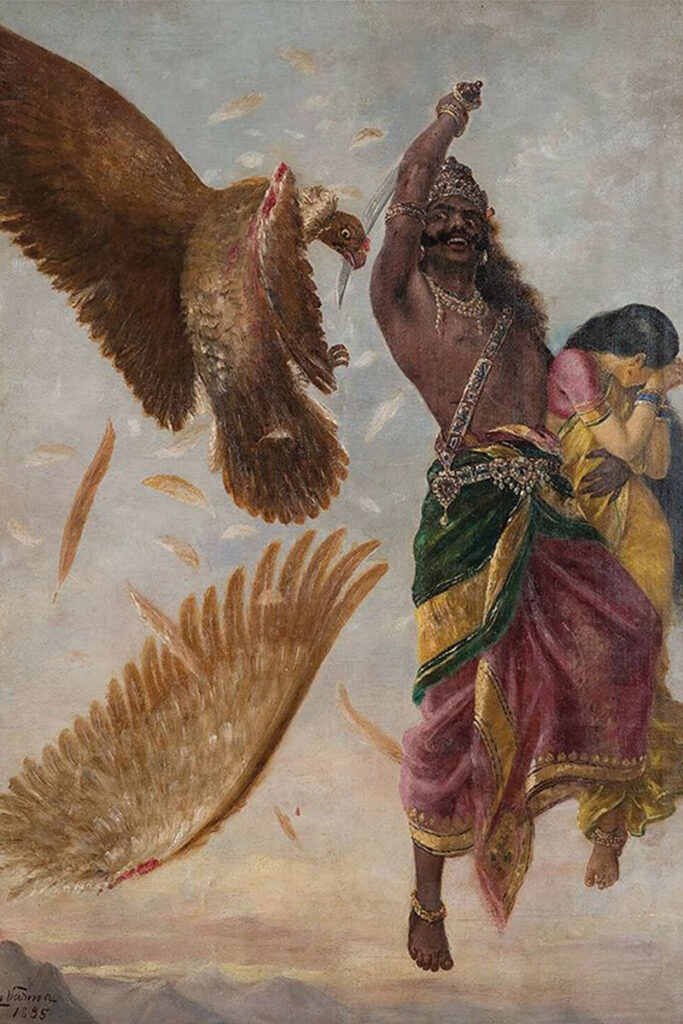
While she was being abducted, she had called out for help to anyone who might intervene. As she was being whisked away by Ravana in his airplane, she had spotted the elderly vulture Jatayu resting atop a tree. Being a warrior’s daughter and queen, she had immediately surmised that the bird would be no match for the powerful and ruthless Ravana. She had explicitly told Jatayu to not try to stop Ravana, but to just inform Rama about what had happened to her. Why, oh why, had Jatayu not listened to her? Why had he rushed to stop Ravana and had met a horrible end? Would Rama ever come to know where she was? But was she doomed to be abducted and lost forever?
Almost everything that could have gone wrong had gone wrong on that day. She had all reason to panic; she could have fallen apart in terror and despair. It would have been so easy to just give up hope. And yet she didn’t. Why not? Because she had faith that Rama loved her and Rama would come to protect her.
A Tiny Opening
With that faith, she kept her wits with her and stayed on the lookout for some opportunity to leave some clues about her whereabouts to Rama, who she was sure would come searching for her.
When Ravana was taking her through the skyways, she saw sitting far below a group of strange beings – they looked like a cross between humans and monkeys. Hearing her cry for help, they looked up. They had a kindly look about them, though they didn’t seem equipped to stop the mighty demon-king who was streaking through the sky high above them. Yet seeing their concerned expression, Sita intuited that they would help her as much as they could. She promptly took out some of the jewels ornamenting her, tied them in cloth and dropped them while she was being carried above them.
Those beings were celestial apes known as Vanaras. They were headed by Sugriva, the Vanara prince-in-exile, flanked by among others the heroic Hanuman as his chief advisor. They picked up the jewels and preserved them safely in their cave. Later, when they met Rama, Sugriva brought out the jewels to show him. On seeing those jewels, he broke down in the agony of separation. But from that agony also emerged a greater eagerness to find Sita. Rama thought: “If Sita’s abductor had wanted to devour her, he would have done so. That the demon had carried her with him indicated that he wanted her alive.” Rama felt the hope of finding Sita rising within him.
Three Steps To Go Far
Sita’s gesture in dropping those ornaments while being abducted was undoubtedly a tiny gesture, yet even that tiny gesture pointed to a mighty faith, a faith that she would not be abandoned by Rama, who would come to look for her. How can we remain faithful and do what we can when life seems to suddenly and severely work against us? When most people may tend to crumble and crash, giving up hope, how can we ensure that we keep moving forward? By focusing on three things we can do, which can be conveyed through an acronym FAR: Faith, Acceptance, Resourcefulness. These are things which can empower us to go as far as we need to till we come to light at the end of the tunnel.
Faith
If we look at only the particular set of reversals that have happened recently, then it’s easy to lose faith. But if we look at the bigger picture of our life, we can see that so many things could have gone wrong in so many ways during the course of our life. The very fact that we are alive is itself a miracle, considering how fragile our bodies are and how many people die long before they even get to our age. We may have done our part in ensuring that we survive and progress. Still, it is ultimately God who has kept us safe and brought us to our present place. And he has not brought us this far to abandon us now. The same Lord who has seen us through our many past troubles — not just the troubles that we knew about, even the troubles that we didn’t know about — that same Lord will take us through our present troubles too.
Acceptance
Faith helps us accept and acknowledge that whatever we are able to do is ultimately by our Lord’s arrangement and within his plan. And his plan, which is formed according to his infinite wisdom, is often inconceivable to our finite minds. According to his plan, sometimes our role may expand and sometimes it may shrink. Sometimes the ability that we have to change our externals may increase, and sometimes it may dramatically decrease. When our power to play our part has shrunk substantially, and indeed when even our part has shrunk substantially, it is our faith that can help us accept our humbler situation. We gracefully accept the situation that has come upon us within his plan and we seek to play our modified part accordingly.
What if our present situation has been created by causes that seem to be non-divine — by causes such as our own mistakes or the mistakes of the people around us? Is our situation still within the Lord’s plan? Yes, no human mistake can ever be so big as to disturb, leave alone disrupt, God’s plan. His plan is so expert and so subtly inclusive that it can continue to work on even through the ill-advised choices of the human participants in his plan, be they us or others.
By accepting that we are always parts of God, as stated in Bhagavad Gita 15.7, and therefore we always have parts in Krishna’s plan, we can accept our constrained situations. Rather than fixating on why our externals have changed so adversely for us, we can focus on using those externals for finding a path ahead.
Resourcefulness
Once we faithfully accept the smaller, humbler part that we presently have, then we can resourcefully direct our attention and energy toward playing that part as well as is possible. Even if everything around us seems dark, we can still find some way to do something to decrease that darkness around us. If we feel that we can absolutely do nothing to improve our situation, if we feel that we are utterly powerless to do anything about our situation, then we can jolt ourselves out of that stupor of illusion by asking ourselves a counterintuitive question: Can we make things worse? Obviously, we don’t want to make things worse, but if we answer this rhetorical question honestly, we can acknowledge that we can indeed make things worse. No matter how bad things are, we never lose the power to make them worse. And if we can make things worse, then we can make them better too; we are not as powerless as we think. The least we can do is think about ways in which we could make things worse and ensure that we don’t do any of those things.
Even if we are in a situation of utter external powerlessness, we are never in a situation of utter internal powerlessness. No matter how bad things are, our conscious awareness and our presence of mind are our resources that no one can steal from us – unless we let them. And we unwittingly let our mind steal those resources. When things go out of control, our mind too goes out of control by dwelling on those out-of-control things, sabotaging our capacity to respond constructively.
If we keep the resources within our control steady and ready, we can tap whatever opportunity comes our way. Just as Sita showed Rama her desire to be rescued by dropping her jewels, we too can show God our desire to be helped by doing whatever we can to make things better. Therefore, just because we seem helpless doesn’t mean we should help ourselves less. Rather than lamenting or blaming or resenting, we can focus on praying and improvising. Praying attracts the supreme power to arrange things beyond our control for our ultimate good; and improvising allows us to use the few things in our control creatively and constructively.
Such praying and improvising become easier when we have practiced directing our thoughts towards realities higher than the material and purposes higher than our material comforts and pleasures. It is in directing our thoughts thus that spirituality can offer us extraordinary empowerment. Spiritual wisdom helps us understand that in our inner world, we always have access to an inexhaustible source of energy, clarity, and positivity: our indwelling Lord. And he is just one thought away from us; we can connect with him simply by directing our thoughts toward him. Devotional directives to always remember the Divine are not just mindless rituals; they are time-tested strategies for inner empowerment by providing us an ever-available enriching and empowering object of thought.
The more we are resourceful in connecting with our indwelling Lord internally through remembrance, the more we will be guided by that very Lord to become resourceful externally for acting constructively (Gita 10.10).
On the path of our life-journey, even if life shuts down the streetlights, we can still turn on the flashlight of our devotional service attitude and keep moving forward one step at a time. Each step in the darkness of adversity can be guided by simple questions that will become our sources of light: “My dear Lord, how can I serve you in this situation? In your service, how can I act to make things better? And what can I learn through this situation so that I can become a better human being?” It is by such devotionally pragmatic driving questions that each one of us can become resourceful and go through and grow through life’s toughest adversities.
When we show that we want to be helped by doing whatever we can to help ourselves, we attract help in ways that we can foresee, from those around us — as well as in ways that we can’t foresee, from the One whom we can’t see.
Chaitanya Carana Dasa is the associate-editor of Back to Godhead (US and Indian editions). To read his daily Bhagavad-gita reflections, please subscribe to Gitadaily on his website, thespiritualscientist.com.
बीटीजी डिजिटल पत्रिका की सदस्यता लें
BTG डिजिटल मैगज़ीन के साथ कृष्ण भावनामृत के अपने पथ पर आगे बढ़ें! अभी सदस्यता लें और हमारे समुदाय द्वारा साझा की गई विकास, आत्मज्ञान और जुड़ाव की प्रेरणादायक कहानियों को जानें।
सदस्यता लें