


His Life and Teachings
A luminous portrait of Bharata—often misunderstood yet
unwavering in devotion—revealing how humility, sacrifice, and
love in separation define the highest ideals of dharma and bhakti.
By Devasekhara Vishnu Dasa
Life is a test, and even the most honest hearts can be tragically misunderstood, forced to prove their loyalty time and again. Prince Bharata from the Ramayana is a prime example of this universal truth. Despite his unwavering devotion to Lord Ramacandra, he was cast as a tragic hero—wrongly assumed to be an accomplice in his brother’s exile.
From the moment he returned to Ayodhya, Bharata was burdened with the task of proving his innocence—not only to his stepmother Kaushalya, his guru, and his brother Lakshmana, but also to the citizens and well-wishers of Ayodhya. Srila Prabhupada, in his purport to Srimad-Bhagavatam 2.7.23, comments: “Lord Rama is the Supreme Personality of Godhead, and His brothers, namely Bharata, Lakshmana and Satrughna, are His plenary expansions. All four brothers are Vishnu-tattva and were never ordinary human beings.”
Despite being divine, Bharata had to walk a path filled with suspicion and sorrow, all while remaining steadfast in his devotion to his brother Rama, the crest jewel of the Solar dynasty. This article explores the life of this tragic hero, tracing the seminal moments of his journey as depicted in the sacred Ramayana.
Childhood and Maternal Lineage
Bharata was the second of the four sons of King Dasaratha of Ayodhya, born to his youngest and most beloved queen, Kaikeyi. His maternal roots traced back to the Kekaya kingdom; his maternal grandfather was King Asvapati.
Bharata’s childhood was marked by a deep and abiding bond with his brothers. The four princes—Rama, Lakshmana, Bharata, and Satrughna—were inseparable, their affection celebrated throughout the epic. Bharata, in particular, was known for his intense love for Lord Rama, viewing his eldest brother not merely as a sibling but as a spiritual guide.
All four sons of King Dasaratha were epitomes of beauty, knowledge, and discipline. They understood the etiquette of relationships and strictly followed the customs and moral codes of society.
The Return to a Kingdom of Sorrow
Bharata had been residing in the Kekaya kingdom with his maternal grandparents for several years. When messengers suddenly summoned him back to Ayodhya without explanation, he was bewildered by the urgency.
Upon his return, Bharata was met not with celebration but with an eerie silence and a city draped in mourning. Disturbed by the absence of Lord Rama, Sita, and Lakshmana, he soon learned the horrifying truth from his mother Kaikeyi, who recounted—with a sense of triumph—how she had exiled Lord Rama for fourteen years and secured the throne for Bharata.
Her words struck him like a thunderbolt. Bharata’s sorrow was not mere grief; it was spiritual agony born of injustice toward his brother and father. The Valmiki Ramayana records Bharata’s searing rebuke of his mother. He condemns her as the cause of the family’s suffering and declares: “Though in appearance you are my mother, you are inimical to me. You are a cruel woman, greedy for the kingdom. With evil conduct, you killed your husband. I should never speak to you.” (Ayodhya Kanda 2.74.7)
He rejected outright any kingdom gained through treachery and deceit, proclaiming his complete disassociation from her actions. Demonstrating both his innocence and his intense devotion to Lord Rama, Bharata resolved to find his brother, seek forgiveness on behalf of the family, and restore Rama to His rightful place.
As stated in Ayodhya Kanda 2.74.31, Bharata declares: “Rama, the son of Kausalya and of great prowess, will be brought back to Ayodhya, and I myself will go to the forest inhabited by sages.”
Rama–Bharata Milana at Citraküma
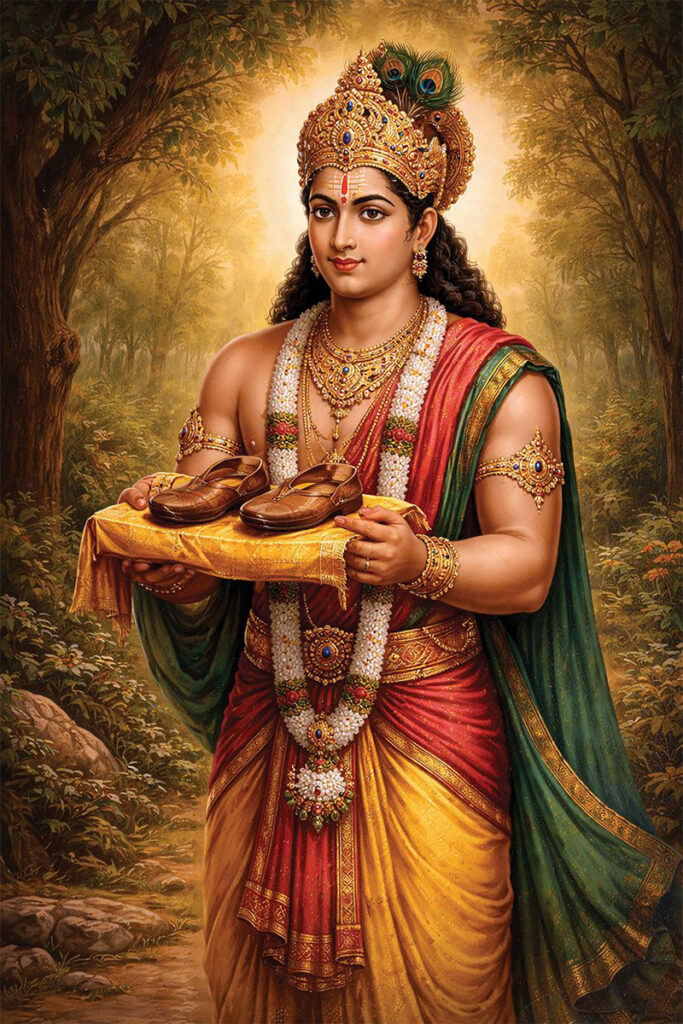
Driven by a deep desire for atonement, Bharata journeyed to the forest of Citraküma, accompanied by the royal court, queens, ministers, and a vast army. When he finally beheld Lord Rama, the reunion was heart-rending. Bharata fell at Rama’s feet, his body wracked with sobs. It was not a meeting of prince and king, but of a devotee and his Lord.
A profound philosophical dialogue followed, forming the moral heart of this episode. Lord Rama instructed Bharata on the duties of a king. Bharata pleaded fervently for Rama’s return, arguing that King Dasaratha’s promise to Kaikeyi had been extracted under duress and should not bind Him.
But Lord Rama, the unwavering embodiment of dharma, replied resolutely: “The moon may lose its light, the Himalayas may shed their snow, the ocean may transgress its shores—but I will never violate my father’s vow.” (Ayodhya Kanda 2.112.18)
Accepting Rama’s decision, Bharata requested His sandals (padukas). Placing them upon his head, Bharata declared that they would rule Ayodhya for the fourteen years of exile.
This episode exemplifies Bharata’s ananya-bhakti. Though Rama refused to return, Bharata ensured that Rama remained the center of his life. By enthroning the sandals, he taught us that our only true goal is to place Krishna—or Rama—at the center of our existence and reject anything less.
Self-Imposed Austerity at Nandigrama
Returning to Ayodhya, Bharata refused to enter the city. Instead, he resided in Nandigrama, on its outskirts, living as an ascetic for fourteen years. He wore garments of bark, kept matted hair, and subsisted on fruits and roots.
After ceremonially enthroning the sandals of Lord Rama, Bharata governed the kingdom solely as a custodian. Every matter of state was first symbolically presented before the padukas before action was taken.
To further emulate his exiled brother, Bharata undertook extreme austerities. He slept not on a bed but in a pit dug into the ground and subsisted on barley cooked in cow urine. These practices—far exceeding even typical ascetic standards—demonstrated his unwavering solidarity with Lord Rama.
Though possessing every royal luxury, Bharata lived as a servant, fully aware that Rama alone was the true king of Ayodhya. As stated in Bhagavad-gita 5.29, one who knows the Lord as the ultimate beneficiary and well-wisher attains peace. Bharata lived this truth, acting not as proprietor or enjoyer, but as the Lord’s representative.
As the fourteen years neared completion, Bharata’s longing for Lord Rama became unbearable. At that moment, Hanuman arrived in Nandigrama with news of Rama’s victory and return.
Seeing Bharata emaciated from austerity and seated beside the sandals, Hanuman spoke words of divine reassurance: “O Lord! I bring you joyful news. Abandon this dreadful sorrow. Very soon you will meet your elder brother Rama.” (Yuddha Kanda 6.125.37)
Overwhelmed with joy, Bharata fainted. For fourteen years he had lived in viraha-bhava, a state of devotion considered even higher than direct association. This intense separation deepened his remembrance and service daily, resembling the exalted mood of the gopis, especially Srimati Radharani.
Soul Meets Soulmate
The culmination of Bharata’s journey came with the grand reunion at Nandigrama. As the Pushpaka Vimana descended, Bharata ran forward, tears streaming from his eyes. Overcome with emotion, he lay prostrate, refusing to rise.
The Valmiki Ramayana describes how Lord Rama forcibly lifted Bharata and embraced him, His lotus eyes overflowing with tears of love. The reunion was not merely emotional—it was spiritual and symbolic.
Bharata ceremonially returned the sandals and the kingdom to Lord Rama, completing his service as a selfless custodian. His sacrifice was total and without reservation.
Bharata’s life—especially during the fourteen years of Lord Rama’s exile—is a perfect demonstration of pure devotional service. His rejection of power, his unwavering humility, and his love in separation reveal the essence of unalloyed bhakti.
By enthroning the Lord’s sandals, Bharata showed that devotion means rejecting the false sense of proprietorship. His constant yearning kept his consciousness fixed entirely on Rama.
For us, Srila Prabhupada instructs engagement in uninterrupted devotional service—hearing, chanting the Hare Krishna maha-mantra, deity worship, and prayer—so that remembrance of the Lord never fades.
Above all, Bharata exemplifies saranagati. Though he failed in bringing Rama back, he immediately accepted the Lord’s will and served accordingly. Surrender to Krishna’s will alone leads to ultimate glory.
Let us pray at the lotus feet of Lord Ramacandra to bless us with the same dedication, surrender, and attraction shown by Bharata.
Devsekhara Vishnu Dasa is a disciple of H.H. Gopala Krishna Gosvami and a native of Ayodhya. A B.Tech. graduate by training, he has taught the Bhagavad-gita to over one million registered learners through online platforms. He currently serves as the Project Director of ISKCON Ayodhya and is also a member of the ISKCON Communications Team and a faculty member at the Mayapur Institute.