Pilgrimage Sites or Picnic Spots?

Free to Read
5 mins September, 2026
00:00
00:00

Reclaiming sacred spaces from the grip of material consciousness

By Prabhupada Ashraya Dasa


In the age of Instagram reels and travel vlogs, even the  holiest of places are not spared from the lens of material enjoyment. Temples, dhamas, andtirthas—once revered as portals to transcendence—are increasingly approached as tourist destinations, picnic spots, or backdrops for selfies. The question arises: Have we forgotten the sanctity of our religious places? More importantly, what do our acharyas say about this shift in consciousness?


Srila Prabhupada, the founder-acharya of the International Society for Krishna Consciousness (ISKCON), was deeply concerned about this trend. He often warned that visiting holy places without proper spiritual intent is not only futile but can be spiritually detrimental. This article explores the material and spiritual dimensions of pilgrimage, drawing from the teachings of Srila Prabhupada and other acharyas, and offers a path to reclaim the sacredness of our religious spaces.


The Material Mindset: Pilgrimage as Entertainment


In modern times, pilgrimage has often been reduced to a checklist item—something to “do” for social prestige, family tradition, or even recreation. The symptoms of this mindset are visible:

– Loud music and dancing in temple premises

– Littering and consumption of packaged food in sacred areas

– Selfie culture overtaking darshan culture

– Shopping and sightseeing prioritized over spiritual practices


Srila Prabhupada called this “pilgrimage for sense gratification.” In a lecture in Vrindavan, he remarked: “People go to Vrindavan and Mathura, but they do not know what is Vrindavan. They go there for recreation, not for spiritual realization. That is not the purpose of visiting a holy place.”


This attitude stems from a misunderstanding of the purpose of tirtha-yatra (pilgrimage). Instead of purifying the heart, it becomes another avenue for enjoying the senses—ironically, in places meant to transcend them.


Srila Prabhupada emphasized that visiting a holy place should be an act of surrender, not sightseeing. In his purports to the Srimad-Bhagavatam and Bhagavad-gita, he repeatedly stressed that the purpose of pilgrimage is to associate with saintly persons and deepen one’s devotion. In Bhagavad-gita 4.34, he writes, “Just try to learn the truth by approaching a spiritual master. Inquire from him submissively and render service unto him.” He explains that the real benefit of visiting a holy place is not the geography but the sadhu-sanga—the association of devotees who reside there. Without this, the visit is hollow.


In Srimad-Bhagavatam (1.13.10), Srila Prabhupada writes, “One should not make a business of visiting temples. The purpose of visiting a holy place is to hear from the saintly persons residing there.” Thus, the transformation lies not in the location but in the consciousness. A temple is not a picnic spot—it is a spiritual hospital, a place for healing the soul.


The Acharyas Speak: A Tradition of Reverence


The Gaudiya Vaishnava acharyas have consistently upheld the sanctity of holy places. Srila Bhaktisiddhanta Sarasvati Thakura was known for his strong stance against superficial pilgrimage. He once said: “Don’t try to see Krishna. Try to act in such a way that Krishna will want to see you.” He discouraged idle wandering in holy places and emphasized service and hearing as the real pilgrimage.


Similarly, Srila Rupa Gosvami in his Bhakti-rasamrita-sindhu, outlines the limbs of devotional service, including visiting holy places with proper consciousness. He warns that without humility and devotion, even sacred geography becomes mundane. The Padma Purana also cautions: “A person who visits holy places but does not change his heart is like an elephant bathing—he washes off the dirt but rolls in it again.”


These teachings reveal a consistent theme: the holy place is not for entertainment but for enlightenment.


Material vs. Spiritual Connection


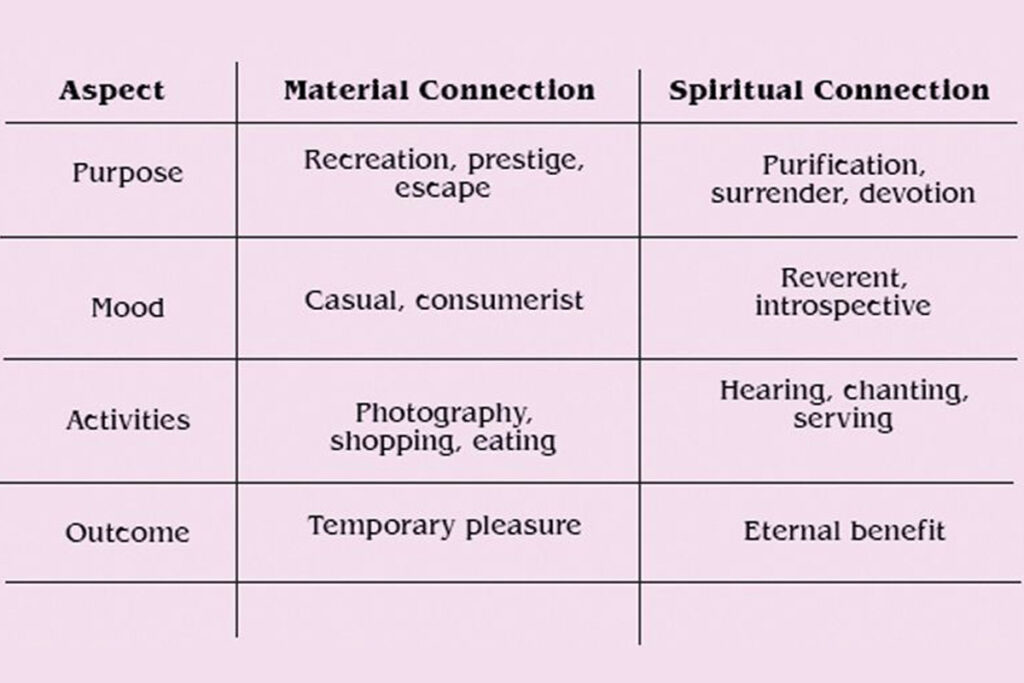
Let us examine the difference between a material and spiritual connection to religious places:


The materialist sees the temple as a structure; the devotee sees it as Krishna’s home. The materialist seeks entertainment; the devotee seeks transformation.


One subtle danger is the loss of reverence due to familiarity. When we live near a temple or visit frequently, we may begin to take it for granted. Srila Prabhupada warned against this: “Familiarity breeds contempt. Even in Vrindavan, people are engaged in material activities. They do not understand the value of the place.”


This is especially relevant for devotees living in dhamas or serving in temples. The sacred must never become routine. Every visit should be a fresh offering of love and surrender.

Reclaiming the Sacred


So how do we reclaim our religious places from the grip of material consciousness? Here are some practical steps:


  • 1. Educate the visitors: Temples should offer orientation sessions or signage that explains the sanctity of the space. Visitors must be gently reminded that this is not a tourist spot but a spiritual sanctuary.

  • 2. Encourage sadhu-Sanga: Pilgrimage should include hearing from senior devotees, attending kirtans, and engaging in service. This transforms the visit from passive to participatory.

  • 3. Promote cleanliness and etiquette: Devotees should model respectful behavior—no loud talking, littering, or casual attire. Cleanliness is next to godliness.

  • 4. Offer spiritual experiences: Instead of entertainment, temples can offer guided meditations, japa walks, and seva opportunities. This engages the heart, not just the senses.

  • 5. Cultivate internal pilgrimage: Ultimately, the real pilgrimage is within. Srila Prabhupada said, “Vrindavan is not a geographical location. It is a state of consciousness.” Even if we cannot visit a dhama physically, we can enter it through remembrance, service, and devotion.


During a recent visit to a temple, I saw a group of young people laughing and taking selfies in front of the deity. Their joy was genuine, but their understanding was shallow. I felt a pang of sadness—not judgment, but concern. I remembered Srila Prabhupada’s words, “If you go to a holy place and do not hear from the saintly persons, your visit is useless.”


I prayed that someday they would return—not for photos, but for darshan. Not for fun, but for faith.


Religious places are not picnic spots. They are sacred spaces where the soul meets the divine. Srila Prabhupada and our acharyas have given us a clear roadmap: approach with humility, engage in service, and seek transformation.


Let us not reduce the temple to a tourist attraction. Let us elevate it to its true glory—a gateway to Goloka, a mirror of the spiritual world, a home for the heart. In the words of Srila Prabhupada: “Come to the temple not to see, but to be seen by Krishna.”


May our pilgrimages be purposeful, our visits be reverent, and our hearts be transformed.


Prabhupada Ashraya Dasa serves as the General Manager and Secretary at ISKCON Aravade, where he orchestrates events, nurtures community engagement, and crafts spiritually resonant communications. Fluent in Marathi, Hindi, and English, he blends heartfelt storytelling with meticulous organization and uplift devotees through creative outreach.

Subscribe to BTG Digital Magazine

Embark on your path to Krishna consciousness with BTG Digital Magazine! Subscribe now and discover inspiring stories of growth, enlightenment, and connection shared by our community.

Subscribe

Pilgrimage Sites or Picnic Spots?

Pilgrimage Sites or Picnic Spots?
Listen to Article
Press Play to listen

Reclaiming sacred spaces from the grip of material consciousness

By Prabhupada Ashraya Dasa


In the age of Instagram reels and travel vlogs, even the  holiest of places are not spared from the lens of material enjoyment. Temples, dhamas, andtirthas—once revered as portals to transcendence—are increasingly approached as tourist destinations, picnic spots, or backdrops for selfies. The question arises: Have we forgotten the sanctity of our religious places? More importantly, what do our acharyas say about this shift in consciousness?


Srila Prabhupada, the founder-acharya of the International Society for Krishna Consciousness (ISKCON), was deeply concerned about this trend. He often warned that visiting holy places without proper spiritual intent is not only futile but can be spiritually detrimental. This article explores the material and spiritual dimensions of pilgrimage, drawing from the teachings of Srila Prabhupada and other acharyas, and offers a path to reclaim the sacredness of our religious spaces.


The Material Mindset: Pilgrimage as Entertainment


In modern times, pilgrimage has often been reduced to a checklist item—something to “do” for social prestige, family tradition, or even recreation. The symptoms of this mindset are visible:

– Loud music and dancing in temple premises

– Littering and consumption of packaged food in sacred areas

– Selfie culture overtaking darshan culture

– Shopping and sightseeing prioritized over spiritual practices


Srila Prabhupada called this “pilgrimage for sense gratification.” In a lecture in Vrindavan, he remarked: “People go to Vrindavan and Mathura, but they do not know what is Vrindavan. They go there for recreation, not for spiritual realization. That is not the purpose of visiting a holy place.”


This attitude stems from a misunderstanding of the purpose of tirtha-yatra (pilgrimage). Instead of purifying the heart, it becomes another avenue for enjoying the senses—ironically, in places meant to transcend them.


Srila Prabhupada emphasized that visiting a holy place should be an act of surrender, not sightseeing. In his purports to the Srimad-Bhagavatam and Bhagavad-gita, he repeatedly stressed that the purpose of pilgrimage is to associate with saintly persons and deepen one’s devotion. In Bhagavad-gita 4.34, he writes, “Just try to learn the truth by approaching a spiritual master. Inquire from him submissively and render service unto him.” He explains that the real benefit of visiting a holy place is not the geography but the sadhu-sanga—the association of devotees who reside there. Without this, the visit is hollow.


In Srimad-Bhagavatam (1.13.10), Srila Prabhupada writes, “One should not make a business of visiting temples. The purpose of visiting a holy place is to hear from the saintly persons residing there.” Thus, the transformation lies not in the location but in the consciousness. A temple is not a picnic spot—it is a spiritual hospital, a place for healing the soul.


The Acharyas Speak: A Tradition of Reverence


The Gaudiya Vaishnava acharyas have consistently upheld the sanctity of holy places. Srila Bhaktisiddhanta Sarasvati Thakura was known for his strong stance against superficial pilgrimage. He once said: “Don’t try to see Krishna. Try to act in such a way that Krishna will want to see you.” He discouraged idle wandering in holy places and emphasized service and hearing as the real pilgrimage.


Similarly, Srila Rupa Gosvami in his Bhakti-rasamrita-sindhu, outlines the limbs of devotional service, including visiting holy places with proper consciousness. He warns that without humility and devotion, even sacred geography becomes mundane. The Padma Purana also cautions: “A person who visits holy places but does not change his heart is like an elephant bathing—he washes off the dirt but rolls in it again.”


These teachings reveal a consistent theme: the holy place is not for entertainment but for enlightenment.


Material vs. Spiritual Connection


Let us examine the difference between a material and spiritual connection to religious places:


The materialist sees the temple as a structure; the devotee sees it as Krishna’s home. The materialist seeks entertainment; the devotee seeks transformation.


One subtle danger is the loss of reverence due to familiarity. When we live near a temple or visit frequently, we may begin to take it for granted. Srila Prabhupada warned against this: “Familiarity breeds contempt. Even in Vrindavan, people are engaged in material activities. They do not understand the value of the place.”


This is especially relevant for devotees living in dhamas or serving in temples. The sacred must never become routine. Every visit should be a fresh offering of love and surrender.


Reclaiming the Sacred


So how do we reclaim our religious places from the grip of material consciousness? Here are some practical steps:


  • 1. Educate the visitors: Temples should offer orientation sessions or signage that explains the sanctity of the space. Visitors must be gently reminded that this is not a tourist spot but a spiritual sanctuary.

  • 2. Encourage sadhu-Sanga: Pilgrimage should include hearing from senior devotees, attending kirtans, and engaging in service. This transforms the visit from passive to participatory.

  • 3. Promote cleanliness and etiquette: Devotees should model respectful behavior—no loud talking, littering, or casual attire. Cleanliness is next to godliness.

  • 4. Offer spiritual experiences: Instead of entertainment, temples can offer guided meditations, japa walks, and seva opportunities. This engages the heart, not just the senses.

  • 5. Cultivate internal pilgrimage: Ultimately, the real pilgrimage is within. Srila Prabhupada said, “Vrindavan is not a geographical location. It is a state of consciousness.” Even if we cannot visit a dhama physically, we can enter it through remembrance, service, and devotion.


During a recent visit to a temple, I saw a group of young people laughing and taking selfies in front of the deity. Their joy was genuine, but their understanding was shallow. I felt a pang of sadness—not judgment, but concern. I remembered Srila Prabhupada’s words, “If you go to a holy place and do not hear from the saintly persons, your visit is useless.”


I prayed that someday they would return—not for photos, but for darshan. Not for fun, but for faith.


Religious places are not picnic spots. They are sacred spaces where the soul meets the divine. Srila Prabhupada and our acharyas have given us a clear roadmap: approach with humility, engage in service, and seek transformation.


Let us not reduce the temple to a tourist attraction. Let us elevate it to its true glory—a gateway to Goloka, a mirror of the spiritual world, a home for the heart. In the words of Srila Prabhupada: “Come to the temple not to see, but to be seen by Krishna.”


May our pilgrimages be purposeful, our visits be reverent, and our hearts be transformed.


Prabhupada Ashraya Dasa serves as the General Manager and Secretary at ISKCON Aravade, where he orchestrates events, nurtures community engagement, and crafts spiritually resonant communications. Fluent in Marathi, Hindi, and English, he blends heartfelt storytelling with meticulous organization and uplift devotees through creative outreach.