


When God Spoke — and Still Speaks
By Charu Bali
During Gita Jayanti each year, I find myself drawn back to that sacred moment on the battlefield of Kurukshetra — the moment when time stood still, and the Supreme Lord chose to speak.
It was not in a temple, nor in the serenity of a forest hermitage, but amidst the dust, the clanging of weapons, and the trembling heart of a warrior. In that chaos, Krishna’s voice emerged — calm, compassionate, and eternal.
Sometimes I wonder — why did the Lord choose a battlefield to reveal the most peaceful and profound message of the ages? Perhaps because every human heart is a Kurukshetra. Each of us stands, like Arjuna, facing our own wars — between duty and desire, conviction and confusion, surrender and control.
When I open Bhagavad-gitaand read Arjuna’s trembling words — “Now I am confused about my duty and have lost all composure because of weakness” (Bg. 2.7) — I see not a distant hero, but myself. Srila Prabhupada writes that Arjuna’s hesitation was not weakness, but the beginning of wisdom — the humility to admit, “I do not know; I must hear from Krishna.”
That is where the Gita begins. Not with pride, but with surrender. Not with answers, but with a prayer to be guided.
Kurukshetra was not just a field of war—it was the battlefield of the heart. When Arjuna, the mightiest of warriors, saw his loved ones standing before him, his resolve melted. His bow slipped from his hand, his limbs trembled, and he sank into despair. “Govinda, I shall not fight,” he said (Gita 1.47).
In that moment, Arjuna became every one of us. Each of us faces our own Kurukshetra — the inner conflict between duty and desire, reason and emotion, self-interest and selflessness. It appears in our offices, where ambition wrestles with integrity. It surfaces in our families, where love demands sacrifice. It arises within, when we struggle between what we want and what we ought to do.
The Gita does not tell us to run away from these battlefields; it teaches us how to stand and fight — with consciousness. Krishna’s instruction to Arjuna, “Fight for the sake of fighting,without considering happiness or distress, loss or gain, victory or defeat” (Gita 2.38), is not a call to violence but to detachment — to act without selfish motive and to let the Lord be the doer.
Srila Prabhupada explains that true spirituality is not about changing our work but changing our consciousness while we work. The battlefield may remain, but our heart becomes sanctified when we act as Krishna’s instrument.
When Arjuna, overwhelmed, finally turned to Krishna and said, “Now I am confused about my duty and have lost all composure because of weakness. Please instruct me” (Gita 2.7), the real battle began — not with weapons, but with surrender. Srila Prabhupada writes, “When a man is confused in his duty, he should not act blindly but should approach a spiritual master for guidance.” That single moment of surrender transformed Arjuna’s despair into the doorway to divine wisdom. And it can do the same for us.
When I first grasped this, the Gita stopped being a book and became a mirror. It began to show me my attachments, my fears, and the smallness of my surrender. It reminded me that Krishna is not asking for perfection — only for participation. He asks that we act for Him, think of Him, and remember Him — and then He promises to take care of the rest.
The words of the Bhagavad-gita are not relics preserved in scripture; they are living instructions, spoken by the eternal Lord for a world that is still restless and searching. Though the dialogue took place five thousand years ago, its sound continues to echo through the ages — the compassionate call of Krishna to every bewildered soul.
In this age of anxiety and endless distraction, His assurance still resounds: “For one who has conquered the mind, the mind is the best friend; for one who has failed to do so, the mind will remain the greatest enemy.” (Gita 6.6) When life feels like a race between gain and loss, success and failure, He gently reminds us: “You have a right to perform your prescribed duty, but not to the fruits thereof.” (Gita 2.47) And to a humanity divided by boundaries of nation, creed, and class, He reveals the truth that unites us all: “I am the seed-giving father of all living entities.” (Gita 14.4)
The Gita speaks not to one category of people, but to every sincere heart — to kings and clerks, monks and mothers, scientists and students — to anyone who has ever felt lost in the noise of life and longed for a steady voice of guidance. Srila Prabhupada writes in his introduction to Bhagavad-gita: “The Gita is meant for delivering mankind from the nescience of material existence. It teaches us to act for Krishna and thus become free from all reactions.”
The world may change — empires may rise and fall, languages may fade, technologies may advance — but Krishna’s voice remains the same. It is the voice beyond time, calling each of us to awaken, to remember, and to return to our eternal relationship with Him.
Five thousand years have passed since that conversation, yet every time I open the Gita, Krishna speaks again. His words are not locked in time; they are alive. Srila Prabhupada once said, “We do not read the Bhagavad-gita; we hear it directly from Krishna.”
That is the miracle of the Gita — it is not philosophy on paper, but a divine dialogue that continues through parampara. Through Srila Prabhupada, the same voice that spoke to Arjuna now speaks to us.
When Srila Prabhupada boarded the Jaladuta in 1965 with a few boxes of Bhagavad-gita, he was carrying the eternal sound of Kurukshetra across the oceans. The world had heard many translations before, but none that revealed Krishna as the Supreme Person, the loving friend of all beings.
Through his purports, Krishna’s words regained their original sweetness and authority. The Gita was no longer a text to be analyzed; it became a relationship to be lived. Srila Prabhupada often said, “The Bhagavad-gita is the summary of the whole Vedic knowledge.” But more than that — it is Krishna’s invitation to come home.
Every December, as Gita Jayanti coincides with the Book Distribution Marathon in ISKCON, I’m reminded that Kurukshetra is not only a battlefield of surrender — it’s also a battlefield of compassion. When devotees go out to share the Gita, they are continuing Arjuna’s service. Each book handed out is another chariot waiting to be drawn by Krishna. Each seeker who opens it becomes another Arjuna, waiting to be guided.
I once heard a senior devotee say, “The sound of sankirtan is Krishna speaking again through His devotees.” How true that is! When we distribute Prabhupada’s books, we are not merely spreading information — we are offering Krishna’s voice to a world that has forgotten how to listen.
Srila Prabhupada once told his disciples, “Distribute books and your life will be perfect.” That statement is not about numbers or achievements — it’s about participation in Krishna’s compassion. It’s about becoming an instrument. When we serve in that mood, the battlefield of Kurukshetra merges with the battlefield of sankirtana — both are arenas where the Lord’s plan unfolds through the surrender of His devotee.
The Bhagavad-gita is often called the Gitopanishad — the essence of all Vedic wisdom. Within its seven hundred verses, Krishna reveals the heart of the Upanishads, the conclusion of the Vedanta, and the mercy of the Puranas — all distilled into one eternal conversation between the Lord and His devotee.
In Chapter 15, verse 15, Krishna declares: “By all the Vedas, I am to be known. Indeed, I am the compiler of Vedanta, and I am the knower of the Vedas.” Srila Prabhupada explains with such simplicity and grace: “The purpose of studying the Vedas is to understand Krishna. One who is engaged in devotional service has already understood everything.”
Every path — karma, jnana, or dhyana — eventually leads to this single truth: that all knowledge, all austerity, all endeavor finds its fulfillment in loving surrender to the Supreme. Step by step, Krishna leads the soul through duty, knowledge, and meditation until He finally reveals the secret of all secrets: “Abandon all varieties of religion and just surrender unto Me. I shall deliver you from all sinful reactions. Do not fear.” (Gita 18.66) This verse stands like the golden sun rising over the horizon of all scriptures. It is not merely a command; it is a promise — a tender assurance from the Lord that surrender is not defeat, but the beginning of true freedom.
Some people think the Gita is an ancient scripture meant for seers or scholars, but the more I live with it, the more I see — it’s meant for me, for all of us.Krishna’s words are timeless because the soul’s struggle never changes. We may now hold smartphones instead of bows, but the confusions of the heart remain the same.
“To those who are constantly devoted to serving Me with love, I give the understanding by which they can come to Me.” (Gita 10.10) Every time I read this verse, I feel Krishna’s promise whispering softly — “Just remember Me, and I will guide you.”
In moments of doubt, the Gita becomes my anchor. In times of pride, it becomes my mirror. And in times of weakness, it becomes my shelter. It teaches me that Krishna does not love me because I am strong; He loves me even when I am bewildered, just as He loved Arjuna before the battle began.
Gita Jayanti is not just a festival; it is an invitation. It calls every soul to rediscover the divine dialogue between God and His devotee.
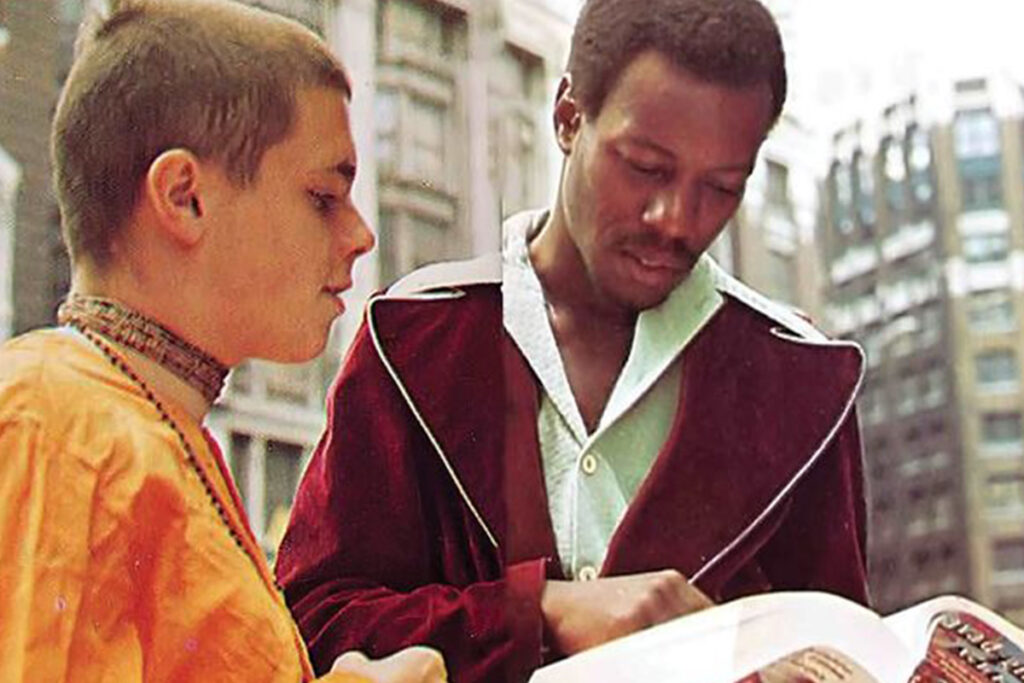
The battlefield may look different today — crowded offices, silent hospital rooms, busy highways—but the war remains the same: the struggle between illusion and remembrance, between selfishness and surrender.
Kurukshetra is not far away. It is within us. And victory does not come when we defeat others, but when we allow Krishna to conquer our heart. Srila Prabhupada concludes in his preface: “If one reads Bhagavad-gita very sincerely and with all seriousness, then by the grace of the Lord, the reaction of knowledge will act upon him. There will be enlightenment, and Krishna will reveal Himself.”
So this Gita Jayanti, let us do just that. Let us open the Gita once more, not as readers but as seekers. Let us hear Krishna again. Let us live by His words. Let us share them with others.
For the Bhagavad-gita is not merely a scripture — it is the Lord’s song of love. And its call still resounds — from Kurukshetra to every heart willing to listen.
Charu Bali serves with the India Tribal Care Trust, supporting initiatives in tribal welfare and education, and is actively engaged in tribal upliftment and spiritual outreach initiatives. An MBA and event curator by profession, she lives in Dwarka, Delhi, and has been practicing Krishna consciousness under the guidance of His Holiness Radhanatha Swami Maharaja.