The Night of Janmashtami

Free to Read
9 mins September, 2026
00:00
00:00

A renowned Sri Vaishnava scholar has given
interesting insights into the episode of Lord Krishna’s birth.


By Kaustubh Narasimhan


Come Sravana-masa and  Bhadrapada-masa of the Vedic calendar (the month of August in the English calendar), and all the followers of Sanatana-dharma celebrate the most auspicious festival of the entire year — Sri Krishna Janmashtami. Observed with grandeur and resplendence in many parts of the country, Janmashtami sure marks an occasion of happiness for the entire country.


Traditionally, Sri Krishna Janmashtami is referred to by the words “Sri Krishna Jayanti.” Having heard this word jayanti too often in connection with many other noble occasions in India, we may be unaware of its true meaning. Sri Vedanta Desika, a renowned Sri Vaishnava acharya, cherishes this word in his epic classical description of Sri Krishna’s pastimes called the Yadavabhyudayam. Indeed, he starts this maha-kavya employing the same word:

vande vrindavana-caraà vallavi-jana-vallabham
jayanti-sambhavaà dhama vaijayanti-vibhushanam 


The word jayanti-sambhavaà indicates “one who appeared on the occasion of jayanti.” The commentary to this verse explains its meaning. Jayaà ca punyaà ca tanute: “the sacred time that brings victory (jaya) and merit (punya) to everybody.” And that time is further explained as rohini-sahita sravana-bahulashtami — “the time at which the star named Rohini and the eighth day of the waning moon of the month Sravana come in contact with each other.” Moreover, Jayanti is also the name of that auspicious muhurta in which five planets are in their exaltations, with the Taurus as the ascendant with the Moon. Hence, considering all the above factors, one can safely conclude that this time of Krishna’s appearance in this world is certainly the rarest of rare occasions.


Hence, the word Jayanti is reserved only for the day of Krishna’s appearance in the strict sense of the term. Though many other festivals in India are also indicated using the same word, we can understand that they don’t stand good sense, since the word refers to a specific time frame in which Lord Krishna appeared.


WHAT EXACTLY HAPPENED IN MATHURA?


The first three chapters of the Tenth Canto of the Srimad-Bhagavatam give a vivid description of the exalted attributes that Mathura showed on the night of appearance of Krishna. And so does Sri Vedanta Desika in his Yadavabhyudayam.


As Devaki and Vasudeva spent their evening in prison of Kaàsa, Vasudeva observed an uncommon radiance and resplendence in Devaki’s countenance. The Srimad-Bhagavatam (10.2.20) describes Devaki as prabhayajitantaraà virocayantià bhavanaà suci-smitam: “One who because of keeping Ajita or the Unconquerable Lord within Herself was illuminating the entire atmosphere of the house and was smiling brilliantly.” In the Yadavabhyudayam, she is described as:

athagamanamanaghena bhumna

dharmasya purnena dhanagamena

divaukasaà darsayata vibhutià

devi babhau dauhridalakshanena
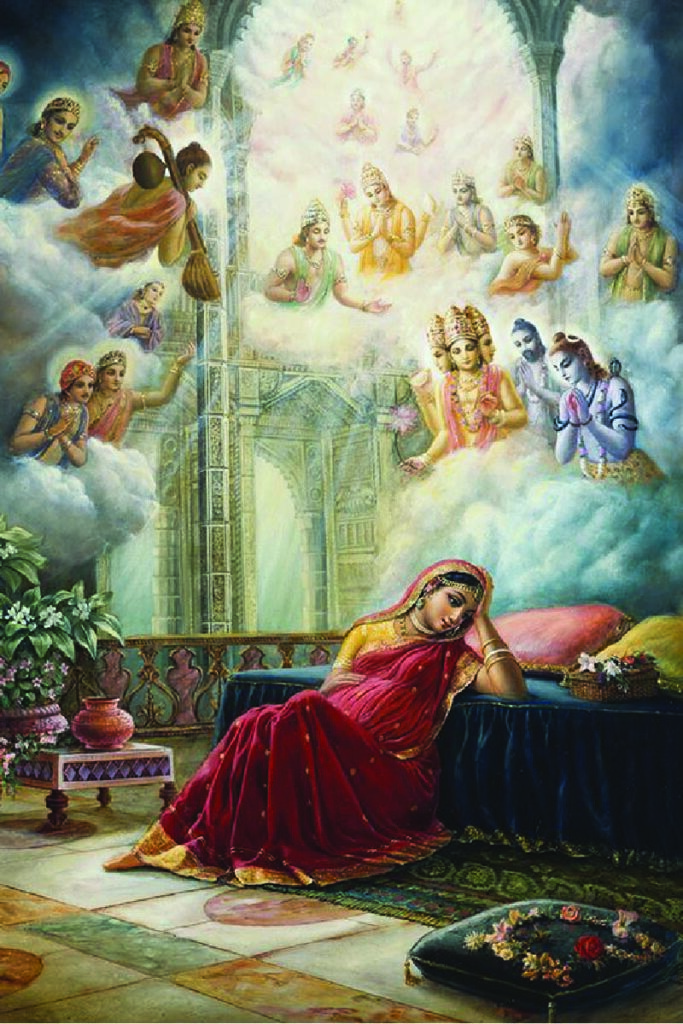

It seemed Devaki’s copious resplendence indicated the bountiful future flourishing of dharma that the Vedic literature talks about generously, at a dark phase in the world when the demon named Kaàsa had turned everything head over heels. That effulgence also seemed to suggest the future elimination of umpteen demons who went against the Vedic injunctions.


Usually a yogi gets an otherworldly luster on his body by the consumption of a particular potion upon perfection in one of the yogic processes. Devaki, however, shone with a superhuman luster even without exclusive yogic practices just by the fact that she bore Lord Krishna in her womb.


As the guards of the prison-house did their regular rounds, they sensed consternation when they glanced upon Devaki (saàkshobhayamasa manaàsi saisha). They could smell an imminent event of far-reaching significance right at that prison.


Upon learning the fact that the Supreme Personality of Godhead was in the womb of Devaki, all the demigods came to catch a glance and worship the Lord. The Srimad Bhagavatam (10.2) describes the beautiful prayers that the demigods offered to the Supreme Lord. It seemed their number was so huge that Vishvaksena, who is the commander-in-chief of the Lord’s Army, was employed to control the demigods’ crowd. 

surasuradhisv-aramauli-ghatat

visirna-jambunada-vetra-sringam 

alakshya santosham-alakshyam-anyair

anika-netaram avaikshatarat


However, the crowd of demigods that came to see the Supreme Lord was so huge that the golden baton that Vishvaksena used in order to strike their crowns and thereby control them became worn out.


As Devaki walked around the prison-house, holding the hands of some of the maids, she walked very slowly, as if to avoid burdening the earth with the weight of the great Lord of the three worlds, residing in her (mayi sthite visvagurau mahiyan ma bhut bhuvo bhara itiva matva).


As sunset approached, the twilight of dusk not only gave relief from the burning heat of the sun but also seemed to announce the ensuing incarnation of the Lord, who would extinguish the agonies of the world, and who is waited upon by the devotees (tam idrisià visvapituh prasutià saàvedayantiva samajagama).


As the sun was about to disappear into the ocean, he seemed to extend his long rays high up like hand as though looking for a savior. This image of the sinking sun resembled a lotus playfully plucked from the pond of sky by the maiden called twilight and thrown into the sea (sandhyakumarya gaganamburaseh kriahritaà kshiptam-ivaravindam).


A little after sunset, the night covering herself with the dark blue sky as cloth, approached the eastern horizon, trying to meet the moon. Here, the author of Yadavabhyudayam makes a delightful and appealing comparison of the appearance of the moon to the appearance of the Supreme Lord, Krishna. This is especially apt since Lord Krishna appeared in the Candra-vaàsa, as Lord Rama did in the Surya-vaàsa. Moreover, Lord Krishna appeared in the midnight, while Lord Rama did in the afternoon.


Some of these beautiful verses run as follows:

tamah prasangena vimucyamana

gaura-prabha gotrabhidabhinandya

vidhudayarambha-visesha-drisya

praci disabhasata devakiva


“As the moon made his appearance, the eastern direction looked like Devaki, relieved from sorrow in the form of darkness, shining bright, and singularly attractive because of the impending appearance of the moon in the form of the Supreme Lord, Krishna.”


“As one who is sorrow because of darkness before moonrise becomes delightful on the emergence of the first rays of the moon, so did the entire world of sadhus rejoice upon learning the imminent rise of the moon of Krishna.”


Now, the acharya goes a step ahead and compares the moon to a priest who, having taken his bath in the ocean, rose to officiate at the rituals connected to the birth of Krishna, the son of Vasudeva (tadvaàsa-manyena smikshya purvaà praptaà pratitena purodhaseva).


Furthermore, the moon is also compared to the striking conchshell of Krishna called the Païcajanya. As a blowing conch alerts everybody to the opening of curtains for the gracious darsana of the Lord, so did the conch-like moon (which resembled the Païcajanya) on the night of Janmashtami indicate to everybody the fast-approaching appearance of the Supreme Personality of Godhead (udeshyatas cakrabhrito niyogat pradurbhavan pragiva païcajanyah). With the moon revealing the universe as it was and brightening the stars, the midnight appeared to be bestowed with as much good fortune as a blind person blessed with vision.


That night which looked beautiful like the freshly bloomed blue lotuses, with its waves of darkness overwhelmed by the bright moonlight, appeared like the dark Yamuna mingling with the divine river Ganga (syama babhau sandranavotpalasrih surasravantyeva kalindakanya). The sea and the moon seemed to team up to enact many of the upcoming pastimes of Lord Krishna. For instance, the sea with the several reflections of the moon on it appeared to be enacting a kind of rasa-lila (the playful dance of Krishna with the gopis) in joy holding the rays of the moon as the hands of its damsels, after partaking the honey-like water offered by the rivers, his consorts.


Finally at midnight, when the moon and the stars were bright, the lily had blossomed, the ocean was throwing up its waves, and the rest of the world was fast asleep, the most auspicious hour shone seeing forth the appearance of the Lord (sa tadriso devapateh prasutià pushyan babhau punyatamo muhurtah). That point of midnight, with the first half of darkness and the bright later half, appeared like the divider between the dark, bonded life and the bliss of emancipation that bestows peace to the yogis (tada nisithah sa sataà prasattyai saàsaramuktyor iva sandhirasit).


The lamps that were burning in Kaàsa’s palace as well as his prison-house got extinguished all of a sudden by themselves as midnight approached. Simultaneously, the sufferings in the minds of pure devotees of Krishna also got extinguished (pradipitaih kaàsa-griheshu dipais tapais ca bhaveshu tapodhananam).


Though the Supreme Lord has no birth and is referred to by the name Aja, He chose to appear in the dynasty of Yadu, chose the eighth phase of the waning moon, which therefore became the first ashtami phase, and also made his yoga-maya appear the following night of navami.


Eventually at midnight, when the Taurus was the ascendant, Devaki brought forth Lord Krishna. Drawing a parallel with the Srimad-Bhagavatam, we see that Srila Vyasadeva also chooses to compare Lord Krishna with the moon rising on a full moon night, when he describes the divine Appearance of the Lord. He says:

devakyaà deva-rupinyaà
vishnuh sarva-guha-sayah 

avirasid yatha pracyaà
disindur iva pushkalah ||

           
  (SB 10.3.8)


“The Supreme Personality of Godhead, Vishnu, who is situated in the core of everyone’s heart, appeared from the heart of Devaki in the dense darkness of night, like the full moon rising from the eastern horizon, because Devaki was of the same category as Sri Krishna.


However, the appearance of Lord Krishna is also compared to the appearance of the sun, as in the following verse of the Yadavabhyudayam:

atha sita-ruci-lagne siddha-païcagrahocce 

vyajanayad-anaghanaà vaijayantyaà jayantyam 

nikhila-bhuvana-padma-klesa-nidrapanuttyai 

dinakaram-anapayaà devaki-purvasandhya 


“On the auspicious day of Jayanti, which was the flag of victory for the faultless Yogis and the auspicious hour when five planets were in their exaltation, Devaki in the form of the eastern horizon brought forth Lord Krishna, the never-setting sun, for dispelling the hardships of the lotus in the form of all the three worlds.”


That moment was so joyous to all the devotees across the universe that the demigods from the higher planetary systems started to shower streams of flowers in a joyous mood, clouds gathered in the sky and very mildly thundered, making sounds like those of the ocean’s waves. The Kinnaras and Gandharvas began to sing auspicious songs, the Siddhas and Caranas offered auspicious prayers, and the Vidyadharis, along with the Apsaras, began to dance in jubilation (SB 10.3.6-7).


All the quarters resounded with the words “Victory, Victory,” generated by demigods in apparently invisible forms, proclaiming the Lord to be “naturally indefatigable.”


Even though it was the rainy season, the rivers were very clear like the autumn. And similarly, the minds of the yogis were completely clear and free from logical confusion.


However, antithetical to the experience of the devotees was the experience of demons at that auspicious hour. Omens foreboding evil appeared frequently in their abodes. It seemed that the agitation in the minds of all beings appeared to unite instantaneously and flow into the mind of the King of Bhoja (Kaàsa) like the waters of rivers entering the ocean.

nikhila-cetana-manasa-nihsritah

kalushatah samudetya kila kshanat

vivisurambha iva svayam-apagah

jalanidher-iva bhojapater-manah


Even so, Vasudeva was immediately relieved of the strong chains that were tied to him, though this wasn’t a very big surprise. When the presence of that Supreme Person can cut asunder all bondage and attachment, of what amazement was it that Vasudeva’s chains got untied?


Thus did unwind events on that night of Janmashtami, when the Lord of all the lords made His divine Appearance into this world. Just as Vasudeva’s chains got untied by the mere appearance of Krishna, so will anybody’s hard chains of bondage get untied effortlessly when one meditates sincerely and earnestly on this divine appearance of Krishna.


Kaustubh Narasimhan hails from a devout Vaishnava family in Melukote, Karnataka. He presently serves as a full-time brahmacari at ISKCON Dharwad under the guidance of His Holiness Bhaktirasamrita Swami Maharaja.

Subscribe to BTG Digital Magazine

Embark on your path to Krishna consciousness with BTG Digital Magazine! Subscribe now and discover inspiring stories of growth, enlightenment, and connection shared by our community.

Subscribe

The Night of Janmashtami

The Night of Janmashtami
Listen to Article
Press Play to listen

A renowned Sri Vaishnava scholar has given
interesting insights into the episode of Lord Krishna’s birth.


By Kaustubh Narasimhan


Come Sravana-masa and  Bhadrapada-masa of the Vedic calendar (the month of August in the English calendar), and all the followers of Sanatana-dharma celebrate the most auspicious festival of the entire year — Sri Krishna Janmashtami. Observed with grandeur and resplendence in many parts of the country, Janmashtami sure marks an occasion of happiness for the entire country.


Traditionally, Sri Krishna Janmashtami is referred to by the words “Sri Krishna Jayanti.” Having heard this word jayanti too often in connection with many other noble occasions in India, we may be unaware of its true meaning. Sri Vedanta Desika, a renowned Sri Vaishnava acharya, cherishes this word in his epic classical description of Sri Krishna’s pastimes called the Yadavabhyudayam. Indeed, he starts this maha-kavya employing the same word:

vande vrindavana-caraà vallavi-jana-vallabham
jayanti-sambhavaà dhama vaijayanti-vibhushanam 


The word jayanti-sambhavaà indicates “one who appeared on the occasion of jayanti.” The commentary to this verse explains its meaning. Jayaà ca punyaà ca tanute: “the sacred time that brings victory (jaya) and merit (punya) to everybody.” And that time is further explained as rohini-sahita sravana-bahulashtami — “the time at which the star named Rohini and the eighth day of the waning moon of the month Sravana come in contact with each other.” Moreover, Jayanti is also the name of that auspicious muhurta in which five planets are in their exaltations, with the Taurus as the ascendant with the Moon. Hence, considering all the above factors, one can safely conclude that this time of Krishna’s appearance in this world is certainly the rarest of rare occasions.


Hence, the word Jayanti is reserved only for the day of Krishna’s appearance in the strict sense of the term. Though many other festivals in India are also indicated using the same word, we can understand that they don’t stand good sense, since the word refers to a specific time frame in which Lord Krishna appeared.


WHAT EXACTLY HAPPENED IN MATHURA?


The first three chapters of the Tenth Canto of the Srimad-Bhagavatam give a vivid description of the exalted attributes that Mathura showed on the night of appearance of Krishna. And so does Sri Vedanta Desika in his Yadavabhyudayam.


As Devaki and Vasudeva spent their evening in prison of Kaàsa, Vasudeva observed an uncommon radiance and resplendence in Devaki’s countenance. The Srimad-Bhagavatam (10.2.20) describes Devaki as prabhayajitantaraà virocayantià bhavanaà suci-smitam: “One who because of keeping Ajita or the Unconquerable Lord within Herself was illuminating the entire atmosphere of the house and was smiling brilliantly.” In the Yadavabhyudayam, she is described as:

athagamanamanaghena bhumna

dharmasya purnena dhanagamena

divaukasaà darsayata vibhutià

devi babhau dauhridalakshanena


It seemed Devaki’s copious resplendence indicated the bountiful future flourishing of dharma that the Vedic literature talks about generously, at a dark phase in the world when the demon named Kaàsa had turned everything head over heels. That effulgence also seemed to suggest the future elimination of umpteen demons who went against the Vedic injunctions.


Usually a yogi gets an otherworldly luster on his body by the consumption of a particular potion upon perfection in one of the yogic processes. Devaki, however, shone with a superhuman luster even without exclusive yogic practices just by the fact that she bore Lord Krishna in her womb.


As the guards of the prison-house did their regular rounds, they sensed consternation when they glanced upon Devaki (saàkshobhayamasa manaàsi saisha). They could smell an imminent event of far-reaching significance right at that prison.


Upon learning the fact that the Supreme Personality of Godhead was in the womb of Devaki, all the demigods came to catch a glance and worship the Lord. The Srimad Bhagavatam (10.2) describes the beautiful prayers that the demigods offered to the Supreme Lord. It seemed their number was so huge that Vishvaksena, who is the commander-in-chief of the Lord’s Army, was employed to control the demigods’ crowd. 

surasuradhisv-aramauli-ghatat

visirna-jambunada-vetra-sringam 

alakshya santosham-alakshyam-anyair

anika-netaram avaikshatarat


However, the crowd of demigods that came to see the Supreme Lord was so huge that the golden baton that Vishvaksena used in order to strike their crowns and thereby control them became worn out.


As Devaki walked around the prison-house, holding the hands of some of the maids, she walked very slowly, as if to avoid burdening the earth with the weight of the great Lord of the three worlds, residing in her (mayi sthite visvagurau mahiyan ma bhut bhuvo bhara itiva matva).


As sunset approached, the twilight of dusk not only gave relief from the burning heat of the sun but also seemed to announce the ensuing incarnation of the Lord, who would extinguish the agonies of the world, and who is waited upon by the devotees (tam idrisià visvapituh prasutià saàvedayantiva samajagama).


As the sun was about to disappear into the ocean, he seemed to extend his long rays high up like hand as though looking for a savior. This image of the sinking sun resembled a lotus playfully plucked from the pond of sky by the maiden called twilight and thrown into the sea (sandhyakumarya gaganamburaseh kriahritaà kshiptam-ivaravindam).


A little after sunset, the night covering herself with the dark blue sky as cloth, approached the eastern horizon, trying to meet the moon. Here, the author of Yadavabhyudayam makes a delightful and appealing comparison of the appearance of the moon to the appearance of the Supreme Lord, Krishna. This is especially apt since Lord Krishna appeared in the Candra-vaàsa, as Lord Rama did in the Surya-vaàsa. Moreover, Lord Krishna appeared in the midnight, while Lord Rama did in the afternoon.


Some of these beautiful verses run as follows:

tamah prasangena vimucyamana

gaura-prabha gotrabhidabhinandya

vidhudayarambha-visesha-drisya

praci disabhasata devakiva


“As the moon made his appearance, the eastern direction looked like Devaki, relieved from sorrow in the form of darkness, shining bright, and singularly attractive because of the impending appearance of the moon in the form of the Supreme Lord, Krishna.”


“As one who is sorrow because of darkness before moonrise becomes delightful on the emergence of the first rays of the moon, so did the entire world of sadhus rejoice upon learning the imminent rise of the moon of Krishna.”


Now, the acharya goes a step ahead and compares the moon to a priest who, having taken his bath in the ocean, rose to officiate at the rituals connected to the birth of Krishna, the son of Vasudeva (tadvaàsa-manyena smikshya purvaà praptaà pratitena purodhaseva).


Furthermore, the moon is also compared to the striking conchshell of Krishna called the Païcajanya. As a blowing conch alerts everybody to the opening of curtains for the gracious darsana of the Lord, so did the conch-like moon (which resembled the Païcajanya) on the night of Janmashtami indicate to everybody the fast-approaching appearance of the Supreme Personality of Godhead (udeshyatas cakrabhrito niyogat pradurbhavan pragiva païcajanyah). With the moon revealing the universe as it was and brightening the stars, the midnight appeared to be bestowed with as much good fortune as a blind person blessed with vision.


That night which looked beautiful like the freshly bloomed blue lotuses, with its waves of darkness overwhelmed by the bright moonlight, appeared like the dark Yamuna mingling with the divine river Ganga (syama babhau sandranavotpalasrih surasravantyeva kalindakanya). The sea and the moon seemed to team up to enact many of the upcoming pastimes of Lord Krishna. For instance, the sea with the several reflections of the moon on it appeared to be enacting a kind of rasa-lila (the playful dance of Krishna with the gopis) in joy holding the rays of the moon as the hands of its damsels, after partaking the honey-like water offered by the rivers, his consorts.


Finally at midnight, when the moon and the stars were bright, the lily had blossomed, the ocean was throwing up its waves, and the rest of the world was fast asleep, the most auspicious hour shone seeing forth the appearance of the Lord (sa tadriso devapateh prasutià pushyan babhau punyatamo muhurtah). That point of midnight, with the first half of darkness and the bright later half, appeared like the divider between the dark, bonded life and the bliss of emancipation that bestows peace to the yogis (tada nisithah sa sataà prasattyai saàsaramuktyor iva sandhirasit).


The lamps that were burning in Kaàsa’s palace as well as his prison-house got extinguished all of a sudden by themselves as midnight approached. Simultaneously, the sufferings in the minds of pure devotees of Krishna also got extinguished (pradipitaih kaàsa-griheshu dipais tapais ca bhaveshu tapodhananam).


Though the Supreme Lord has no birth and is referred to by the name Aja, He chose to appear in the dynasty of Yadu, chose the eighth phase of the waning moon, which therefore became the first ashtami phase, and also made his yoga-maya appear the following night of navami.


Eventually at midnight, when the Taurus was the ascendant, Devaki brought forth Lord Krishna. Drawing a parallel with the Srimad-Bhagavatam, we see that Srila Vyasadeva also chooses to compare Lord Krishna with the moon rising on a full moon night, when he describes the divine Appearance of the Lord. He says:

devakyaà deva-rupinyaà
vishnuh sarva-guha-sayah 

avirasid yatha pracyaà
disindur iva pushkalah ||

           
  (SB 10.3.8)


“The Supreme Personality of Godhead, Vishnu, who is situated in the core of everyone’s heart, appeared from the heart of Devaki in the dense darkness of night, like the full moon rising from the eastern horizon, because Devaki was of the same category as Sri Krishna.


However, the appearance of Lord Krishna is also compared to the appearance of the sun, as in the following verse of the Yadavabhyudayam:

atha sita-ruci-lagne siddha-païcagrahocce 

vyajanayad-anaghanaà vaijayantyaà jayantyam 

nikhila-bhuvana-padma-klesa-nidrapanuttyai 

dinakaram-anapayaà devaki-purvasandhya 


“On the auspicious day of Jayanti, which was the flag of victory for the faultless Yogis and the auspicious hour when five planets were in their exaltation, Devaki in the form of the eastern horizon brought forth Lord Krishna, the never-setting sun, for dispelling the hardships of the lotus in the form of all the three worlds.”


That moment was so joyous to all the devotees across the universe that the demigods from the higher planetary systems started to shower streams of flowers in a joyous mood, clouds gathered in the sky and very mildly thundered, making sounds like those of the ocean’s waves. The Kinnaras and Gandharvas began to sing auspicious songs, the Siddhas and Caranas offered auspicious prayers, and the Vidyadharis, along with the Apsaras, began to dance in jubilation (SB 10.3.6-7).


All the quarters resounded with the words “Victory, Victory,” generated by demigods in apparently invisible forms, proclaiming the Lord to be “naturally indefatigable.”


Even though it was the rainy season, the rivers were very clear like the autumn. And similarly, the minds of the yogis were completely clear and free from logical confusion.


However, antithetical to the experience of the devotees was the experience of demons at that auspicious hour. Omens foreboding evil appeared frequently in their abodes. It seemed that the agitation in the minds of all beings appeared to unite instantaneously and flow into the mind of the King of Bhoja (Kaàsa) like the waters of rivers entering the ocean.

nikhila-cetana-manasa-nihsritah

kalushatah samudetya kila kshanat

vivisurambha iva svayam-apagah

jalanidher-iva bhojapater-manah


Even so, Vasudeva was immediately relieved of the strong chains that were tied to him, though this wasn’t a very big surprise. When the presence of that Supreme Person can cut asunder all bondage and attachment, of what amazement was it that Vasudeva’s chains got untied?


Thus did unwind events on that night of Janmashtami, when the Lord of all the lords made His divine Appearance into this world. Just as Vasudeva’s chains got untied by the mere appearance of Krishna, so will anybody’s hard chains of bondage get untied effortlessly when one meditates sincerely and earnestly on this divine appearance of Krishna.


Kaustubh Narasimhan hails from a devout Vaishnava family in Melukote, Karnataka. He presently serves as a full-time brahmacari at ISKCON Dharwad under the guidance of His Holiness Bhaktirasamrita Swami Maharaja.