
Craving For Respect And Its Disastrous Consequences

One who always expects to be honored ends up offending exalted personalities
By Vrinda Duraisamy
In the Srimad-Bhagavatam, Lord Siva is declared as the ideal devotee (vaishnavanam yatha sambhuh), celebrated as the embodiment of Vaishnava qualities among devotees. His divine virtues help as a guide for devotees on the Vaishnava path. Yet even a perfected being like Lord Siva is envied by ordinary conditioned souls. Delving into one such incident, we will examine virtues exhibited by both divine and demoniac mentalities.
Daksha Perceives Humiliation
Once upon a time, in the heavenly realm, a grand sacrifice was taking place under the direction of Daksha, the respected chief Prajapati and father-in-law of Lord Siva. It was to be a magnificent sacrifice, an event attended by celebrities from every part of the universe.
As Daksha entered the assembly hall, his presence commanded awe, and all rose in reverence. Having entered, he paid homage to his father, Lord Brahma. Yet, amidst all this pomp and celebration, a simmering tension slithered.
Amidst the divine gathering sat Lord Siva, lost in transcendental meditation, seemingly oblivious to the protocols of respect. Daksha’s pride was severely offended, igniting a flame of resentment within him. In a fit of rage, masked with mimicked civility, Daksha shamelessly criticized Siva, his words reeking with disrespect. He cursed Lord Siva, declaring him unworthy of sacrificial offerings, and stormed out, leaving a trail of stunned silence.
|
A true devotee of the Lord is endowed with humility and willingly endures insults while eager to offer respect to others. Daksha, however, expected reverence from Lord Siva and became deeply angered when it was not met. On the other hand, Lord Siva honored Daksha, by recognizing the presence of the Lord within himself and Daksha. Therefore, he never sought respect from others.
Nandisvara, the chief servant of Lord Siva, could not bear the insult hurled at his revered master. His fury unleashed a torrent of curses upon the assembly, setting off a chain of retaliation and chaos from the agitated followers of Daksha, especially Bhrigu Muni. The air smoked with hatred, and Lord Siva, pained by the disorder, departed silently, followed by his gloomy procession.
All boundaries Crossed
While Nadisvara’s anger towards Daksha and his loyalists was understandable, it did not justify him cursing all the brahmanas in the assembly. Recognizing the distinction between the wrongdoer and those connected with them is crucial in such provoking situations.
This had the members of the assembly soothed. They turned their devotion towards Lord Vishnu, the main objective of all sacrifices.
Yet, this story was far from over.
Still, consumed by his false ego, Daksha hosted another sacrifice, intentionally excluding Lord Siva from the guest list.
Sati, the daughter of Daksha and the beloved wife of Lord Siva, yearned to visit her parental home, her heart torn between her familial and marital relationships. Despite her husband’s warnings of looming difficulties, Sati, powered by a strong longing, started on a journey embedded with unbearable insults.
Arriving at her father’s doorstep, Sati was met with cold indifference, except for the warm embrace of her mother and sisters. But the absence of her father’s welcome and the glaring neglect of offerings to her husband set ablaze of fury within her.
Pride Leads To Fall
Daksha’s arrogance, shown in neglecting his daughter due to her ties with Lord Siva, leads to his downfall. His pride results in vaishnava-aparadhas, termed the “mad-elephant offense” by Sri Chaitanya Mahaprabhu (Cc. Madhya 19.156), leaving him with enduring consequences of unchecked pride.
With fury surging through her veins, Sati condemned Daksha’s arrogance and envy towards Lord Siva, lamenting her own lineage. And in a final act of defiance towards the ego of Daksha, she renounced her mortal body in a blinding self-immolated blaze while meditating on the lotus feet of Lord Siva. This action greatly infuriated Lord Siva’s servants, who wanted to attack at once. Witnessing the situation, the devatas known as the RIbhus intervened and drove them away.
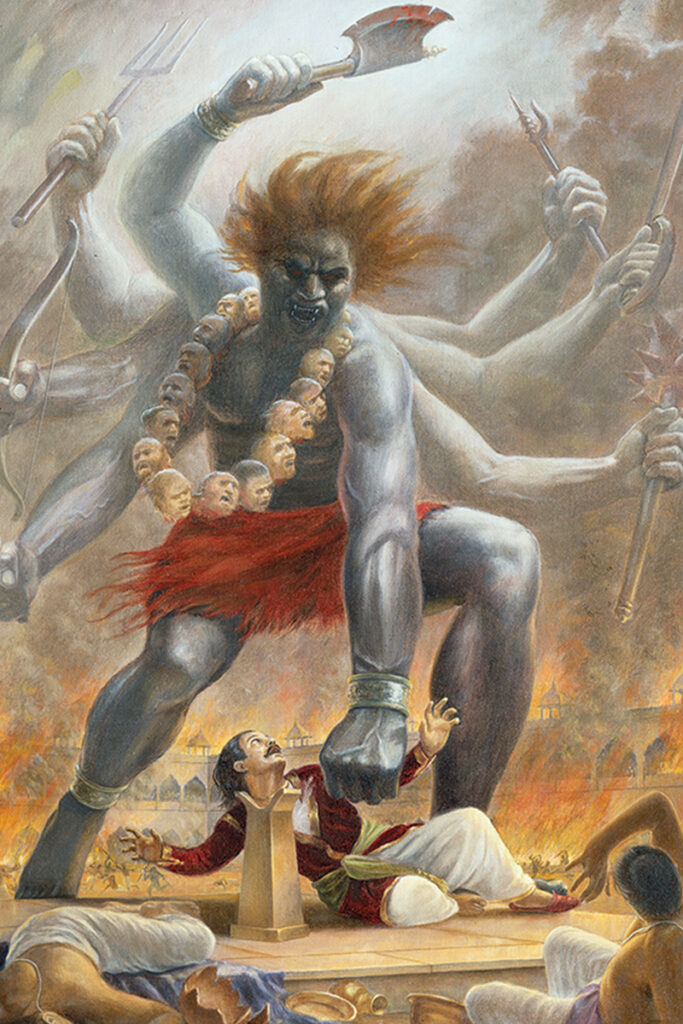
Upon hearing of Sati’s demise, Lord Siva filled with a sorrowful fury. He immediately created Virabhadra, a fearsome personality from his hair, ordering him to kill all the sacrificial participants. Chaos followed with deaths and injuries, finally ending in Daksha’s beheading and his head cast into the flames. With the ceremony thoroughly disrupted, Siva’s followers departed for Kailasa, leaving behind terror and destruction.
Siva’s Exalted Qualities
In this episode, Lord Siva demonstrates the qualities of tolerance and forgiveness time and again. As we shall see, despite Daksha’s role in Sati’s death, Siva forgave him and gave him a second life, showing his magnanimity and compassion.
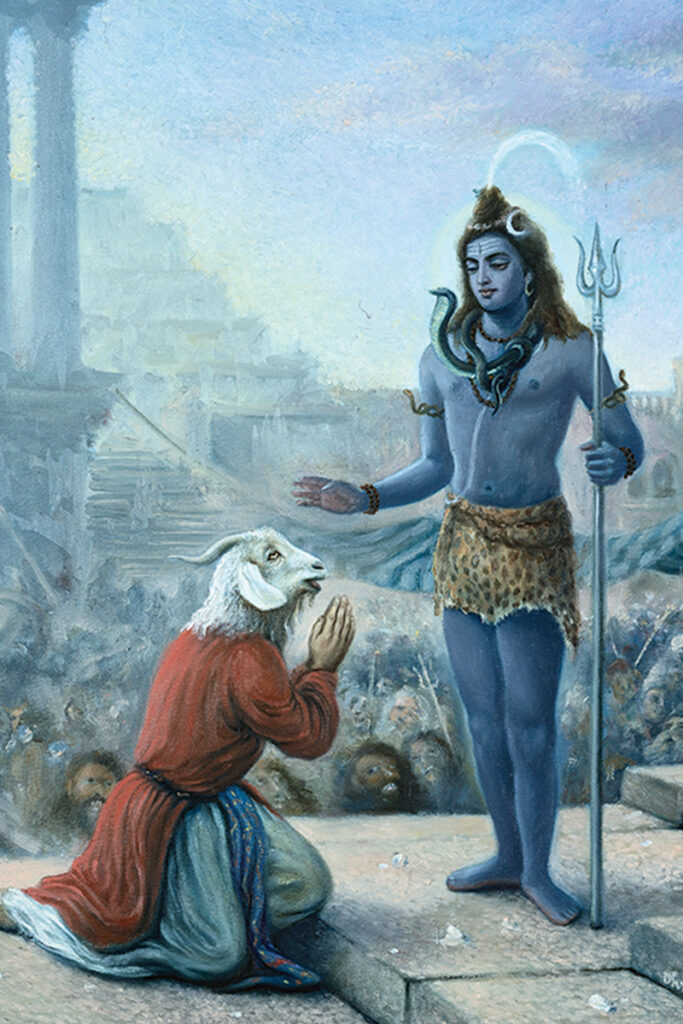
Accompanied by sages and devatas, Lord Brahma requested Lord Siva for forgiveness and Daksha’s life. Known for his being easily satisfied, Lord Siva not only suggested remedies for the injured but also a solution to regain Daksha: replacing his head with a goat’s. By this act of mercy, Siva restored Daksha’s life. Daksha, upon gaining a new life, realized his blunders. He apologized to Lord Siva by offering sincere prayers of repentance.
Thus unfolds the tale of Daksha’s sacrifice — a story of envy, tolerance, forgiveness and distress, set aside through the pages of time.
Vrinda Duraisamy, 15, is a resident of Sridhama Mayapur. She is a student of Sri Mayapur International School, about to finish her IGCSE qualification. She also engages in sastric studies at Bhaktivedanta Vidyapitha.
बीटीजी डिजिटल पत्रिका की सदस्यता लें
BTG डिजिटल मैगज़ीन के साथ कृष्ण भावनामृत के अपने पथ पर आगे बढ़ें! अभी सदस्यता लें और हमारे समुदाय द्वारा साझा की गई विकास, आत्मज्ञान और जुड़ाव की प्रेरणादायक कहानियों को जानें।
सदस्यता लें