


An analysis of four combinations of
feedback givers and feedback takers
by Gauranga Darshan Das
GIVING FEEDBACK or or correcting others for their mistakes is an art that requires responsibility, maturity, and a wellwishing nature. Receiving feedback in a positive way is also an art, and it requires humility, honesty, and sincerity.
Based on episodes from Srimad-Bhagavatam, Sri Caitanya-caritamrta, the Ramayana, and the Mahabharata, this article discusses four combinations of feedback givers and feedback takers: goodgood, goodbad, badgood, and badbad.
Good-Good
When the feedback giver and the feedback taker both are genuine.
Even noble people can sometimes act in a way that may not be the best. But they don’t do so deliberately, with a negative intention. Their mistakes are incidental. And when they receive feedback from a wellwisher, they respect it and accept it gratefully, without justifying their mistakes. And the good feedback giver doesn’t intend to just find fault and discourage the person, but honestly desires to help.
Even warriors need guidance: The Fourth Canto of the Bhagavatam tells the story of King Dhruva, whose younger brother, Uttama, was killed in the Himalayas by a powerful Yaksa, a semidivine spirit and follower of Kuvera, the lord of wealth. Overwhelmed with lamentation and anger, Dhruva attacked Alakapuri, the city of the Yaksas. A fierce battle took place, and Dhruva was indiscriminately killing the Yaksas, almost to the point of destroying their entire race. Seeing Dhruva killing so many innocent Yaksas, his grandfather Svayambhuva Manu approached him and said:
My dear son, please stop. It is not good to become unnecessarily angry – it is the path to hellish life. Now you are going beyond the limit by killing Yaksas who are actually not offenders. My dear son, the killing of the sinless Yaksas which you have undertaken is not at all approved by authorities, and it does not befit our family, which is supposed to know the laws of religion and irreligion. My dear son, it has been proved that you are very much affectionate towards your brother and are greatly aggrieved at his being killed by the Yaksas, but just consider – for one Yaksa’s offense, you have killed many others, who are innocent. (Bhagavatam 4.11.7–9)
Manu ended by instructing Dhruva to pacify Kuvera with gentle words and prayers.
On receiving this feedback and well-intended advice from Manu, Dhruva stopped fighting and approached Kuvera, who was happy with him and blessed him that he might have unflinching faith in and remembrance of the Supreme Personality of Godhead. Dhruva then returned to his capital city.
Even authors need advice: Sage Vyasa, with deep compassion for common people, wrote the four Vedas, the eighteen major Puranas, and the Mahabharata. Despite his good efforts, he felt dissatisfied. Then Vyasa’s guru Narada Muni told him that in his works he had overemphasized what are generally considered the four purusarthas, or human goals – dharma (religion), artha (economic development), kama (sense gratification), and moksa (liberation) – and hadn’t sufficiently glorified the Supreme Lord Krishna and the process of Krishna -bhakti. Narada Muni commented that people are naturally inclined toward sense enjoyment and Vyasa had encouraged them through his works. Narada finally instructed Vyasa to write Srimad-Bhagavatam to elaborately describe the Supreme Lord’s glories. Vyasadeva gratefully received this advice and wrote Srimad-Bhagavatam for the benefit of humanity.
Even poets need correction: We read a similar story in Sri Caitanya-caritamrita, a biography of Lord Caitanya Mahaprabhu, the most merciful incarnation of Lord KRISHNA . Once, a Bengali poet wrote a drama describing Lord Caitanya and Lord Jagannatha. With great eagerness he recited his introductory verse in front of Svarupa Damodara Gosvami, the personal secretary of Lord Caitanya. Svarupa Damodara found serious philosophical deviation in the poet’s composition and gave him critical feedback. The poet realized that he had made a grave mistake. Being simple at heart, he felt humbled and embarrassed, but didn’t argue or try to justify what he had written. Seeing his humble demeanor, Svarupa Damodara encouraged him to study and learn the Bhagavatam in the association of devotees and then compose poetry with proper philosophical understanding.
In the above three stories both the feedback giver and the taker are honest, and thus their interactions resulted in highly positive outcomes. One has to be honest enough to admit a mistake, humble enough to receive feedback, and sincere enough to work on the correction. Thus one can improve oneself. One who corrects others’ mistakes must do so with a well-wishing heart, and not with pride or a superiority complex.
Good-Bad
When the feedback giver is honest but the feedback taker is haughty.
Pride, greed, and selfishness make one miss the opportunity to elevate one’s consciousness in response to a wellwisher’s good advice.
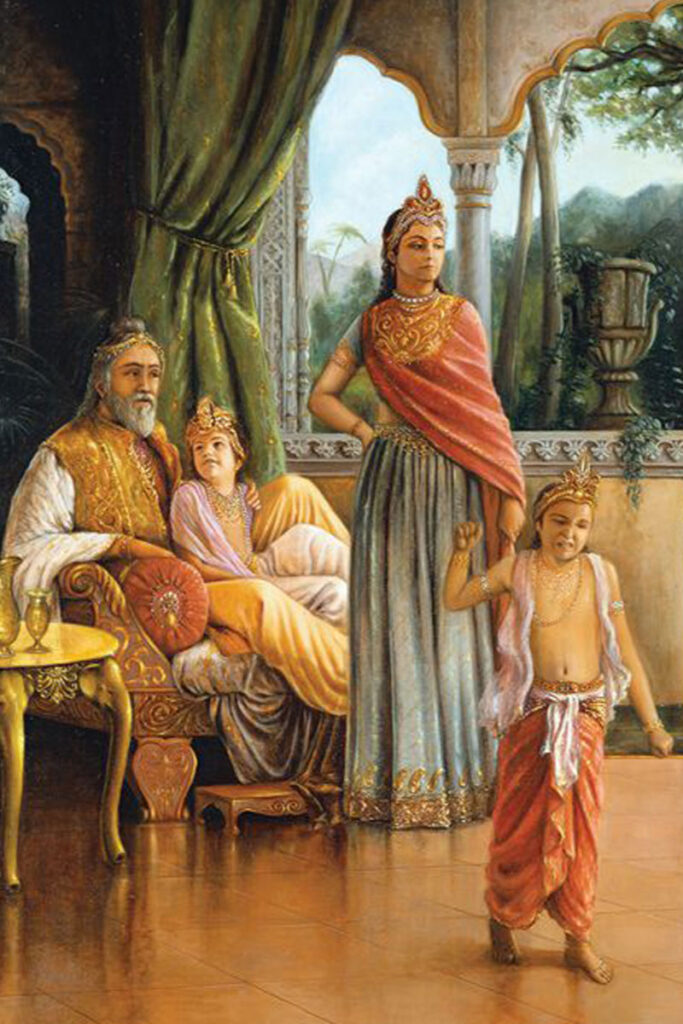
Pride causes degradation: In another instructive story from the Fourth Canto of the Bhagavatam, a king named Anga had a cruel son named Vena, whom he tried to reform but failed. Frustrated, Anga left the kingdom, and sages and brahmanas enthroned Vena as the king. The innately cruel and proud Vena tormented innocent people and stopped brahmanas from performing sacrifices and worshiping Lord Vishnu. Considering the citizens’ difficulties due to Vena’s atrocities, sages advised him that a king should protect citizens by maintaining varnasram and worshiping the Lord. They asked him to stop forbidding sacrifices and disrespecting the devatas. Vena arrogantly retorted that the king is God and the reservoir of all the devatas. He said that the sages’ affection for the devatas was like the affection of an unchaste woman for a paramour. He told them to give up their foolishness and worship him with their sacrifices.
The sages were furious at Vena’s impudence and his blasphemy of Lord Vishnu. They killed him simply by chanting mantras. Although the sages gave feedback on Vena’s
activities with all good intentions, arrogant Vena didn’t receive them. That caused his own ruination.
Lust makes one blind: In the Ramayana, when demon Ravana kidnapped Sita Devi, his brother Vibhisan repeatedly advised him to respectfully return her to Lord Rama. He warned him of the miserable consequences of his lust for the chaste wife of another man, who was in fact God Himself. But Ravana, blinded by lust, not only rejected Vibhisan’s feedback and well-intended advice, but also banished Vibhisan from the kingdom. Eventually Ravana had to meet his death at the hands of Lord Rama for his offenses and evil acts.
Selfishness makes one shameless: Blinded by the selfish desire to install his evil sons as the rulers, Dhritarastra supported their atrocities against the Pandavas. Akrura, a minister in Mathura and a devotee of Lord Krishna , gave feedback to Dhritarastra, advising him to treat the Pandavas fairly. But Dhrtarastra said, “Because my unsteady heart is prejudiced by affection for my sons, these pleasing words of yours cannot remain fixed there, just as lightning cannot remain fixed in a cloud.” (Bhagavatam 10.49.27)
Dhritarastra continued to support his sons. He did not forbid Duhsasana’s abominable act of dragging Draupadi by the hair into the royal assembly, although she was weeping helplessly. He allowed
Duryodhana and his party to cheat the Pandavas in a gambling match and usurp their kingdom. Once, Dhritarastra’s brother Vidura advised him, “You are maintaining offense personified, Duryodhana, as your infallible son, but he is envious of Lord Krishna . And because you are thus maintaining a non-devotee of Krishna , you are devoid of all auspicious qualities. Relieve yourself of this ill fortune as soon as possible and do good to the whole family!” (Bhagavatam 3.1.13)
Duryodhana became furious and insulted Vidura with poisonous words. He ordered that Vidura be driven from the palace with only his breath. Despite hearing all this, Dhritarastra didn’t take any action against Duryodhana or attempt to keep Vidura back. Eventually, in the Battle of Kurukshetra Dhritarastra had to lose all his sons, for whom he had maintained such undue attachment.
Unfortunate are those who do not have access to worthy advice. More unfortunate are those who care nothing for good advice even when available. One has to humbly receive the suggestions of wise people for one’s own benefit.
Bad-Good
When the feedback giver is disingenuous, but the feedback taker is sincere.
Sometimes the words of a proud person are truthful but the intentions are not. Although the heart of someone who gives a suggestion may be mean, a noble person tries to recognize the good part of it.
Harsh but right: Dhruva was a five-year-old prince. One day, when he tried to sit on the lap of his father, King Uttanapada, his stepmother, Suruci, harshly told him that he was unqualified to sit on his father’s lap because he was not born from her womb. If he wanted to become qualified, she said, he should go to the forest and worship Lord Vishnu and then take birth as her son in his next life.
Her insensitive words pierced Dhruva’s tender heart. Uttanapada’s silence further pained him. Being disappointed, he ran to his mother, Suniti, who told him that what his stepmother had said was true. To fulfill any desire, he should worship Lord Vishnu.
Suruci’s intention in advising worship of Lord Vishnu was just to impress her husband; she wasn’t a great devotee of Vishnu. Further, she was proud, and she was envious of Suniti. But Suniti, being a mature devotee, took the good part of Suruci’s words and told Dhruva to worship Lord Vishnu. She never hated Suruci, although Suruci hated her. Accepting the advice, Dhruva worshiped the Lord, became a pure devotee, and fulfilled all his desires.
The truth in a critic’s words: Once, a sannyasi named Ramacandra Puri arrived in Jagannatha Puri, where Sri Caitanya Mahaprabhu was living.
Ramacandra Puri was a disciple of Madhavendra Puri. Therefore he was a godbrother of Isvara Puri, the spiritual master of Sri Caitanya Mahaprabhu, who treated Ramacandra
Puri with the respect his position called for.
By nature Ramacandra Puri was envious and critical. His nature was to induce people to eat more than necessary and then criticize them for overeating. He even criticized Lord Caitanya, falsely accusing Him of eating too many sweets. Due to this criticism, Lord Caitanya began eating much less than usual during His meals. Ramacandra Puri then went to Lord Caitanya to give Him feedback. He told Him that dry renunciation was not the duty of a sannyasi and that a sannyasi eats as much as necessary to maintain his body but does not enjoy satisfying his senses materially.
Lord Caitanya replied, “I am just like an ignorant boy and am like your disciple. It is My great fortune that you are instructing Me.” (Caitanya caritamrta, Antya 8.69)
Lord Caitanya even told the other devotees that Ramacandra Puri was expounding the natural principles of sannyasa life.
A humble person sees good in the words of even envious people, without envying them. Thus, although the person who gives us a suggestion may not have good intentions, we can still see the suggestion in a positive light if it’s worthy.
BAD-BAD
When both the feedback giver and the taker are weak-hearted or selfish.
Such persons cannot benefit each other or anyone else. Feedback givers of this type may speak so-called dharma or moral values just to suit their own purposes. And the equally selfish receiver won’t accept that ill-motivated advice.
Even devils speak about morals: Once, the devatas and the asuras (demons) churned the milk ocean. This event, popularly known as Samudra-manthana, is described in the Eighth Canto of Srimad-Bhagavatam. When the pot of amrita (nectar of immortality) was produced from the churning, the asuras immediately snatched it. But instead of distributing it equally among themselves, they quarrelled about who would get the first share of it, each saying, “Me first, not you!”
Among the asuras some were strong and some were weak. Being unable to fight, the weaker asuras gave feedback to the stronger asuras, saying that because the devatas had also worked hard in churning the milk ocean, according to dharma they should get a share of the nectar. The stronger asuras paid no heed to this feedback. Of course, the weaker asuras never intended to share the nectar with the devatas, but they cited dharma just because they couldn’t fight with the other asuras to drink the nectar first.
The love that ended life: The Mahabharata tells the story of two powerful asura brothers named Sunda and Upasunda. They loved each other and were like one person divided into two. They received a boon from Brahma that they could die only at each other’s hands. Thus, having no fear of death, they terrorized the universe. To destroy them, Lord Brahma created a beautiful woman called Tilottama and ordered her to go to these two asuras. Tilottama then went before Sunda and Upasunda when they were intoxicated. Attracted by her beauty, both of them desired her. They argued. Sunda told Upasunda, “This woman shall be my wife and your sister!” Upasunda replied, “No, brother, I saw her first. She is mine! You shouldn’t see her in any other way.” Thus the two loving brothers argued, finding fault with each other’s words and intentions, all for the sake of a woman. They then fell upon each other with their fierce weapons and killed each other.
The first concern of a demoniac person is personal sense enjoyment. Thus materialistic people regularly disagree, compete, and fight among themselves. Unless they are trained to satisfy God’s senses, there cannot be peace in society.
A Journey Toward the Best Combination
For obvious reasons, the first combination is the best in the above four cases. However, it’s not so easy to see such goodgood combinations in this world. But if we are determined, it’s not impossible to come to this stage from wherever we are. Here is a story of a couple in this regard.
Diti was one of the many wives of the sage Kasyapa. Once, afflicted by lust and an intense desire for a child, she approached Kasyapa in the evening for union. Kasyapa tried to dissuade her, telling her that it was the inauspicious time of day when ghosts move about. It was not an appropriate time for union, he said, and it would make Lord Siva, the lord of the ghosts, angry. Pressed by Cupid, however, Diti was not in a mood to take any feedback. Although Kasyapa gave her good feedback, he himself didn’t have sufficient self-control. So he gave in to her unreasonable appeal and united with her. Sometimes although we tell people what is right, we ourselves may not have the ability to act right.
As a result of this untimely union, Diti gave birth to the two ferocious asuras Hiranyaksa and Hiranyakasipu, who were later killed by Lord Vishnu in the forms of Varaha and Narashima respectively. Thinking that Lord Vishnu had killed her sons just to favor Indra, the king of the devatas, Diti desired a son who would kill Indra. She served Kasyapa affectionately to get his favor. Impressed with her service, Kasyapa told her to ask for a boon, and Diti asked for a son who would kill Indra. Kasyapa was surprised, but this time he didn’t give in to her demand. Although one might have acted inappropriately at some point in life, that doesn’t mean one must continue to do so. By honest deliberation and mature guidance, one can improve from where one is.
Kasyapa didn’t immediately point out the fault in Diti’s thinking, but he was concerned about her envious attitude and desired a transformation in her. He instructed her to worship Lakshmi-Narayana by a vow called Pumsavana for one year. If she did so without any mistakes, she would get a son who could kill Indra. If she broke her vow, her son would be Indra’s friend.
Diti followed the vow strictly and became pregnant. But once, when she was inattentive in performing the Pumsavana, Indra entered her womb and cut her embryo into forty-nine pieces. They survived and came to be known as the Maruts. Seeing them, both Diti and Indra, who had been inimical toward each other, were transformed. Later Indra accepted the Maruts as his brothers. This was the result of Diti’s worship of Laksmi Narayana, by which everything became auspicious.
Being a good feedback giver:
Those who correct others’ mistakes must do so with responsibility and a well-intentioned heart, and not to show their superiority. Good feedback givers help people to be right rather than prove them wrong. They wish to continue the relationship, not to cut it. They communicate the feedback in a dignified way and at an appropriate time.
If necessary one may use strong words, just as Krishna chastised Arjuna in the Bhagavad-gita, but ultimately one’s words should inspire people and not demotivate or intimidate them. We cannot expect a change overnight, so we must be patient enough to explain things just as Krishna patiently answered all of Arjuna’s questions. A listener becomes more attentive to good advice when undue criticism and fault-finding are absent. So, in giving feedback to others, we need to shift the focus from a failed past to a positive future, and thus avoid negative feelings in oneself and others.
Being a good feedback taker:
A humble person is willing to receive feedback from others for self-improvement. On the other hand, arrogant persons, due to selfishness and self-righteousness, cannot take any feedback. They tend to think that whatever they think, do, or speak is all right. Just as a full pot cannot take any more contents, a mind filled with pride and greed cannot accept any well-intended advice. But if one is open to receiving corrections from one’s guru or other Vaishnavas, and humbly attempts to improve oneself, one can have good relationships with others and serve the Lord effectively.
When the feedback giver and feedback taker are both in the right spirit and consciousness, there is an improvement in the quality of service to the Supreme Lord, the community of His devotees, and humanity.
Gauranga Darshan Das, a disciple of His Holiness Radhanath Swami, is the dean of the Bhaktivedanta Vidyapitha at ISKCON Govardhan Ecovillage. He has written over thirty-three books, including the Subodhini and Bhagavatam Tales series, and has delivered over seven thousand hours of spiritual discourses. He regularly conducts scriptural courses for adults and children. Learn more at gaurangadarshan.com.