Where Krishna Is Remembered, Life Becomes Beautiful

Free to Read
6 mins September, 2026
00:00
00:00

How conscious connection with the supreme
transforms ordinary life into sacred experience


By Vraja Bihari Dasa


“O Gadadhara [Krishna], our kingdom is now marked with the impressions of Your lotus feet, and therefore it appears beautiful. But when You leave, it will no longer be so.” — Srimad-Bhagavatam (Kunti’s prayers, 1.8.39)


Queen Kunti’s prayer captures a profound spiritual truth: life becomes beautiful and auspicious only by the presence of Krishna. When Krishna is remembered and welcomed into our lives, everything shines; when He is forgotten, even abundance loses its charm.


Srila Prabhupada repeatedly emphasized this simple but powerful principle: somehow or other, remember Krishna. When we connect our consciousness with Krishna, our lives are spiritualized, meaningful, and auspicious.


THE TRANSFORMING POWER OF REMEMBERING KRISHNA


Srila Prabhupada often illustrated this truth through his own preaching experience. When he encountered American youth during the counterculture movement of the 1960s, many were lost, confused, and disillusioned. Yet, after practicing Krishna consciousness, their lives visibly changed. Even newspaper reporters remarked that these young devotees appeared”bright-faced”—a striking confirmation that Krishna consciousness bestows genuine spiritual joy.


This transformation happens because remembering Krishna connects us to a transcendental reality. When consciousness rises beyond the material plane, life regains depth, purpose, and inner coherence.


A house may have fans, lights, air-conditioners, and appliances perfectly installed. Everything looks complete. Yet, if electricity is cut off, the entire house becomes useless. Similarly, we may have education, relationships, achievements, and even religious activity—but without remembrance of Krishna, there is no spiritual current flowing. When Krishna is remembered, life is energized; when He is forgotten, everything becomes mechanical.


BEAUTY COMES FROM THE HIGHEST PRINCIPLE


Canakya Panòita famously observed that: the sky is beautiful when adorned by the full moon, a kingdom is beautiful when ruled by good governance, and learning beautifies everything it touches. Srila Prabhupada expanded this wisdom by adding the highest principle: when Krishna is added to our life, everything becomes alive and meaningful. Our ordinary, material activities are then spiritualized—not by abandoning them, but by remembering Krishna while performing them.


Our problems may not disappear immediately, but we feel the presence of a loved one. A person driving with GPS may still face traffic, rain, or detours—but they are peaceful because they know they are heading in the right direction. Without GPS, even an empty road creates anxiety. 


Remembering Krishna does not remove life’s difficulties, but it gives orientation, assurance, and inner calm. One knows: “I am connected; I am going somewhere.” Spiritualization happens not merely by activity, but by presence—being consciously connected with Krishna.


MAHARAJA AMBARISA: THE ART OF BEING PRESENT WITH KRISHNA


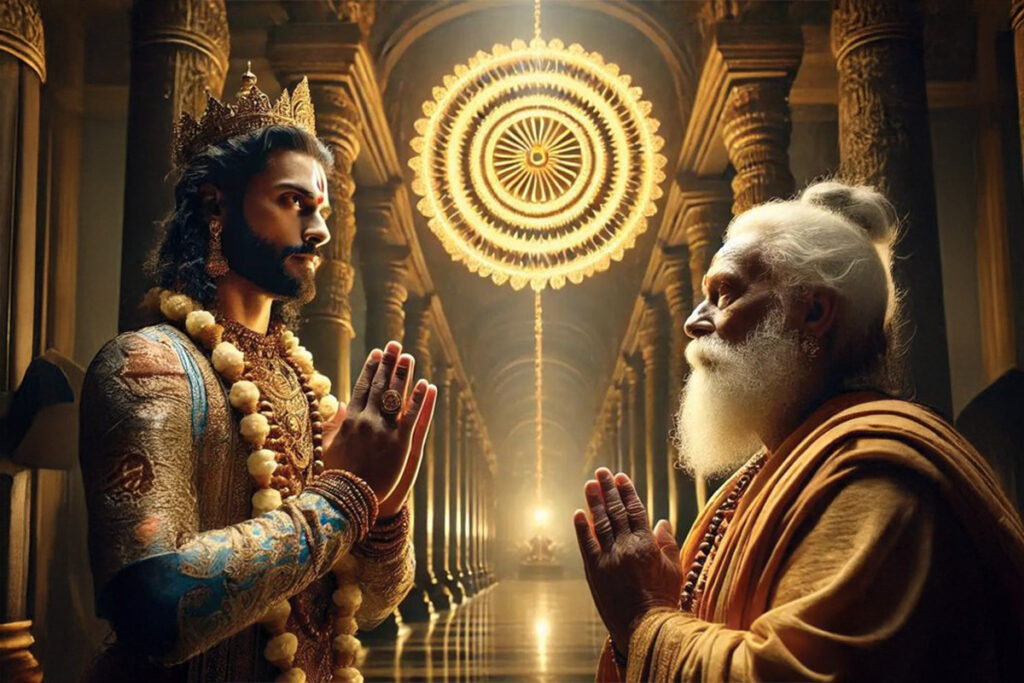
Maharaja Ambarisa exemplifies this art of spiritual presence. The Srimad-Bhagavatam describes in detail how he engaged every sense in Krishna’s service: his mouth glorified the Lord, his tongue tasted Krishna-prasada, his hands cleaned the temple, his legs walked to holy places, his ears heard the Lord’s pastimes.


Yet the most crucial element was his mind. The Bhagavatam states, sa vai manah Krishna-padaravindayoh (Srimad-Bhagavatam 9.4.18). His mind was fixed on Krishna while performing all these activities. This teaches us that external engagement becomes spiritually potent only when accompanied by conscious remembrance.


A person may walk through a garden of flowers, but if the mind is elsewhere, the fragrance is missed. Another person pauses, breathes deeply, and carries the fragrance with them even after leaving. In the same way, devotional activities without presence miss the essence, while activities performed with remembrance carry spiritual fragrance throughout the day.


REMEMBERING KRISHNA IN SEPARATION: THE EXAMPLE OF VRINDAVAN


Alongside presence, remembrance also flourishes in separation. The residents of Vrindavan—especially the gopis—demonstrate this highest form of remembrance.


Although Krishna physically left Vrindavan to go to Mathura, it is said that He never truly left Vrindavan. Why? Because the residents remembered Him so intensely that His presence became even more vivid in their hearts. They remembered His smile and playful words, His flute melodies, His forest pastimes, and even worried whether thorns pricked His tender feet.


Absorbed in remembrance, they felt deep union with Krishna. Thus, separation (vipralambha) intensified their love to the point of constant presence (sambhoga). When a loved one is far away, their photograph does not increase pain—it creates warmth and connection. One remembers their smile, voice, and gestures, and the heart feels close despite physical distance. Similarly, the gopis remembered Krishna in separation. Their remembrance did not create emptiness; it created intense presence.


PRACTICING REMEMBRANCE IN OUR DAILY LIFE


We may not be able to imitate the gopis, but we can follow their example. Like Maharaja Ambarisa, we can begin by engaging our senses in Krishna’s service while fixing our mind on Him. Alongside this, we can cultivate remembrance throughout daily life.


For example: When seeing the ocean, we may remember how we are safe in land and Krishna ordered it not to cross its limits. When tasting water or feeling sunshine, we can remember Krishna, as He says, 

raso ’ham apsu kaunteya prabhasmi sasi-suryayoh

(Bhagavad-gita 7.8)


When reflecting on vision and cosmic order, we may recall the Brahma-samhita: yac-caksur esa savita sakala-grahanam (Brahma-samhita 5.52) “By Krishna’s order, the sun illuminates and the planets move. Such remembrance transforms ordinary perception into spiritual awareness.”

These two modes of remembrance are technically known as:


Sambhoga – remembrance in union: serving Krishna directly and being present with Him.


· Vipralambha – remembrance in separation: remembering Krishna with longing and prayer.


Srila Prabhupada himself embodied this mood. Even as a child, he would remember Krishna and pray to Him—for example, while flying his kite. This remembrance deepened feelings of separation, which in turn intensified love.


Vipralambha makes the heart grow fonder. Therefore, we must practice both—being present with Krishna through service, and remembering Him deeply while living in a world far from Him. Radio waves fill the air constantly, but only a tuned radio receives music. The broadcast is not absent; the receiver is misaligned. Krishna’s presence is constant. It is our remembrance of Krishna that tunes the heart; forgetfulness creates a disconnect.


Krishna and the scriptures have already shown us how to remember Him. There is no need to invent speculative methods and then despair that God cannot be seen.


To meet an important person in this world, we follow an established system. Similarly, to see Krishna, we follow the system He Himself has given—engage the senses, be present, and remember Him sincerely. When we do so, life becomes auspicious and beautiful.


CHANTING IN REMEMBRANCE: THE SUPREME PURIFICATION


When chanting is performed in the mood of remembrance, it becomes supremely powerful. Scripture therefore urges: kirtaniyah sada harih (Siksasmakam 3)


Just as fire burns anyone who touches it, the holy name burns away karmic reactions when chanted with remembrance. Such chanting establishes us in pure consciousness—beautiful, blissful, and auspicious.


An iron rod placed in fire gradually becomes fire-like—it burns whatever it touches. But an iron rod kept near fire without contact remains cold. Chanting mechanically is like keeping the rod nearby. Chanting with remembrance is like placing it directly into the fire—the heart becomes purified and luminous.


Every bhakti-yogi endeavors to remain in Krishna’s presence.

krishna surya-sama,
maya haya andhakara
yahaì krishna, tahaì nahi
mayara adhikara


— Caitanya-caritamrita, Madhya 22.31


“Krishna is like the sun, and illusion is darkness. Where Krishna is present, darkness cannot remain.” By remembering Krishna always, our lives become illuminated—auspicious, beautiful, and filled with spiritual meaning.


Salt is rarely noticed, yet without it, food becomes tasteless. Similarly, Krishna is not always dramatically visible—but without remembrance of Him, life loses flavor. And by adding Krishna into our activities, we find life relishable.


Vraja Bihari Dasa holds a post-graduate degree in International Finance and an MBA from Mumbai University. He is a resident monk at ISKCON Chowpatty and an active teacher of bhakti-yoga. Visit his website: www.yogaformodernage.com 


Image caption : Maharaja Ambarisa remembering Krishna druing a moment of crisis

Subscribe to BTG Digital Magazine

Embark on your path to Krishna consciousness with BTG Digital Magazine! Subscribe now and discover inspiring stories of growth, enlightenment, and connection shared by our community.

Subscribe

Where Krishna Is Remembered, Life Becomes Beautiful

Where Krishna Is Remembered, Life Becomes Beautiful
Listen to Article
Press Play to listen

How conscious connection with the supreme
transforms ordinary life into sacred experience


By Vraja Bihari Dasa


“O Gadadhara [Krishna], our kingdom is now marked with the impressions of Your lotus feet, and therefore it appears beautiful. But when You leave, it will no longer be so.” — Srimad-Bhagavatam (Kunti’s prayers, 1.8.39)


Queen Kunti’s prayer captures a profound spiritual truth: life becomes beautiful and auspicious only by the presence of Krishna. When Krishna is remembered and welcomed into our lives, everything shines; when He is forgotten, even abundance loses its charm.


Srila Prabhupada repeatedly emphasized this simple but powerful principle: somehow or other, remember Krishna. When we connect our consciousness with Krishna, our lives are spiritualized, meaningful, and auspicious.


THE TRANSFORMING POWER OF REMEMBERING KRISHNA


Srila Prabhupada often illustrated this truth through his own preaching experience. When he encountered American youth during the counterculture movement of the 1960s, many were lost, confused, and disillusioned. Yet, after practicing Krishna consciousness, their lives visibly changed. Even newspaper reporters remarked that these young devotees appeared”bright-faced”—a striking confirmation that Krishna consciousness bestows genuine spiritual joy.


This transformation happens because remembering Krishna connects us to a transcendental reality. When consciousness rises beyond the material plane, life regains depth, purpose, and inner coherence.


A house may have fans, lights, air-conditioners, and appliances perfectly installed. Everything looks complete. Yet, if electricity is cut off, the entire house becomes useless. Similarly, we may have education, relationships, achievements, and even religious activity—but without remembrance of Krishna, there is no spiritual current flowing. When Krishna is remembered, life is energized; when He is forgotten, everything becomes mechanical.


BEAUTY COMES FROM THE HIGHEST PRINCIPLE


Canakya Panòita famously observed that: the sky is beautiful when adorned by the full moon, a kingdom is beautiful when ruled by good governance, and learning beautifies everything it touches. Srila Prabhupada expanded this wisdom by adding the highest principle: when Krishna is added to our life, everything becomes alive and meaningful. Our ordinary, material activities are then spiritualized—not by abandoning them, but by remembering Krishna while performing them.


Our problems may not disappear immediately, but we feel the presence of a loved one. A person driving with GPS may still face traffic, rain, or detours—but they are peaceful because they know they are heading in the right direction. Without GPS, even an empty road creates anxiety. 


Remembering Krishna does not remove life’s difficulties, but it gives orientation, assurance, and inner calm. One knows: “I am connected; I am going somewhere.” Spiritualization happens not merely by activity, but by presence—being consciously connected with Krishna.


MAHARAJA AMBARISA: THE ART OF BEING PRESENT WITH KRISHNA


Maharaja Ambarisa exemplifies this art of spiritual presence. The Srimad-Bhagavatam describes in detail how he engaged every sense in Krishna’s service: his mouth glorified the Lord, his tongue tasted Krishna-prasada, his hands cleaned the temple, his legs walked to holy places, his ears heard the Lord’s pastimes.


Yet the most crucial element was his mind. The Bhagavatam states, sa vai manah Krishna-padaravindayoh (Srimad-Bhagavatam 9.4.18). His mind was fixed on Krishna while performing all these activities. This teaches us that external engagement becomes spiritually potent only when accompanied by conscious remembrance.


A person may walk through a garden of flowers, but if the mind is elsewhere, the fragrance is missed. Another person pauses, breathes deeply, and carries the fragrance with them even after leaving. In the same way, devotional activities without presence miss the essence, while activities performed with remembrance carry spiritual fragrance throughout the day.


REMEMBERING KRISHNA IN SEPARATION: THE EXAMPLE OF VRINDAVAN


Alongside presence, remembrance also flourishes in separation. The residents of Vrindavan—especially the gopis—demonstrate this highest form of remembrance.


Although Krishna physically left Vrindavan to go to Mathura, it is said that He never truly left Vrindavan. Why? Because the residents remembered Him so intensely that His presence became even more vivid in their hearts. They remembered His smile and playful words, His flute melodies, His forest pastimes, and even worried whether thorns pricked His tender feet.


Absorbed in remembrance, they felt deep union with Krishna. Thus, separation (vipralambha) intensified their love to the point of constant presence (sambhoga). When a loved one is far away, their photograph does not increase pain—it creates warmth and connection. One remembers their smile, voice, and gestures, and the heart feels close despite physical distance. Similarly, the gopis remembered Krishna in separation. Their remembrance did not create emptiness; it created intense presence.


PRACTICING REMEMBRANCE IN OUR DAILY LIFE


We may not be able to imitate the gopis, but we can follow their example. Like Maharaja Ambarisa, we can begin by engaging our senses in Krishna’s service while fixing our mind on Him. Alongside this, we can cultivate remembrance throughout daily life.


For example: When seeing the ocean, we may remember how we are safe in land and Krishna ordered it not to cross its limits. When tasting water or feeling sunshine, we can remember Krishna, as He says, 

raso ’ham apsu kaunteya prabhasmi sasi-suryayoh

(Bhagavad-gita 7.8)


When reflecting on vision and cosmic order, we may recall the Brahma-samhita: yac-caksur esa savita sakala-grahanam (Brahma-samhita 5.52) “By Krishna’s order, the sun illuminates and the planets move. Such remembrance transforms ordinary perception into spiritual awareness.”


These two modes of remembrance are technically known as:


Sambhoga – remembrance in union: serving Krishna directly and being present with Him.


· Vipralambha – remembrance in separation: remembering Krishna with longing and prayer.


Srila Prabhupada himself embodied this mood. Even as a child, he would remember Krishna and pray to Him—for example, while flying his kite. This remembrance deepened feelings of separation, which in turn intensified love.


Vipralambha makes the heart grow fonder. Therefore, we must practice both—being present with Krishna through service, and remembering Him deeply while living in a world far from Him. Radio waves fill the air constantly, but only a tuned radio receives music. The broadcast is not absent; the receiver is misaligned. Krishna’s presence is constant. It is our remembrance of Krishna that tunes the heart; forgetfulness creates a disconnect.


Krishna and the scriptures have already shown us how to remember Him. There is no need to invent speculative methods and then despair that God cannot be seen.


To meet an important person in this world, we follow an established system. Similarly, to see Krishna, we follow the system He Himself has given—engage the senses, be present, and remember Him sincerely. When we do so, life becomes auspicious and beautiful.


CHANTING IN REMEMBRANCE: THE SUPREME PURIFICATION


When chanting is performed in the mood of remembrance, it becomes supremely powerful. Scripture therefore urges: kirtaniyah sada harih (Siksasmakam 3)


Just as fire burns anyone who touches it, the holy name burns away karmic reactions when chanted with remembrance. Such chanting establishes us in pure consciousness—beautiful, blissful, and auspicious.


An iron rod placed in fire gradually becomes fire-like—it burns whatever it touches. But an iron rod kept near fire without contact remains cold. Chanting mechanically is like keeping the rod nearby. Chanting with remembrance is like placing it directly into the fire—the heart becomes purified and luminous.


Every bhakti-yogi endeavors to remain in Krishna’s presence.

krishna surya-sama,
maya haya andhakara
yahaì krishna, tahaì nahi
mayara adhikara


— Caitanya-caritamrita, Madhya 22.31


“Krishna is like the sun, and illusion is darkness. Where Krishna is present, darkness cannot remain.” By remembering Krishna always, our lives become illuminated—auspicious, beautiful, and filled with spiritual meaning.


Salt is rarely noticed, yet without it, food becomes tasteless. Similarly, Krishna is not always dramatically visible—but without remembrance of Him, life loses flavor. And by adding Krishna into our activities, we find life relishable.


Vraja Bihari Dasa holds a post-graduate degree in International Finance and an MBA from Mumbai University. He is a resident monk at ISKCON Chowpatty and an active teacher of bhakti-yoga. Visit his website: www.yogaformodernage.com 


Image caption : Maharaja Ambarisa remembering Krishna druing a moment of crisis