From Wandering to Wondering

Free to Read
12 mins September, 2026
00:00
00:00

Travel travails through the Bhagavad-gita’s lens


The author’s visa mishap in Singapore becomes a catalyst for spiritual reflection, revealing the power of surrender and divine guidance
in navigating life’s unexpected twists and turns.


By Caitanya Carana Dasa


But how can my visa not be valid?” I asked the Jetstar employee at the transit counter in Singapore, trying to keep the alarm out of my voice.


I was halfway through my international flight from Mumbai to Perth via Singapore, about to begin a two-month tour of Australia and New Zealand. I normally travel to North America in the first half of every year and to Oceania in the second half. But this year, due to unexpected issues with my American visa, I had decided to switch the two trips.


What made the switch easier was that I found both my Australian and New Zealand visas had one-year validity with multiple entries. So I did not have to apply for another visa, since I had traveled there last year from mid-August to mid-October 2025, and I was starting my next tour at the end of March 2026.


ROADBLOCK OR THE ROAD BACK?


I was scheduled to give a Rama-navami talk in Perth the very next day. And yet here I was in Singapore, being told that I could not enter Australia because my visa was not valid. Apparently, there was an unwritten stipulation in the one-year multiple-entry visa that all subsequent entries had to be within three months of the first entry. As the realization began to sink in—that this was not just a clerical error but a legal roadblock with no way around it—my frustration gave way to despair.


As I tried to steady myself, my thoughts went to the Bhagavad-gita and the verse that I connect most with my travels: “The Supreme Lord is situated in everyone’s heart, O Arjuna, and is directing the wanderings of all living entities, who are seated as on a machine, made of the material energy.” (Gita 18.61)


As I tried to recite and contemplate these words, I started gaining an anchor amid my inner storm. My thoughts had found a road back to the Lord that I wanted to serve. Even if my plan had been thwarted, the Lord’s plan is never thwarted. The mantra that I chant daily, the Hare Krishna mantra, is essentially a prayer for service. Srila Prabhupada said we chant it in the mood, “O Lord, please engage me in your service.”


While contemplating this thought of being engaged in the Lord’s service, in a recent talk I had spontaneously broken that prayer into two parts—one associated with our knowledge senses and the other with our working senses. To serve means to be a part of a bigger plan shaped by a greater will—indeed, the divine will. So a prayer for service can be divided into two essential, connected questions: “My dear Lord, what is your plan here?” and “What part do you want me to play in your plan?”


THE LOST CAUSE OR THE LAST CAUSE


Although I didn’t know what the Lord’s plan was, it had become clear what His plan was not: my going to Perth was not going to happen. Accordingly, I called and informed the Perth organizers of my tour, explaining the problem and apologizing for my inability to be there for the festival.


One of my favorite metaphors about how the spirit of service needs to be sustained in spite of obstacles comes from the , in Queen Kunti’s prayers (1.8.42), where she prays that her consciousness may forever flow toward the Lord just as the Ganga always flows toward the ocean. In that spirit—if the Ganga can’t move ahead one way, it finds another—I considered how my service could move on. Even if my immediate plan to go to Australia via Perth was a lost cause, the Lord still remained the last cause of everything that happened, and He was my lasting shelter.


WHAT’S FAIR IN THE UNFAIR?


Since the process of applying for a new Australian visa was online, I could do it from anywhere in the world. I wondered where I could be of service for the Rama-navami festival.


I could think of three options: try to stay in Singapore, return to India, or go to some other country. I didn’t have a valid Singapore visa, although I had visited there a few times earlier and had received a one-month visa for each visit. I requested the devotee who organizes my tour there to check if he could immediately apply for an online visa. Normally, the process is prompt, but it still takes one or two days. Fortunately, my visa was granted within an hour. Thus, I at least didn’t have to face the prospect of fasting and staying stranded in Singapore while awaiting the next phase of my service to become clear.


My spiritual master, His Holiness Radhanatha Maharaja, had told me—when I had asked for guidance on how to share Krishna’s wisdom more effectively—“Listen to your words attentively. The wisdom you are speaking is not just for others to learn; it is also for you to learn.”


In my classes over the last year or so, I have repeatedly spoken on the theme that even when life is unfair to us, it is often fairly unfair. When we get a bad deal in one area of life, sooner or later we also receive a good deal in some other area. Somehow, I remembered that point as it struck me how, while the Australian visa situation had turned out unfair for me, the Singapore visa situation had worked out more than fair.


But before I could leave the Singapore airport to stay at a devotee’s home—while I completed the application for my new Australian visa and decided what to do over the weekend—I had another challenge. My check-in bag had been checked in till Perth, and I wondered whether it had already gone there, since my connecting flight to Perth had departed.


Ideally, the Australian visa problem should have been detected at the Mumbai airport itself, and I should not have been allowed to begin the journey. But the Indigo staff hadn’t pointed it out, even though they had asked me for my visa. It was probably because a joint ticket was involved, with two distinct airlines—Indigo and Jetstar. It’s possible that Indigo hadn’t checked the visa’s validity beyond scanning the document. Only when the visa number was entered into an online system did the issue of invalidity come up.


Anyway, I was told that my bag had most likely not gone to Perth because, if a passenger does not board a connecting flight, the bag is not transferred to that flight—that’s standard airline policy. But my bag was probably somewhere in the lost-and-found department, and I was told to go there to make my claim.


I had stuffed my carry-on bag far too much—it weighed almost nine and a half kilos instead of the allowed seven. And because I was no longer connected with any airline—my Indigo flight was over and my next flight had already departed—no airline was willing to provide me with wheelchair assistance.


As I was walking on my crutches with the nearly 10 kg backpack on my back, I realized that the burden that I had been outsourcing to my wheelchair assistants, who had most of the time carried it without complaining, had now come back on me. What goes around comes around. I resolved to decrease the content of my bag in Singapore so that some devotees from there could take it back to Mumbai whenever they went.


SHELTER THROUGH STRUCTURE AND SURRENDER


Finally, I reached the lost-and-found counter and requested them to take the necessary action for locating my bag. At that time, my thoughts went back to contemplate how the great teachers of our tradition had faced far greater challenges in their travels to share Krishna’s message. Once, Srila Prabhupada, in the early days of our movement, while traveling alone and catching a close connecting flight and climbing down a set of stairs in America, had slipped and fallen. Before the advent of modern technology, travel was far less structured. The saints and sages hardly carried any luggage and had no advanced plan of where they would stay and where they would get food. Lord Caitanya Mahaprabhu had traveled through jungles and other dangerous areas, although his beauty and potency had converted even the threat of predatory animals into an opportunity for sharing divine love with species beyond the human.


Our travels nowadays are far more structured, and that does help in making the speaking engagements more effective. I tend to plan my travel schedule three to six months in advance. I know some other speakers who plan their entire year in advance. Still, that adherence to structure and schedule can leave out something essential: surrender. It struck me that in the last two hours of my travel, I had probably been far more conscious of Krishna and receptive to his plan for me than I had been in many other travels that had gone more smoothly.


I try to phrase my thoughts in succinct sentences that feature some kind of alliteration. In fact, trying to rearticulate thoughts into more punchy and memorable formulations is one of my favorite intellectual devotional engagements. As I was churning my thoughts, a sentence popped up within me: Structure may aid service, but it may impede surrender. And Krishna can offer a shelter through both service that goes according to our plans and surrender that requires us to give up our plans. Let my striving for structure never lead to my shutting out the far greater principle of shelter.


As I had just finished dictating my thoughts on my phone, my check-in bag was found.


FROM ALARMED TO AMAZED


As I retrieved my bag and then pushed my trolley toward the arrival, I started thinking about my next plan. I had been told that there was already another speaker in Singapore for Rama-navami, and they had two visiting speakers for the next weekend. I remembered that during my previous, my last year’s Australia visit, while in Brisbane, I had met a devotee based in Taipei, Taiwan. And he had invited me to come there. Thinking that I could go there for the weekend, I called him, and he got back to me within an hour, recreating the invitation enthusiastically.


As I completed, with the help of a devotee-friend from India, the Australia visa application, I immediately got the email that I had to go for biometric verification. Normally, I had been called for biometric verification only for the first time when I had gone to Australia in 2014. But apparently, because I was applying from a country other than my home country, India, biometric verification was required. Unfortunately, no slots were available for the biometrics in Singapore over the next several days. Fortunately, they had a provision for walk-in, but with the caveat that there was no guarantee whether I would get a slot or when I would get the slot. The devotee who hosted me in Singapore resourcefully managed all the logistics and took me the next morning, early in the morning, and we got a slot. And this was Rama-navami day, and that very day we booked a ticket to Taiwan, and I was able to, by Lord Rama’s grace, reach in time for the evening talk in Taiwan.


In the meantime, I had called my New Zealand tour organizer, exploring the possibility that I could come to New Zealand for some extra days while I waited to get my Australia visa granted. He resourcefully and diligently prepared an itinerary recommending that I visit Dunedin and Christchurch, places that I hadn’t visited in my previous New Zealand tours. And I finally cleared Taiwan immigration and was standing in front of the altar in the Taipei Hare Krishna center, surrounded by what were mostly Taiwanese devotees and just a few Indians. I couldn’t but marvel at how the Lord’s plan had worked so brilliantly, indeed so inconceivably brilliantly.


As I spoke on the pastimes of Lord Rama, I watched devotees from a Taiwanese background—absorbed, almost entranced—and was struck by a quiet realization: the Ramayana, which had once spread across Eastern Asia for centuries, still carries a message that transcends time and culture—the call to face adversity with dignity, as shown by divinity walking among humanity. Those who, not long ago, had never even heard of Rama were now singing his names with joy. Such is the grace of bhakti. Just as the Lord had guided my wanderings to this small yet significant island, so too had he guided theirs, across cultures and circumstances, so that they might also taste the sweetness of his glories.
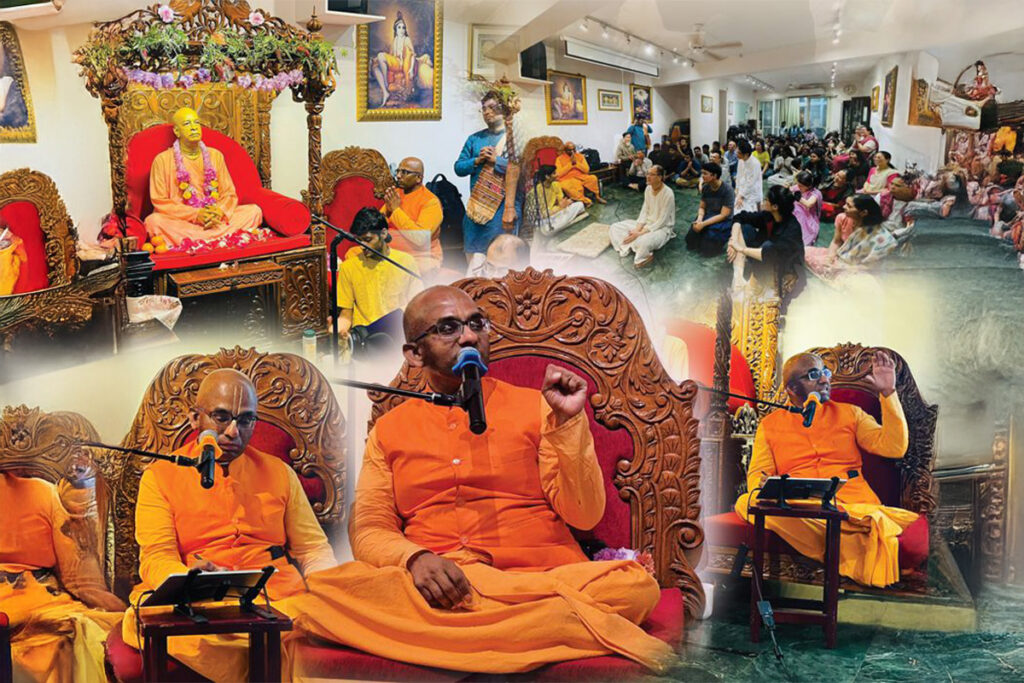

I started my trip from Mumbai thinking of ways in which I could share Krishna’s glory with others. But through the unpredictable change in my travel trajectory, I felt as if Krishna had shown me his glories.


Toward the end of the Bhagavad-gita, the narrator Sanjaya states that he is amazed and thrilled to contemplate Krishna’s glories through the lens of the Bhagavad-gita, a message that he has just been fortunate enough to hear. It struck me that if I hadn’t been blessed with the lens of the Gita’s wisdom, through which I could see my life’s experiences, I would probably have felt distressed, or at least disoriented, by all that had happened over the last few days. But the Gita’s lens had helped me to feel connected and stay composed.


And now I had been brought to a moment where I could not just keep a lid on my negative emotions, but rather float in the surge of positive emotions of appreciation and admiration for the wondrous ways in which the Lord works.


I pray that whatever wandering or traveling I may do in the future—in this life or future lives—through it all, may I be prompted toward greater wondering about the Lord’s plan. And may I thus become more and more conscious of him as the greater reality who sustains my present material reality while also presenting me a way to a richer reality beyond this present reality.


Caitanya Carana Dasa is the associate-editor of Back to Godhead (US and Indian editions). To read his daily Bhagavad-gita reflections, please subscribe to Gitadaily on his website, thespiritualscientist.com.

Subscribe to BTG Digital Magazine

Embark on your path to Krishna consciousness with BTG Digital Magazine! Subscribe now and discover inspiring stories of growth, enlightenment, and connection shared by our community.

Subscribe

From Wandering to Wondering

From Wandering to Wondering
Listen to Article
Press Play to listen

Travel travails through the Bhagavad-gita’s lens


The author’s visa mishap in Singapore becomes a catalyst for spiritual reflection, revealing the power of surrender and divine guidance
in navigating life’s unexpected twists and turns.


By Caitanya Carana Dasa


But how can my visa not be valid?” I asked the Jetstar employee at the transit counter in Singapore, trying to keep the alarm out of my voice.


I was halfway through my international flight from Mumbai to Perth via Singapore, about to begin a two-month tour of Australia and New Zealand. I normally travel to North America in the first half of every year and to Oceania in the second half. But this year, due to unexpected issues with my American visa, I had decided to switch the two trips.


What made the switch easier was that I found both my Australian and New Zealand visas had one-year validity with multiple entries. So I did not have to apply for another visa, since I had traveled there last year from mid-August to mid-October 2025, and I was starting my next tour at the end of March 2026.


ROADBLOCK OR THE ROAD BACK?


I was scheduled to give a Rama-navami talk in Perth the very next day. And yet here I was in Singapore, being told that I could not enter Australia because my visa was not valid. Apparently, there was an unwritten stipulation in the one-year multiple-entry visa that all subsequent entries had to be within three months of the first entry. As the realization began to sink in—that this was not just a clerical error but a legal roadblock with no way around it—my frustration gave way to despair.


As I tried to steady myself, my thoughts went to the Bhagavad-gita and the verse that I connect most with my travels: “The Supreme Lord is situated in everyone’s heart, O Arjuna, and is directing the wanderings of all living entities, who are seated as on a machine, made of the material energy.” (Gita 18.61)


As I tried to recite and contemplate these words, I started gaining an anchor amid my inner storm. My thoughts had found a road back to the Lord that I wanted to serve. Even if my plan had been thwarted, the Lord’s plan is never thwarted. The mantra that I chant daily, the Hare Krishna mantra, is essentially a prayer for service. Srila Prabhupada said we chant it in the mood, “O Lord, please engage me in your service.”


While contemplating this thought of being engaged in the Lord’s service, in a recent talk I had spontaneously broken that prayer into two parts—one associated with our knowledge senses and the other with our working senses. To serve means to be a part of a bigger plan shaped by a greater will—indeed, the divine will. So a prayer for service can be divided into two essential, connected questions: “My dear Lord, what is your plan here?” and “What part do you want me to play in your plan?”


THE LOST CAUSE OR THE LAST CAUSE


Although I didn’t know what the Lord’s plan was, it had become clear what His plan was not: my going to Perth was not going to happen. Accordingly, I called and informed the Perth organizers of my tour, explaining the problem and apologizing for my inability to be there for the festival.


One of my favorite metaphors about how the spirit of service needs to be sustained in spite of obstacles comes from the , in Queen Kunti’s prayers (1.8.42), where she prays that her consciousness may forever flow toward the Lord just as the Ganga always flows toward the ocean. In that spirit—if the Ganga can’t move ahead one way, it finds another—I considered how my service could move on. Even if my immediate plan to go to Australia via Perth was a lost cause, the Lord still remained the last cause of everything that happened, and He was my lasting shelter.


WHAT’S FAIR IN THE UNFAIR?


Since the process of applying for a new Australian visa was online, I could do it from anywhere in the world. I wondered where I could be of service for the Rama-navami festival.


I could think of three options: try to stay in Singapore, return to India, or go to some other country. I didn’t have a valid Singapore visa, although I had visited there a few times earlier and had received a one-month visa for each visit. I requested the devotee who organizes my tour there to check if he could immediately apply for an online visa. Normally, the process is prompt, but it still takes one or two days. Fortunately, my visa was granted within an hour. Thus, I at least didn’t have to face the prospect of fasting and staying stranded in Singapore while awaiting the next phase of my service to become clear.


My spiritual master, His Holiness Radhanatha Maharaja, had told me—when I had asked for guidance on how to share Krishna’s wisdom more effectively—“Listen to your words attentively. The wisdom you are speaking is not just for others to learn; it is also for you to learn.”


In my classes over the last year or so, I have repeatedly spoken on the theme that even when life is unfair to us, it is often fairly unfair. When we get a bad deal in one area of life, sooner or later we also receive a good deal in some other area. Somehow, I remembered that point as it struck me how, while the Australian visa situation had turned out unfair for me, the Singapore visa situation had worked out more than fair.


But before I could leave the Singapore airport to stay at a devotee’s home—while I completed the application for my new Australian visa and decided what to do over the weekend—I had another challenge. My check-in bag had been checked in till Perth, and I wondered whether it had already gone there, since my connecting flight to Perth had departed.


Ideally, the Australian visa problem should have been detected at the Mumbai airport itself, and I should not have been allowed to begin the journey. But the Indigo staff hadn’t pointed it out, even though they had asked me for my visa. It was probably because a joint ticket was involved, with two distinct airlines—Indigo and Jetstar. It’s possible that Indigo hadn’t checked the visa’s validity beyond scanning the document. Only when the visa number was entered into an online system did the issue of invalidity come up.


Anyway, I was told that my bag had most likely not gone to Perth because, if a passenger does not board a connecting flight, the bag is not transferred to that flight—that’s standard airline policy. But my bag was probably somewhere in the lost-and-found department, and I was told to go there to make my claim.


I had stuffed my carry-on bag far too much—it weighed almost nine and a half kilos instead of the allowed seven. And because I was no longer connected with any airline—my Indigo flight was over and my next flight had already departed—no airline was willing to provide me with wheelchair assistance.


As I was walking on my crutches with the nearly 10 kg backpack on my back, I realized that the burden that I had been outsourcing to my wheelchair assistants, who had most of the time carried it without complaining, had now come back on me. What goes around comes around. I resolved to decrease the content of my bag in Singapore so that some devotees from there could take it back to Mumbai whenever they went.


SHELTER THROUGH STRUCTURE AND SURRENDER


Finally, I reached the lost-and-found counter and requested them to take the necessary action for locating my bag. At that time, my thoughts went back to contemplate how the great teachers of our tradition had faced far greater challenges in their travels to share Krishna’s message. Once, Srila Prabhupada, in the early days of our movement, while traveling alone and catching a close connecting flight and climbing down a set of stairs in America, had slipped and fallen. Before the advent of modern technology, travel was far less structured. The saints and sages hardly carried any luggage and had no advanced plan of where they would stay and where they would get food. Lord Caitanya Mahaprabhu had traveled through jungles and other dangerous areas, although his beauty and potency had converted even the threat of predatory animals into an opportunity for sharing divine love with species beyond the human.


Our travels nowadays are far more structured, and that does help in making the speaking engagements more effective. I tend to plan my travel schedule three to six months in advance. I know some other speakers who plan their entire year in advance. Still, that adherence to structure and schedule can leave out something essential: surrender. It struck me that in the last two hours of my travel, I had probably been far more conscious of Krishna and receptive to his plan for me than I had been in many other travels that had gone more smoothly.


I try to phrase my thoughts in succinct sentences that feature some kind of alliteration. In fact, trying to rearticulate thoughts into more punchy and memorable formulations is one of my favorite intellectual devotional engagements. As I was churning my thoughts, a sentence popped up within me: Structure may aid service, but it may impede surrender. And Krishna can offer a shelter through both service that goes according to our plans and surrender that requires us to give up our plans. Let my striving for structure never lead to my shutting out the far greater principle of shelter.


As I had just finished dictating my thoughts on my phone, my check-in bag was found.


FROM ALARMED TO AMAZED


As I retrieved my bag and then pushed my trolley toward the arrival, I started thinking about my next plan. I had been told that there was already another speaker in Singapore for Rama-navami, and they had two visiting speakers for the next weekend. I remembered that during my previous, my last year’s Australia visit, while in Brisbane, I had met a devotee based in Taipei, Taiwan. And he had invited me to come there. Thinking that I could go there for the weekend, I called him, and he got back to me within an hour, recreating the invitation enthusiastically.


As I completed, with the help of a devotee-friend from India, the Australia visa application, I immediately got the email that I had to go for biometric verification. Normally, I had been called for biometric verification only for the first time when I had gone to Australia in 2014. But apparently, because I was applying from a country other than my home country, India, biometric verification was required. Unfortunately, no slots were available for the biometrics in Singapore over the next several days. Fortunately, they had a provision for walk-in, but with the caveat that there was no guarantee whether I would get a slot or when I would get the slot. The devotee who hosted me in Singapore resourcefully managed all the logistics and took me the next morning, early in the morning, and we got a slot. And this was Rama-navami day, and that very day we booked a ticket to Taiwan, and I was able to, by Lord Rama’s grace, reach in time for the evening talk in Taiwan.


In the meantime, I had called my New Zealand tour organizer, exploring the possibility that I could come to New Zealand for some extra days while I waited to get my Australia visa granted. He resourcefully and diligently prepared an itinerary recommending that I visit Dunedin and Christchurch, places that I hadn’t visited in my previous New Zealand tours. And I finally cleared Taiwan immigration and was standing in front of the altar in the Taipei Hare Krishna center, surrounded by what were mostly Taiwanese devotees and just a few Indians. I couldn’t but marvel at how the Lord’s plan had worked so brilliantly, indeed so inconceivably brilliantly.


As I spoke on the pastimes of Lord Rama, I watched devotees from a Taiwanese background—absorbed, almost entranced—and was struck by a quiet realization: the Ramayana, which had once spread across Eastern Asia for centuries, still carries a message that transcends time and culture—the call to face adversity with dignity, as shown by divinity walking among humanity. Those who, not long ago, had never even heard of Rama were now singing his names with joy. Such is the grace of bhakti. Just as the Lord had guided my wanderings to this small yet significant island, so too had he guided theirs, across cultures and circumstances, so that they might also taste the sweetness of his glories.


I started my trip from Mumbai thinking of ways in which I could share Krishna’s glory with others. But through the unpredictable change in my travel trajectory, I felt as if Krishna had shown me his glories.


Toward the end of the Bhagavad-gita, the narrator Sanjaya states that he is amazed and thrilled to contemplate Krishna’s glories through the lens of the Bhagavad-gita, a message that he has just been fortunate enough to hear. It struck me that if I hadn’t been blessed with the lens of the Gita’s wisdom, through which I could see my life’s experiences, I would probably have felt distressed, or at least disoriented, by all that had happened over the last few days. But the Gita’s lens had helped me to feel connected and stay composed.


And now I had been brought to a moment where I could not just keep a lid on my negative emotions, but rather float in the surge of positive emotions of appreciation and admiration for the wondrous ways in which the Lord works.


I pray that whatever wandering or traveling I may do in the future—in this life or future lives—through it all, may I be prompted toward greater wondering about the Lord’s plan. And may I thus become more and more conscious of him as the greater reality who sustains my present material reality while also presenting me a way to a richer reality beyond this present reality.


Caitanya Carana Dasa is the associate-editor of Back to Godhead (US and Indian editions). To read his daily Bhagavad-gita reflections, please subscribe to Gitadaily on his website, thespiritualscientist.com.