Ramayana’s ART of Resilience

Free to Read
8 mins September, 2026
00:00
00:00

nsights that can help us navigate modern adversity


By Caitanya Carana Dasa


In our modern world, we often define greatness through the lens of power and influence. We measure a person’s stature by how forcefully they can bend the world to their will, or how effectively they can compel others to say “yes” to their demands. However, the Ramayana presents a different, more internal metric for greatness: the ability to gracefully accept the moments when the world says “no.”


Redefining Greatness


Setbacks, reversals, and even blatant injustices are inevitable threads in the fabric of the human experience. While Rama is understood as the Supreme Divine, he descends to the earthly plane to play the role of a human being. By doing so, he teaches us how to navigate the complexities of life from the inside out. As he grew up, he was loved by all—powerful, handsome, compassionate, and highly competent. He was in every way suited to becoming a king. Yet, at the very moment of his ascension to the throne, through no fault of his own but due to a palace conspiracy, he was exiled to the forest.


To modern ears, “exile to the forest” might seem like an abstract concept, as few true wildernesses remain. Today, the closest equivalent might be deportation, but even that is a poor comparison. A deported person can often return to their homeland; an exile becomes fundamentally homeless. In the jurisprudence of that era, exile was a punishment just one step below execution or more precisely capital punishment. In some ways, it was considered worse, for it stripped away everything that made life worth living—status, family, security, and purpose. Faced with this, many would prefer death. Yet, despite being blameless, Rama did not incite a rebellion, though he had the power to do so. He chose to keep the greater good in mind.


From Kama to Calm


The internal struggle of facing injustice is perfectly captured in the classic conversation between Rama and his younger brother, Lakshmana. This dialogue echoes modern psychological struggles regarding how we process adversity. When Lakshmana hears of the exile, he is outraged. He views the situation through the lens of justice and logic. He argues that their father, King Dasaratha, has been blinded by infatuation for his youngest wife, Kaikeyi, and that an order born of such a “spell” need not be obeyed.


In response, Rama brings a profound sense of calm. There is a beautiful linguistic symmetry between the English word “calm” and the Sanskrit word kama (“unrestrained craving”). As long as kama—the fire of selfish desire—burns within us, the English calm will remain out of reach. Rama removes the kama of selfishness and replaces it with the calm of duty.


When we are angry, our minds instinctively look for two things: an aggressor to hit back at and a villain to blame. Lakshmana identifies Kaikeyi as the villain, but Rama refuses this framing. He asks Lakshmana not to speak ill of her, reminding him of the maternal love she had always showered upon them—a love he compared to the “incessant flow of the River Ganga.”


Lakshmana, still seething, tries to weaponize this very metaphor. He asks, “How did the Ganga dry up in a single night? How could such love vanish instantly?” It is here that Rama shifts the discussion to the level of philosophy. He explains that since her change in disposition is humanly inexplicable, it must be attributed to the workings of destiny.


Lakshmana’s retort is one that resonates with many today: “It is only cowards who accept injustice as destiny. Heroes fight against injustice.” This is a crucial turning point in the talk. Rama clarifies that for  him, the debate isn’t actually about destiny; it is about duty.


He explains that his readiness to become king was not born of a desire for power, but out of duty to his father. Consequently, if the situation now requires him to go to the forest so as to honor his father’s word, he will gladly do so as a service to his father. Whether the path leads to a throne or a thicket, the internal anchor of duty remains unmoved. By calming his brother and the citizens, Rama prevents a tragedy from becoming a catastrophe. When bad things happen, it is easy to make everyone around us miserable, thereby worsening the situation. Rama does the opposite; he absorbs the shock so that others may remain at peace.


Three principles to stay calm amid a storm


Let’s consider how Rama stays calm by looking at his response through a three-point framework conveyed as the acronym ART: Acceptance, Responsibility, and Transcendence.
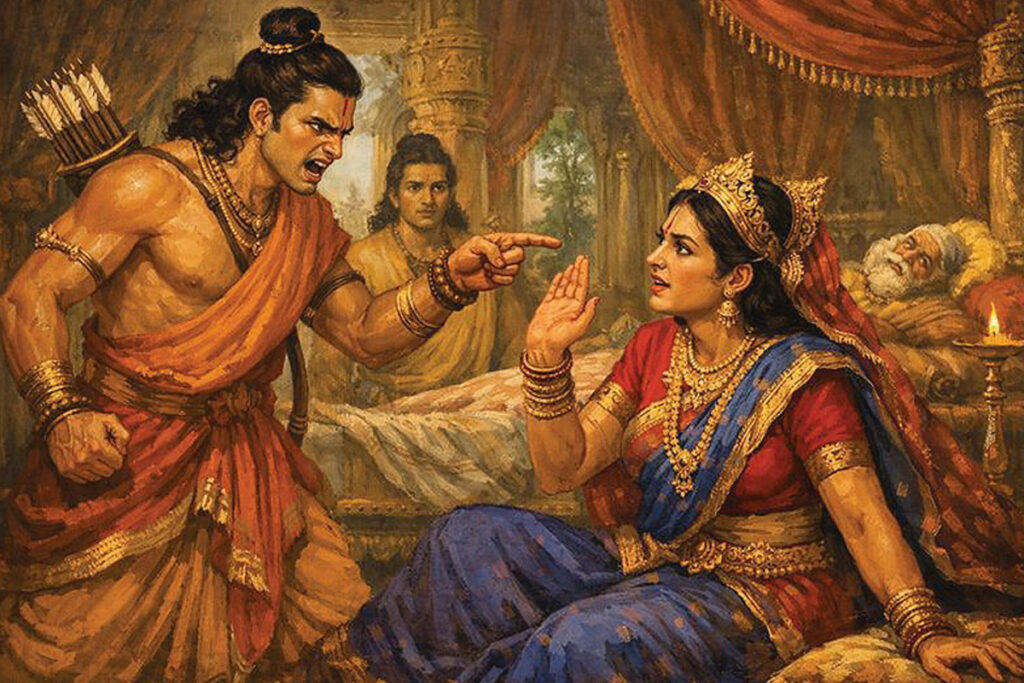

Lakshmana getting angry at Kaikeyi and Lord Rama pacifying Lakshmana


1. Acceptance


The question “Why do bad things happen to good people?” is universal. Through the Ramayana, we are encouraged to rephrase it. Instead of a victim-oriented”Why?”, we are invited to ask: “When bad things happen to good people, what do good people do?”


Rama has no “bad karma” to account for his suffering; therefore, the usual philosophical explanations for misery don’t apply to him. He gracefully accepts that unfairness is an unfortunate truth about the human condition. Yet such unfairness is not life’s only truth.


Sometimes we get worse than we deserve, but sometimes we get better than we deserve. Or if we don’t want to get into the subjective assessment about what we deserve, we can instead acknowledge that while sometimes life treats us worse than others, it also sometimes treats us better than others. A friend might get a better-paid job than us, but we might get a better work environment than them. While some aspects of our life may feel unjust, others may well be more than just. Life is never just unjust or merely unfair; instead, in the big picture, it is justly unjust or fairly unfair. The single biggest decision in our life is whether we focus on how life is unjust to us or how life is just to us. Rama shows us how to do the latter—make the more empowering choice through acceptance.


Acceptance is the prerequisite for peace. It is the ability to acknowledge the unchangeable facts of a situation without letting them embitter the soul. Rama’s acceptance of his exile allowed him to leave the palace without the heavy baggage of resentment.


2. Responsibility


Responsibility is about taking ownership of one’s reaction and finding a constructive path forward. It often requires “reframing.” When Rama’s ministers lamented the “calamity” of his exile, Rama offered a different view. He argued that for an elder brother, a younger brother is like a son. “Which parent does not want to see their son prosper?” he asked, referring to Bharata taking the throne. He saw Bharata’s success not as his own loss, but as a family’s gain.


Furthermore, he reframed his exile. Most people only find time for spiritual contemplation and association with sages in their old age. Rama saw himself as “fortunate” to spend his youth among the wise. He looked at his situation not as a punishment, but as a “service posting.” He was a warrior, a protector; he decided that while in the forest, he would protect the sages from the demonic forces that terrorized them.


Taking responsibility means moving from the “What if?” (What if she hadn’t done that? What if I had been smarter?) to the “What is?” (What is the situation now, and what can I do with it?).


3. Transcendence


Transcendence involves connecting with a higher reality to avoid being crushed by daily burdens. In the Valmiki Ramayana, Rama’s divinity is not always the focal point. This is intentional; if Rama is seen only as a God who can do anything, his example becomes irrelevant to humans. By emphasizing his human struggles, the text shows us how to stay connected to the divine principles of dharma.


As we grow spiritually, our perception of the world changes. Initially, the world is “big” and God is “small” or irrelevant. We are tossed about by the world’s “sine wave” of ups and downs. However, through practices like Bhakti—chanting the names of Rama or Krishna—the dynamic inverts. God becomes the “big” reality, and the world becomes “small.” When the world is small, its ups and downs become mere ripples that no longer have the power to drown us.
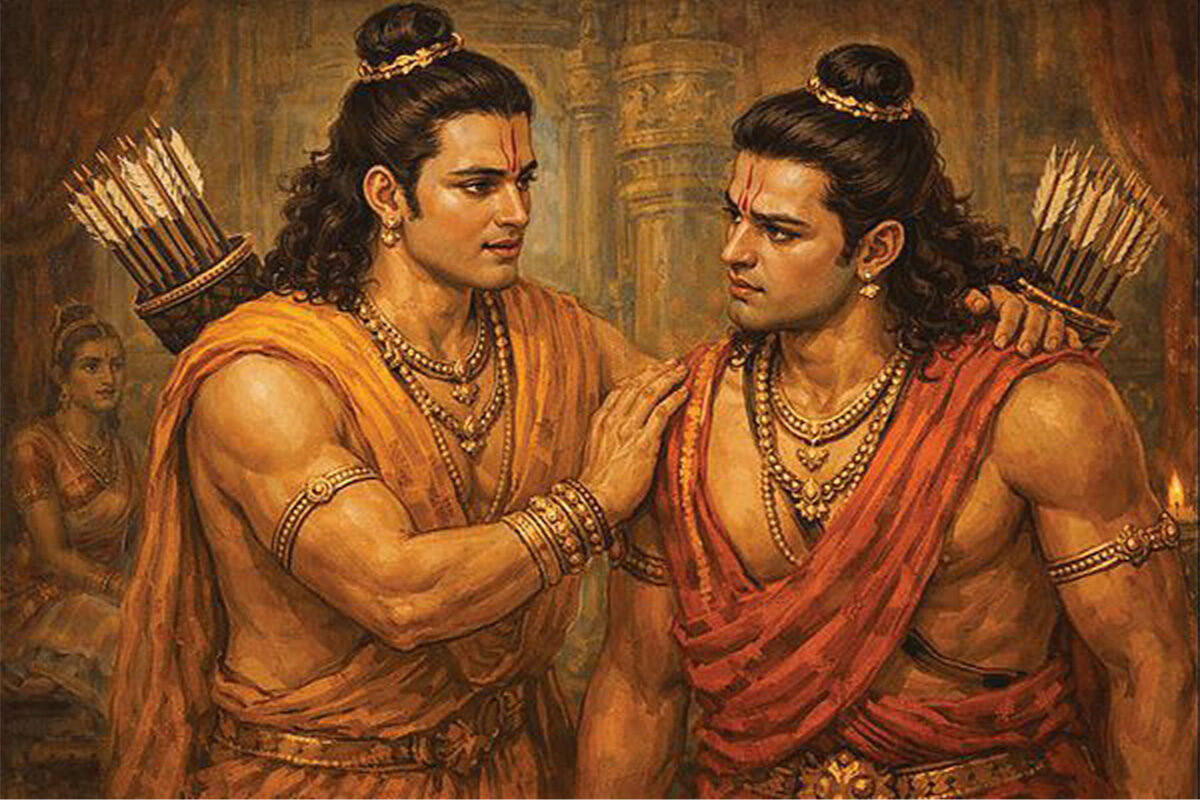

Rama advising and consoling Lakshmana


The Hero Within: Arjuna and Hanuman


A common misconception is that devotion makes us passive, whereby we become mere spectators of God’s greatness. On the contrary, the bhakti wisdom-texts show that God wants each of us to discover the hero within ourselves.


In the Bhagavad-gita, Krishna reveals his divinity but ultimately calls upon Arjuna to take up his bow and fulfill his heroic responsibility. Similarly, in the Ramayana, the most beloved section—the Sundara Kanda—focuses not on Rama’s adventures, but those of his most celebrated devotee: Hanuman.
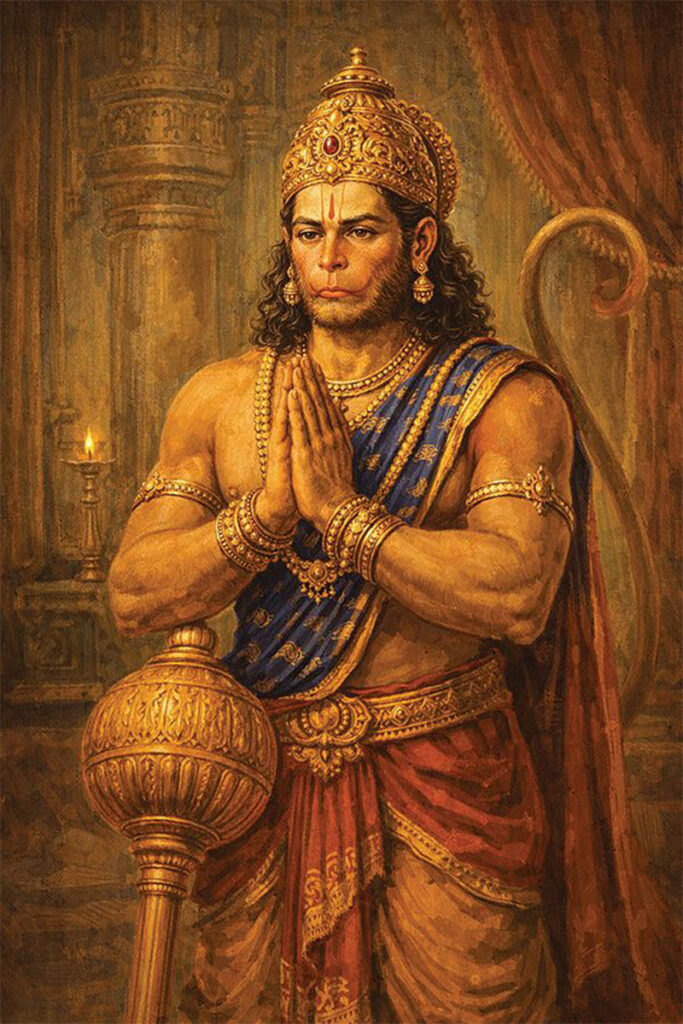

Hanuman, the embodiment of bhakti and sakti


Hanuman is the ultimate model of transcendence in action. He is often depicted with a mace in one hand and his other hands folded in prayer.


· The folded hands represent bhakti (devotion): An inner change where the eyes are fixed on the Divine, seeking no worldly fame or power.


· The mace represents sakti (strength): The outer change, where one uses their talents to bring about positive change in the world.


True transcendence does not mean dismissing the world as an illusion. It means becoming an instrument of God’s will.The inner connection established through bhakti changes our hearts, and the outer contribution we make through our God-given talents—our sakti—helps change the world.


Conclusion: A Graceful Life


Lord Rama’s life teaches us that we do not need to be victims of our circumstances. By practicing acceptance of the unchangeable, taking responsibility for the changeable, and seeking transcendence through a connection with the Divine, we can face any exile-like situation gracefully, resourcefully, transformatively.


Caitanya Carana Dasa is the associate-editor of Back to Godhead (US and Indian editions). To read his daily Bhagavad-gita reflections, please subscribe to Gitadaily on his website, thespiritualscientist.com.

Subscribe to BTG Digital Magazine

Embark on your path to Krishna consciousness with BTG Digital Magazine! Subscribe now and discover inspiring stories of growth, enlightenment, and connection shared by our community.

Subscribe

Ramayana’s ART of Resilience

Ramayana’s ART of Resilience
Listen to Article
Press Play to listen

nsights that can help us navigate modern adversity


By Caitanya Carana Dasa


In our modern world, we often define greatness through the lens of power and influence. We measure a person’s stature by how forcefully they can bend the world to their will, or how effectively they can compel others to say “yes” to their demands. However, the Ramayana presents a different, more internal metric for greatness: the ability to gracefully accept the moments when the world says “no.”


Redefining Greatness


Setbacks, reversals, and even blatant injustices are inevitable threads in the fabric of the human experience. While Rama is understood as the Supreme Divine, he descends to the earthly plane to play the role of a human being. By doing so, he teaches us how to navigate the complexities of life from the inside out. As he grew up, he was loved by all—powerful, handsome, compassionate, and highly competent. He was in every way suited to becoming a king. Yet, at the very moment of his ascension to the throne, through no fault of his own but due to a palace conspiracy, he was exiled to the forest.


To modern ears, “exile to the forest” might seem like an abstract concept, as few true wildernesses remain. Today, the closest equivalent might be deportation, but even that is a poor comparison. A deported person can often return to their homeland; an exile becomes fundamentally homeless. In the jurisprudence of that era, exile was a punishment just one step below execution or more precisely capital punishment. In some ways, it was considered worse, for it stripped away everything that made life worth living—status, family, security, and purpose. Faced with this, many would prefer death. Yet, despite being blameless, Rama did not incite a rebellion, though he had the power to do so. He chose to keep the greater good in mind.


From Kama to Calm


The internal struggle of facing injustice is perfectly captured in the classic conversation between Rama and his younger brother, Lakshmana. This dialogue echoes modern psychological struggles regarding how we process adversity. When Lakshmana hears of the exile, he is outraged. He views the situation through the lens of justice and logic. He argues that their father, King Dasaratha, has been blinded by infatuation for his youngest wife, Kaikeyi, and that an order born of such a “spell” need not be obeyed.


In response, Rama brings a profound sense of calm. There is a beautiful linguistic symmetry between the English word “calm” and the Sanskrit word kama (“unrestrained craving”). As long as kama—the fire of selfish desire—burns within us, the English calm will remain out of reach. Rama removes the kama of selfishness and replaces it with the calm of duty.


When we are angry, our minds instinctively look for two things: an aggressor to hit back at and a villain to blame. Lakshmana identifies Kaikeyi as the villain, but Rama refuses this framing. He asks Lakshmana not to speak ill of her, reminding him of the maternal love she had always showered upon them—a love he compared to the “incessant flow of the River Ganga.”


Lakshmana, still seething, tries to weaponize this very metaphor. He asks, “How did the Ganga dry up in a single night? How could such love vanish instantly?” It is here that Rama shifts the discussion to the level of philosophy. He explains that since her change in disposition is humanly inexplicable, it must be attributed to the workings of destiny.


Lakshmana’s retort is one that resonates with many today: “It is only cowards who accept injustice as destiny. Heroes fight against injustice.” This is a crucial turning point in the talk. Rama clarifies that for  him, the debate isn’t actually about destiny; it is about duty.


He explains that his readiness to become king was not born of a desire for power, but out of duty to his father. Consequently, if the situation now requires him to go to the forest so as to honor his father’s word, he will gladly do so as a service to his father. Whether the path leads to a throne or a thicket, the internal anchor of duty remains unmoved. By calming his brother and the citizens, Rama prevents a tragedy from becoming a catastrophe. When bad things happen, it is easy to make everyone around us miserable, thereby worsening the situation. Rama does the opposite; he absorbs the shock so that others may remain at peace.


Three principles to stay calm amid a storm


Let’s consider how Rama stays calm by looking at his response through a three-point framework conveyed as the acronym ART: Acceptance, Responsibility, and Transcendence.


Lakshmana getting angry at Kaikeyi and Lord Rama pacifying Lakshmana


1. Acceptance


The question “Why do bad things happen to good people?” is universal. Through the Ramayana, we are encouraged to rephrase it. Instead of a victim-oriented”Why?”, we are invited to ask: “When bad things happen to good people, what do good people do?”


Rama has no “bad karma” to account for his suffering; therefore, the usual philosophical explanations for misery don’t apply to him. He gracefully accepts that unfairness is an unfortunate truth about the human condition. Yet such unfairness is not life’s only truth.


Sometimes we get worse than we deserve, but sometimes we get better than we deserve. Or if we don’t want to get into the subjective assessment about what we deserve, we can instead acknowledge that while sometimes life treats us worse than others, it also sometimes treats us better than others. A friend might get a better-paid job than us, but we might get a better work environment than them. While some aspects of our life may feel unjust, others may well be more than just. Life is never just unjust or merely unfair; instead, in the big picture, it is justly unjust or fairly unfair. The single biggest decision in our life is whether we focus on how life is unjust to us or how life is just to us. Rama shows us how to do the latter—make the more empowering choice through acceptance.


Acceptance is the prerequisite for peace. It is the ability to acknowledge the unchangeable facts of a situation without letting them embitter the soul. Rama’s acceptance of his exile allowed him to leave the palace without the heavy baggage of resentment.


2. Responsibility


Responsibility is about taking ownership of one’s reaction and finding a constructive path forward. It often requires “reframing.” When Rama’s ministers lamented the “calamity” of his exile, Rama offered a different view. He argued that for an elder brother, a younger brother is like a son. “Which parent does not want to see their son prosper?” he asked, referring to Bharata taking the throne. He saw Bharata’s success not as his own loss, but as a family’s gain.


Furthermore, he reframed his exile. Most people only find time for spiritual contemplation and association with sages in their old age. Rama saw himself as “fortunate” to spend his youth among the wise. He looked at his situation not as a punishment, but as a “service posting.” He was a warrior, a protector; he decided that while in the forest, he would protect the sages from the demonic forces that terrorized them.


Taking responsibility means moving from the “What if?” (What if she hadn’t done that? What if I had been smarter?) to the “What is?” (What is the situation now, and what can I do with it?).


3. Transcendence


Transcendence involves connecting with a higher reality to avoid being crushed by daily burdens. In the Valmiki Ramayana, Rama’s divinity is not always the focal point. This is intentional; if Rama is seen only as a God who can do anything, his example becomes irrelevant to humans. By emphasizing his human struggles, the text shows us how to stay connected to the divine principles of dharma.


As we grow spiritually, our perception of the world changes. Initially, the world is “big” and God is “small” or irrelevant. We are tossed about by the world’s “sine wave” of ups and downs. However, through practices like Bhakti—chanting the names of Rama or Krishna—the dynamic inverts. God becomes the “big” reality, and the world becomes “small.” When the world is small, its ups and downs become mere ripples that no longer have the power to drown us.


Rama advising and consoling Lakshmana


The Hero Within: Arjuna and Hanuman


A common misconception is that devotion makes us passive, whereby we become mere spectators of God’s greatness. On the contrary, the bhakti wisdom-texts show that God wants each of us to discover the hero within ourselves.


In the Bhagavad-gita, Krishna reveals his divinity but ultimately calls upon Arjuna to take up his bow and fulfill his heroic responsibility. Similarly, in the Ramayana, the most beloved section—the Sundara Kanda—focuses not on Rama’s adventures, but those of his most celebrated devotee: Hanuman.


Hanuman, the embodiment of bhakti and sakti


Hanuman is the ultimate model of transcendence in action. He is often depicted with a mace in one hand and his other hands folded in prayer.


· The folded hands represent bhakti (devotion): An inner change where the eyes are fixed on the Divine, seeking no worldly fame or power.


· The mace represents sakti (strength): The outer change, where one uses their talents to bring about positive change in the world.


True transcendence does not mean dismissing the world as an illusion. It means becoming an instrument of God’s will.The inner connection established through bhakti changes our hearts, and the outer contribution we make through our God-given talents—our sakti—helps change the world.


Conclusion: A Graceful Life


Lord Rama’s life teaches us that we do not need to be victims of our circumstances. By practicing acceptance of the unchangeable, taking responsibility for the changeable, and seeking transcendence through a connection with the Divine, we can face any exile-like situation gracefully, resourcefully, transformatively.


Caitanya Carana Dasa is the associate-editor of Back to Godhead (US and Indian editions). To read his daily Bhagavad-gita reflections, please subscribe to Gitadaily on his website, thespiritualscientist.com.