


Inviting Krishna into Our Hearts
by Gauranga Darsana Dasa
Janmashtami is the sacred celebration of Lord Krishna’s divine appearance in this world. On this auspicious day, devotees commemorate the moment Krishna manifested as the son of Vasudeva and Devaki.
However, Krishna’s “birth” is unlike ours. He is aja—the unborn, without beginning or end. Just as the sunrise does not mark the birth of the sun, Krishna’s appearance is not His origin, but the commencement of His pastimes in a particular universe. And just as sunset does not signify the sun’s death—merely its setting in one place and rising in another—Krishna concludes His pastimes in one universe only to begin them elsewhere. When the next day of Brahma arrives, Krishna reappears, just as the sun rises again where it had once set. Thus, Krishna proclaims in the Bhagavad-gita (4.9): janma karma ca me divyam—His appearance and activities are transcendental. Though ever present, He becomes visible when the time is ripe, to bless and uplift the world.
Devotees around the globe celebrate Janmashtami with joy, reverence, and heartfelt devotion. Yet beyond the external celebrations, this sacred day poses a deeply personal question: Has Krishna appeared in our hearts?
To welcome Him, we must do what the great souls of the Bhagavatam did—prepare our hearts with sincerity, humility, and longing. For it is not just a historical event we observe, but a divine opportunity to invite Krishna into our lives—where He can appear, stay, and never depart.
1. Preparing Our Hearts for Krishna
The story of Lord Krishna’s parents—Devaki and Vasudeva—offers a powerful lesson in devotion and surrender. On the very day of their marriage, a divine prophecy declared that Devaki’s eighth child would be the cause of her brother Kaàsa’s death. Enraged and fearful, the tyrant Kaàsa imprisoned the couple and mercilessly killed their first six children. The seventh child, Lord Balarama, was mystically transferred to the womb of Rohini, paving the way for Krishna’s divine appearance.
According to our Vaishnava acharyas, these six slain sons symbolize the six anarthas—lust, anger, greed, pride, envy, and illusion. Lord Balarama represents guru-tattva, the principle of the spiritual master. What does this teach us? When the heart is cleansed of anarthas and guided by a bona fide spiritual teacher, it becomes a suitable place for Krishna to appear. Removing inner impurities and accepting spiritual guidance prepares the ground for divine connection.
This Janmashtami, let us reflect: Are we creating space for Krishna in our lives? Are we ready for the inner purification required to welcome Him?
2. Enduring the Inevitable Discomfort
Devaki and Vasudeva endured immense hardship—imprisonment, heartbreak, and constant fear. Yet they remained unwavering in their desire to receive Krishna. Their sacrifice and steadfastness ultimately brought the Supreme Lord into their lives.
Similarly, if we wish for Krishna to appear in our hearts, we too must cultivate sincerity, perseverance, and a willingness to undergo inconvenience for His pleasure. Bhakti is not always comfortable—it calls for endurance and sacrifice. But the struggles we face in devotional service purify our hearts and attract the mercy of Krishna.
This Janmashtami, let us reflect: Are we willing to embrace inconvenience for His pleasure? Are we ready to choose devotion over comfort, and sacrifice over ease—for the joy of having Krishna dwell within us?
3. Cultivating a Deep Longing
When Lord Krishna appeared in the dark prison cell of Kaàsa, He filled it with divine radiance. More than just lighting up the space, He brought true joy to the hearts of Devaki and Vasudeva, who had endured unbearable sorrow.
Likewise, when we patiently endure the struggles life brings, the moment Krishna appears in our hearts becomes profoundly transformative. We realize that every hardship was worthwhile for that one moment of divine grace.
But such moments don’t arrive accidentally. We must deeply desire them, sincerely endeavor for them, earnestly pray for them, and yearn with all our heart. Often, Krishna first comes as subtle inspiration—nudging us toward deep devotion. As we serve with sincerity, that inspiration becomes longing, and longing ripens into a heartfelt cry. When that cry becomes pure and intense, Krishna’s presence fills our hearts, dispelling the darkness of doubt, ego, and illusion with the light of divine knowledge, love, and bliss. Until then, we walk the sacred path of bhakti-yoga—with humility and steady dedication—knowing each step draws us closer to Him.
This Janmashtami, let us reflect: Are we cultivating that longing for Krishna’s presence? Are we allowing inspiration to grow into yearning, and yearning into transformation?
4. Sincerity over Grandeur or Simplicity
Today, Janmashtami is celebrated with grandeur—temples adorned with flowers, elaborate abhishekams, sumptuous feasts, and vibrant cultural programs. But how did Devaki and Vasudeva celebrate the original Janmashtami?
They had no palace, no garlands, no feast. Shackled in a dark prison, they celebrated not with outward opulence but with inner devotion. Vasudeva, though bound in chains, mentally gave thousands of cows in charity. Their hearts, not their surroundings, defined the celebration. And when Krishna appeared, even the prison glowed with divine effulgence.
True celebration – whether grand or simple – requires internal sincerity. The rituals—abhishekams, prasadam distribution, and decorations are to be offered with the right mood of pleasing the Lord (saàsiddhir hari-toshanam, SB 1.2.13).
If our hearts are filled with love, humility, and devotion, even a simple Janmashtami becomes glorious. Without those inner qualities, even the grandest events may leave us feeling empty—and untouched by grace.
This Janmashtami, let us reflect: Are we focused more on the celebration or on whom we are celebrating? Are our offerings filled with devotion, or merely decoration?
SRILA PRABHUPADA INVITES KRISHNA
ON THE JALADUTA
How did Srila Prabhupada, the beloved Founder-Acharya of ISKCON, celebrate Janmashtami while sailing across the Atlantic on the Jaladuta?
For over forty years, Srila Prabhupada tirelessly endeavored to spread Krishna consciousness across the globe. Despite facing repeated setbacks, he never gave up. He showed the world that real success lies not merely in achieving results, but in remaining steadfast through failure. True failure is giving up; true success is serving on with unwavering faith.
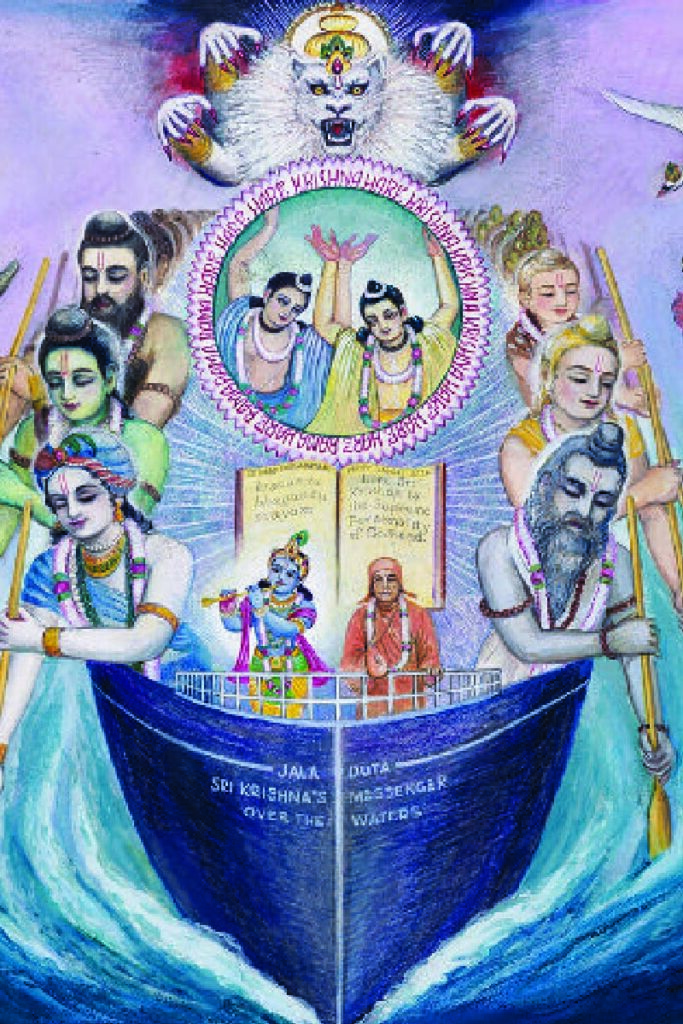
Eventually, by Krishna’s mercy, Srila Prabhupada received passage aboard the Jaladuta, alone, heading toward the unknown shores of the USA. During this solitary voyage, Janmashtami arrived. There were no temples, no devotees, no elaborate arrangements. Yet, Prabhupada celebrated simply—offering little bhoga, singing a small kirtana, and speaking Krishna-katha to a few fellow passengers.
That humble celebration, over fifty years ago, sowed the seeds for something extraordinary. Today, Janmashtami is celebrated by millions—not only in India, but across continents: in the USA, Australia, the UK, New Zealand, and beyond.
Just as Vasudeva and Devaki celebrated Janmastami in the confines of a prison cell, Srila Prabhupada celebrated on the rocking waves of the Atlantic. Both lacked external opulence, but were rich in faith and devotion. Today’s grand celebrations are possible only because of such pure-hearted sacrifices.
The true spirit of Janmashtami, therefore, is gratitude—to Vasudeva and Devaki, to Srila Prabhupada, and to all the acharyas who brought Krishna into our lives.
THE REAL SPIRIT OF JANMASHTAMI
Janmashtami is more than a date—it is an invitation. Krishna doesn’t seek grandeur; He seeks sincerity. What pleases Him most is our genuine desire to serve, love, and
remember Him.
Let us not be spectators, but participants—cleansing our hearts and preparing a place for Him through service, japa, kirtana, and kindness. As we decorate altars and offer bhoga, let us also present the garlands of our efforts, the lamps of our devotion, and the sweets of our purified intentions. Then, Krishna will appear—not just in temples or scriptures, but within our hearts.
This Janmashtami, let our grand celebration be marked by introspection, purification, and deepening devotion—a heartfelt invitation for Krishna to reside in the temple of our hearts. Krishna once lit up Kaàsa’s dark prison. He can surely illuminate our hearts—if we let Him in, this Janmashtami.
Gauranga Darsana Dasa, a disciple of His Holiness Radhanath Swami, is dean of the Bhaktivedanta Vidyapitha. He is an award-winning and best-selling author of forty-seven books, including the Subodhini series of study guides, children’s books such as Bhagavatam Tales, and other self-enrichment books. He conducts online and residential scriptural courses for children and adults, and travels to inspire devotees.