


Life lessons from the Ramayana that remain
powerful in today’s complex world.
By Chaitanya Charana Das
When disaster strikes—never do this one thing . . .
When things fall apart, our first instinct is often our worst one.
What that instinct is—and how to rise above it—is seen in the Ramayana after the abduction of Sita.
When Rama and Lakshmana rushed back to the hermitage, Sita was gone.
Shock. Horror. Anger.
They could have turned on each other.
Rama could have exploded at Lakshmana, “I had asked you to protect her. Why did you leave? Why were you swayed by her emotional words?”
Lakshmana could have fired back, “I had warned you—the deer was a demon in disguise. Why didn’t you listen? Why did you go after it?”
The tension was real. The pain was real. The temptation to blame was real.
Yet they did not accuse each other. They didn’t seek a scapegoat.
They chose responsibility. They focused on finding Sita.
To summarize: Blame looks backward for a scapegoat; responsibility looks forward for a solution.
If you are falsely accused, don’t do these two things
Of all the wounds life can inflict on us, one of the most painful is to have our integrity questioned—especially by those who know us and should trust us.
That is exactly what happened to Bharata in the Ramayana. The citizens and leaders of Ayodhya suspected him of being complicit in Kaikeyi’s scheme to banish Rama to the forest.
Bharata could have become defensive—fixating on proving his innocence.
He could have turned offensive—blasting his critics for defaming him.
Instead, he chose to be constructive.
He focused on undoing the damage and improving the situation. He openly condemned Kaikeyi’s actions and invited the kingdom’s elders to accompany him to the forest to reinforce his plea to Rama to return.
When Rama refused to return, Bharata brought back Rama’s sandals and placed them on the throne.
Thus, he won back their trust.
To summarize:
When we are falsely accused, repair the situation first and our reputation will be repaired; repair our reputation first and both will be impaired.
What we know versus what we love
We often assume, “If I knew more, I would choose better.” But is that true?
What we know can be overruled by what we desire, crave, love.
The Ramayana shows this clearly in the story of Marica.
That demon knew Rama was not just mighty; he was the Almighty. That’s why he first opposed Ravana’s plan to abduct Sita.
But when Ravana threatened to kill him, Marica calculated: “If Ravana kills me, I fall by my karma. If Rama kills me, I am liberated.”
He chose to die at Rama’s hands—even if it meant causing Rama great pain.
Marica had no love for Rama; he saw Rama simply as a tool to his liberation.
Knowing God without loving God leads to using God—not serving God.
In contrast, Jatayu loved Rama. He gave up his life for the sake of the Lord he loved. Such was his exalted character. And he gained something far greater than liberation—Rama’s eternal embrace.
To summarize:
What we know informs our choices; what we love transforms our character.
When lies are sandwiched between truths…
People who want to manipulate rarely speak blatant lies.
They begin with truth. They end with truth. And in between, they hide their lies.
Let’s see how Surpanakha fed Ravana a lie sandwich in the Ramayana.

She had approached Rama out of lust. When rejected, she tried to attack Sita—and was disfigured as punishment.
But when she went to Ravana, she recast the story.
She kept the truth: she had approached Rama and Lakshmana—and they had disfigured her.
But she twisted what happened in between. She claimed she had admired Sita’s beauty and had sought her as a trophy queen for Ravana.
By inflaming Ravana’s lust while concealing her own, she made her selfish act appear selfless.
When Ravana resolved to abduct Sita, he thought he was pursuing his own desire; in reality, he was becoming an instrument of her revenge.
Ask yourself: am I being fed a lie sandwich?
To summarize:
Even if a statement begins and ends with truth, it is still untrue if what lies between are lies.
Concern for the dead, not for the living?
Across history, vendetta wars have lasted for generations.
Why? Because people fixate on revenge.
They repay debts to the dead—while neglecting duties to the living.
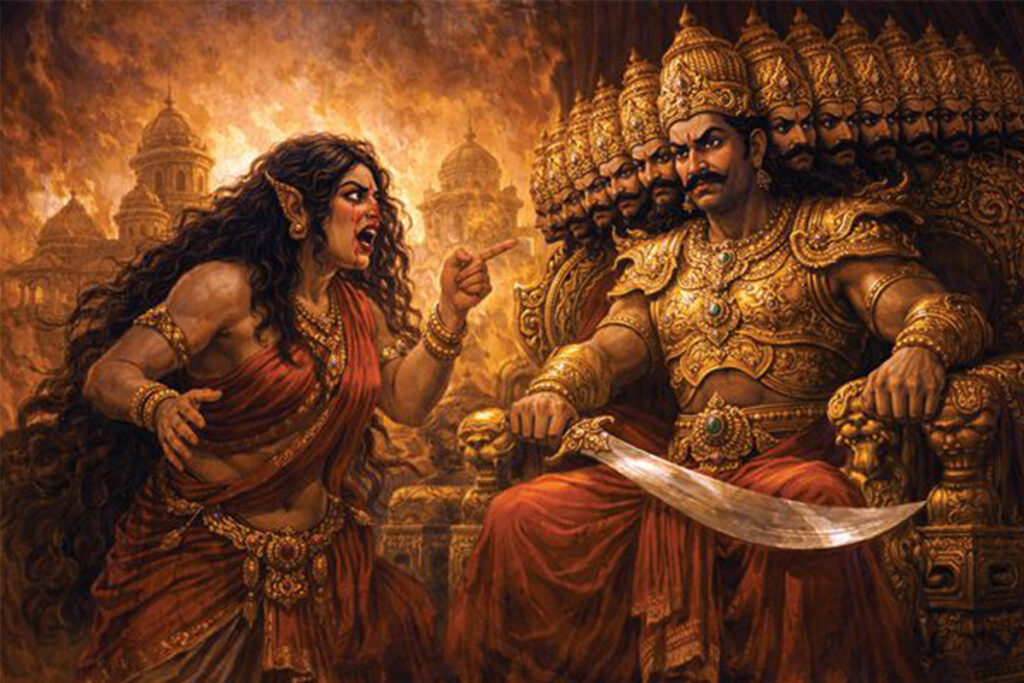
This is what happens to Ravana in his war against Rama.
When his son Indrajit was killed—not even by Rama, but by Lakshmana—the message was clear. Ravana was doomed.
Mandodari pleaded with him: “Return Sita. End this war. Do not destroy what remains of our family and our kingdom.”
Ravana refused. “How will I face the warriors who died for me,” he asked, “if I now withdraw?”
It sounds honourable, but it was tragically misguided. He cared more about whether he would look good before the dead than about what was good for the living.
Even if he were to join his fallen warriors in the next world—would they have wanted the annihilation of their dynasty? Would they have wanted him to persist in a lost cause? Unlikely.
To summarize:
When we become more concerned about our debts to the dead than our duties to the living, we rationalize continuing yesterday’s battles and drag more of the living into the world of the dead.
When someone is envious of us, what should we do?
Success is sweet. But when we rise above our peers, they may become uncomfortable.
How do we respond when they act in ways that suggest envy?
First, let’s give them the benefit of the doubt and consider it may be insecurity; not envy.
Insecurity asks: Will I matter if this person keeps succeeding?
Envy seeks not self-worth—but the other’s downfall.
Let’s turn to Ramayana for insight.
When Rama prepares to go into exile, he advises Sita not to glorify him in front of Bharata. Why? Because Bharata might feel insecure.
The kingdom had come to Bharata under troubling circumstances. Many believed a more qualified Rama had been unfairly displaced. Highlighting Rama’s greatness could deepen Bharata’s insecurity.
To help assuage others’ insecurity, we can respond with humility. We need not parade our success before them. Instead, we can appreciate them. Support them. Reassure them.
To summarize:
When others feel insecure because of us, choose humility — it can prevent their insecurity from hardening into envy.
Chaitanya Carana Das is the associate-editor of Back to Godhead (US and Indian editions). To read his daily Bhagavad-gita reflections, please subscribe to Gitadaily on his website, thespiritualscientist.com.