
Kumbhakarna-Ravana

Love or harmful help masquerading as love?
Protecting our loved ones from the negative consequences of their bad
choices does not show our love for them; providing them with the
resources by which they can make good choices does.
By Chaitanya Carana Dasa
Whenever we love someone, we naturally want to help them, especially when they are in trouble. While our intention to help is undoubtedly desirable and even essential as a testament to genuine love in a relationship, our expression of that intention may not always manifest in desirable or essential ways.
When we help those we love, is our help actually helping them or harming them? If our help ends up harming them, then it begs the question: Was what we did for them really a help? That question becomes even more acute if we knew in advance or could reasonably foresee that the effect of our help on them was going to be counterproductive.
Consider a disturbing, and disturbingly common, example. Suppose someone we love is an alcoholic who has squandered all their money due to their addiction. Now, they seek money from us to deal with their issues. Will our helping them be beneficial? Even if they claim that they will use the money only to pay back other people from whom they have borrowed money — and not to drink — can their words be trusted? Based on our past experience with them, suppose we can reasonably surmise that they are most likely to use the money we give them to drink. Then, if we truly want to help them, we need to make some hard decisions. Maybe we refuse to provide them any cash in their hands and agree to take care of their lenders only if they agree to admit themselves into an addiction recovery center.
Such a need for hard decisions, and a failure to take them, is evident in the Ramayana incident wherein Kumbhakarna, the younger brother of Ravana, offers his total support to Ravana despite acknowledging that his brother has done a grievous wrong. Let’s take a closer look at that incident.
Kumbhakarna Reproaches And Reassures Ravana
After Hanuman single-handedly infiltrated Lanka and set nearly half of it on fire before departing veritably unhurt, Ravana called an emergency council meeting of all his generals. It was clear to everyone that they faced a grave danger from a formidable enemy, even if pride prevented them from admitting it openly. Driven by ego, several of the demons who were leaders in Ravana’s army bragged about their strength. Though they made varied claims, their essence boiled down to one theme: “Neither Hanuman nor the army to which he belongs is any match for us. It is only because he caught us by surprise that he was able to cause some damage. Next time we confront him, it is he and his army that will be in for a nasty surprise.”
Despite their bluff and bravado, the underlying current of tension couldn’t just be wished away. As Ravana’s generals spoke one by one, soon came the turn of his powerful brother Kumbhakarna. That mighty demon could strike terror in the hearts of opponents not only by the ferocity of his power, but just by the enormity of his size. Due to a poorly worded request for a blessing, he was constrained to sleep for the major part of his life; and he had been asleep when Hanuman wreaked havoc in Lanka. The day of the emergency council happened to be a day when he was awake. Everyone in the assembly expected him to be a bulwark of support and strength for the demon army. Yet his first words surprised and even shocked onlookers.
Kumbhakarna said, “O brother, you’re consulting us now, but why didn’t you consult us before you abducted Sita? If you had consulted us then, we would have told you to desist from provoking Rama; and we wouldn’t have had to face such danger now.”
This was the closest that anyone among the demons had ever come to reproaching the mighty demon king in his own court. Though the onlookers gasped at the audacity of Kumbhakarna, he neglected them and continued, “Although you have made a terrible mistake, it is fortunate that you have a brother like me who can undo the consequences of your folly. Rest assured that you and your army will be safe. I will destroy Rama and his army if he dares to set foot on Lanka.”
Ravana was smarting under Kumbhakarna’s reproach but knowing that he needed the help of his powerful brother, he didn’t give vent to his insulted ego. Instead, he politely thanked Kumbhakarna, and the meeting continued in the same vein of perpetuating the hostility with Rama.
The Savior Complex?
Let’s examine Kumbhakarna’s reasoning here. He knew that what his brother had done was terribly wrong. Interestingly, his evaluation of the wrongness of Ravana’s action was based not so much on ethical concerns as on political concerns. He didn’t argue that abducting another man’s wife, or for that matter, abducting any woman, was intrinsically wrong — that’s why Ravana shouldn’t have abducted Sita. Instead, he argue that Rama was an especially powerful enemy, and antagonizing such an enemy for the sake of satisfying one’s carnal desires was politically imprudent. Similarly, his solution to the problem was not based on using any of his moral merits, if at all he had any, to fix the immorality of Ravana’s actions. It was based on his presumption that he could use his martial might to prevent the due consequences of Ravana’s actions from befalling Ravana.
If we look at Kumbhakarna’s history, he was no paragon of moral virtue. Like his brother, he too was demonic in his behavior, even if he might not have been as predatory in his carnal appetites as his brother in preying upon any woman that caught his fancy. Despite Kumbhakarna’s undeniable demonic nature, some people consider him to be the epitome of fraternal loyalty: he was ready to lay down his life for his brother. But was it really love that motivated Kumbhakarna? Or might it have been his own ego which wanted the world to know that even his world-conquering brother needed him for protection?
Even if we can’t know Kumbhakarna’s heart, considering what might have been going on in his heart can serve as a useful mirror to perceive what might be going on in our own heart. When those we love do something wrong, how we help them reveals our mentality. Instead of insisting that they correct their actions, if we take on the self-appointed role of protecting them from the consequences of their actions, no matter how wrong their actions may be, then what we are offering them may not be love; it may be the savior complex or even the God complex masquerading as love. We may well be driven by ego, even if we strongly believe that we are driven by affection: “I will fix any problem, no matter how big, that is created by their actions. So great is my love for them that for protecting them, I can go to any extent, even lay down my life.” But all our elaborate sacrificing for fixing our loved one’s problems may just be our ego’s way of dodging the uncomfortable reality that we can’t fix our loved one. Humility will allow us to acknowledge that we won’t be around to fix the problems that our loved one may get into — or even if we were around all the time, we won’t be able to fix all the problems they get into, given our human limitations. Humility alone will enable us to step back from our self-appointed role as their unconditional protector who takes unlimited liability for their foolhardy actions. Unfortunately, such humility was nowhere close to even the periphery of Kumbhakarna’s consciousness in his dealings with Ravana.
Loyalty Or Loyal Blindness?
Even if we grant that Kumbhakarna didn’t have a savior complex and was motivated by fraternal loyalty, still his moral reasoning remains suspect. This is evident in some later retellings of the Ramayana, which suggest that subsequent events awakened Kumbhakarna’s consciousness slightly.
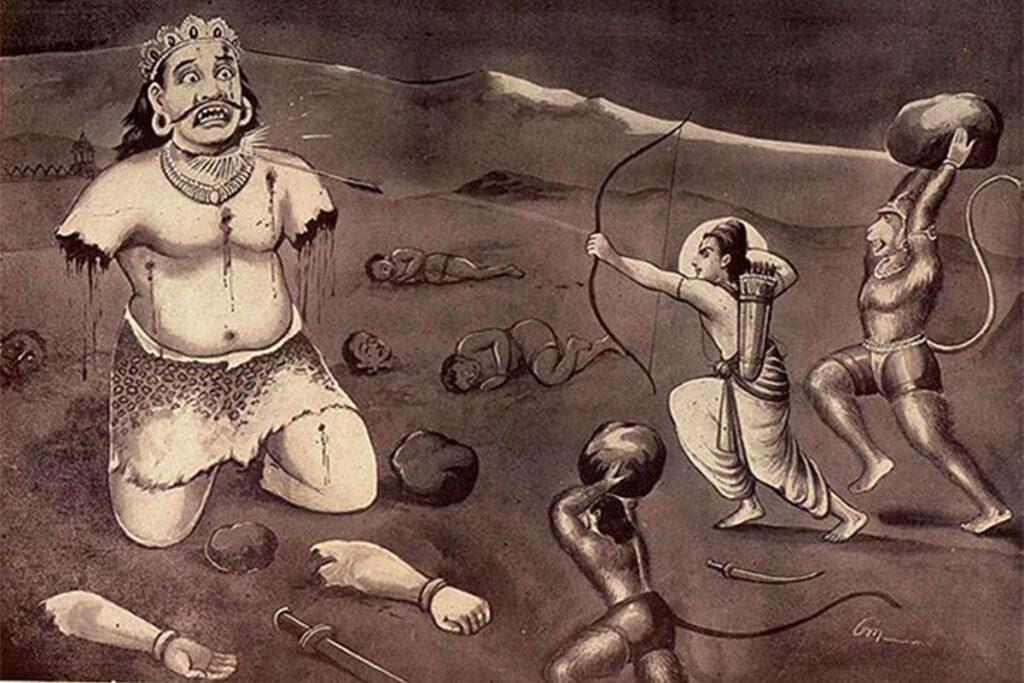
In the eventual war between Ravana and Rama, Kumbhakarna dutifully fights on his brother’s side. But on witnessing Rama’s unmatchable prowess, he soon senses that Rama is no ordinary human being or even an extraordinary human being; Rama is actually the supreme being Vishnu incarnate on the earth. And thus, he realizes that there is no chance for his side to win against Rama. Indeed, there is a greater likelihood of the ocean being dried up off every last drop of its water than of anyone winning against Vishnu.
Chastened by this realization, Kumbhakarna retreats from the battlefield and implores Ravana to desist from the fight and return Sita to Rama forthwith. But Ravana rudely rejects Kumbhakarna’s realization and request; and insists that Kumbhakarna prove his courage and character by fighting for protecting their kingdom. Kumbhakarna regretfully relents, “I know you are wrong, but you are my brother and I love you. Therefore, I will do my duty to protect you even to the point of my death.” Such a declaration of brotherly devotion to the point of martyrdom is certainly moving. Simultaneously, it is an instance where an appeal to the heart is essentially a masked excuse for shutting down the head.
Kumbhakarna could have maintained the same emotion — and still arrived at the opposite conclusion. He could have said, “Even though you are my brother and I love you dearly, still you are wrong. And out of my love for you and my love for our dynasty, I will no longer support you in a war that will lead not just to my destruction but even to yours and to that of the entire kingdom. You as the king of the demons are meant to protect them — not sentence them to death in a doomed attempt to hold on to the object of your lust.”
Such bold reasoning was what drove Kumbhakarna’s other brother, Vibhishana, to leave Ravana’s side and join Rama’s side. Vibhishana’s defection was not a betrayal of Ravana but a courageous expression of his loyalty to his citizens and his kingdom. If a king is ready to let his kingdom meet with destruction for the satisfaction of his lust, then such a king does not deserve to be protected; rather, it is the kingdom that deserves to be protected from such a king.
Tough Love
Leaving Ravana to his fate would have been difficult for Kumbhakarna, as it was undoubtedly difficult for Vibhishana. We feel pain whenever we see our loved ones suffer, even if their suffering is a just result for their own misdeeds. Despite feeling that pain, we may sometimes need to let them undergo the consequences of their actions — especially when that may well be the only way to get them to sober up and recognize that they need to change. When they get the shock treatment of having to pay for their actions, only then may they recognize how unreasonable and unrealistic is their expectation that they can keep making a mess and others will keep cleaning it for them. Only then may they confront the unpalatable-yet-essential truth: no one will be able to help them if they are not ready to help themselves.
When we stop shielding our loved ones from their unwise actions, they may try to emotionally blackmail us, “If you don’t help me now, I will have to conclude that you don’t love me at all.” On facing such an ultimatum, we will need to call their bluff: “I am ready to help you, just not on your terms.” If we don’t steel ourselves and stand our ground, what’s likely to happen? We will succumb to their emotional blackmail and keep trying to help them by protecting them from the consequences of their bad choices. And they will most likely not just continue making bad choices, but even start making worse choices. Sooner or later, they will make some choices with consequences that we will no longer be able to protect them from. For example, if we keep cleaning the mess for a loved one with a drinking problem, they may not just continue drinking but may also start driving under the influence — and may end up causing the accidental death of someone by their drunken driving. Even if we can somehow save them from severe punishment for their horrendously irresponsible action, can we free them from the guilt of having caused the death of another human being? What if their conscience is so numbed and dumbed by their addiction that they feel no guilt? Even then, will we be able to live with the guilt of having enabled someone to become the cause of another’s death?
Contemplating these dire scenarios can help us acknowledge that we need to consider many things to ensure that our expression of heartfelt love is in reality helpful, not harmful. When we appreciate the subtleties involved in expressing love, we won’t cast aside reason at the altar of emotion in the name of love. Nor will we celebrate as embodiments of love those who cast aside their reason at the altar of emotion. Genuine love does what is good for the person we love, not what that person demands or expects us to do as an expression of love. If we are concerned only with making the other person feel good or making ourselves feel good by doing what will make us look good in the other person’s eyes, then what we are expressing are mere shadows of love. In extreme situations, such shadows may even turn out to be counterfeits of love, whose presence dilutes or worse still distorts real love.
The Divine Center
Deliberating Kumbhakarna’s choices brings us to a vital truth: The right course of action is not simply a blind adherence to a preconceived notion of duty; it is a thoughtful adoption of the course of action that will actually fulfill the ultimate purpose behind doing any duty. When we keep this truth alive in our consciousness amid life’s many and messy complexities, only then will we be able to stay true to our love or rather, only then will our love stay true.
Ultimately, the truest love is love that is centered on the source of all love: the Divine. The bhakti tradition embodied in the Ramayana urges us to keep the Divine at the center of all our activities. Being thus centered, we act in a mood of service to our Lord in our various relationships. We see our loved ones as parts of God entrusted in our care and we serve them as part of our service to God. By thus nourishing our primary connection with our Lord, we cultivate the receptive devotional disposition by which we can receive his guidance to make good choices. This is the devotional dynamic explained in the Bhagavad Gita (10.10): dadami buddhi-yogam tam.
Ultimately, all our duties are meant to be integrated within our supreme duty to God, as is unambiguously proclaimed in the Gita’s concluding verse (18.66): cast aside all duties that come in the way of our surrender to God. This statement is not meant to downplay or deny the importance of our various duties; it is meant to ensure that a sentimental or fanatical adherence to a particular duty doesn’t come in the way of our doing actual good to our loved ones. Vibhishana demonstrates this unsentimental integration of duty with devotion and is thus celebrated in learned circles as an icon of not just devotion but also virtue. In unfortunate contrast, Kumbhakarna ends up becoming a tragic footnote in a tale of self-destruction furthered by a short-sighted notion of dutifulness.
Chaitanya Carana Dasa is the associate-editor of Back to Godhead (US and Indian editions). To read his daily Bhagavad-gita reflections, please subscribe to Gitadaily on his website, thespiritualscientist.com.
Subscribe to BTG Digital Magazine
Embark on your path to Krishna consciousness with BTG Digital Magazine! Subscribe now and discover inspiring stories of growth, enlightenment, and connection shared by our community.
Subscribe